Oh, how great is the priest! The priest will not understand the greatness of his office till he is in Heaven. If he understood it on earth, he would die, not of fear, but of love. The priest is not a priest for himself; he does not give himself absolution; he does not administer the Sacraments to himself. He is not for himself, he is for you. After God, the priest is everything. If I were to meet a priest and an angel, I should salute the priest before I saluted the angel. The latter is the friend of God; but the priest holds His place. The priesthood is the love of the Heart of Jesus. When you see the priest, think of Our Lord Jesus Christ.
Truly powerful words from Saint John Vianney, the patron saint of parish priests, regarding the responsibility of the Board of Examining Chaplains, the Priesthood of Jesus Christ. With these glorious words in mind, in this Year for Priests throughout the Western Church, it continues to be my highest privilege to serve as Chairman of the Board and to present once again this year this report to the Diocesan Synod. I am deeply grateful to the Bishop for the confidence and trust he has placed in me by assigning me to this task, and I pray that I have in the past year discharged this vital charge with fidelity and energy.
As Canon Vocations Director of the Diocese, I also serve as the official adviser and assistant to the Bishop for the formation and training of the future clergy of the Diocese of the Eastern United States. In this capacity, my principal role is to serve the Church in the process of attracting, cultivating, encouraging and forming vocations of men to the Sacred Order of Priests and the Sacred Order of Deacons, and of women to the lay ministry of Deaconess. The Canon Vocations Director is available to the whole Diocese to provide information and offer counsel to all interested in the formation process. His ministry is also that of a spiritual director, who is available to supply spiritual assistance and guidance to any who wish to explore or deepen their sense of vocation to Christian service of whatever kind or form. The Canon Vocations Director serves in a particular way the spiritual and personal needs of seminarians and their families and of those engaged in formation in the Diocese.
At this time, I wish to thank the other Examining Chaplains of the Diocese, who sacrifice much of their personal time and effort in the crucial work of this august body. Working with them is the greatest privilege one could have in the Church, and I remain in awe of their knowledge of and commitment to the Gospel of Jesus Christ. We have these Reverend Fathers to thank for the excellent standards now in place in our Diocese for the formation of Priests, Deacons and Deaconesses for the twenty-first century. I have never seen a finer group of dedicated and hard-working priests: Father David Eastes of the Central Florida Deanery; Dean Douglas King of Saint Paul’s Church, Melbourne, Florida; Dean Glenn Spencer of All Saints’ Church, Charlottesville, Virginia; Father Michael Ward of Saint Mark’s Church, Vero Beach, Florida; and Father Raymond Unterburger of Saint Alban’s Church, Joppa, Maryland. Additionally, we are grateful for Deaconess Tina Jenkins, who assists us in Deaconess formation. It continues to be a joyful blessing for all the Examining Chaplains to serve the Church and Diocese in this ministry, and we again thank the Bishop for our appointment.
Since last Synod, 6 men were ordained to the Sacred Order of Deacons and 6 men were ordained to the Sacred Order of Priests – the ‘class of 2008-2009’ may be a record number for one year’s time.
The following men are now Priests forever after the Order of Melchizedek: Father David Bottoms of All Saints’ Church, Charlottesville, Virginia, Father LeRoy ‘Chris’ Gardner of the Church of the Redeemer, Hilton Head, South Carolina, Father Mark William Menees of Saint John’s Church, Greensboro, North Carolina, Father Ernest Pinto of Saint Mary the Virgin Church, Delray Beach, Florida, and Father Daniel Trout of Saint Alban’s Cathedral. Father Virgil ‘Brett’ Travis received ordination sub conditione to the Diaconate and Priesthood.
The following men are now Deacons in the Church of God: Father Thomas Burr of Saint Paul’s Church, Crownsville Maryland, Father David Keller of Saint Alban’s Cathedral and Father Donald Sackett of Saint Matthew’s Church, Weaverville, North Carolina.
Father William Martin SSC of All Saints’ Church, Mills River, North Carolina was received into the Diocese and Province under Canon 10 of the APA.
Currently and wonderfully, there are 19 persons enrolled in the diocesan ministry process, from 4 in the beginning application mode to others who fall into different stages on the way to approval for Orders. We should be infinitely grateful to God for the ongoing increase of vocations in our Diocese. Let us continue to pray for a great harvest of vocations to the Sacred Ministry of the Holy Catholic Church and let us beseech the Lord for truly holy, good and godly Priests and Deacons.
In 2007 we received approval from the Bishop and Diocesan Standing Committee to expand over time the current technology at our disposal for the creation of the Diocese of the Eastern United States House of Theological Studies, to begin as soon as possible. This virtual seminary will serve as a training institute for the Diocese in which the training process for ordinands will be formalised according to our own standards. A legal corporation was created for the structure and organisation of the House; Dean Douglas King serves as administrator/president of the corporation. We are in the process of formally producing the initial seven courses, Canon Law, Dogmatic Theology, Sacramental Theology, Liturgics, Ascetical Theology, Moral Theology and Anglican Church History which we wish to make available on Webex and in print for the seminarians and clergy of the Diocese. Each course will be 12 or 13 hours each, providing a minimum of 84 class hours of Anglican formation for the student. We have assigned instructors for each course: the content, policies, teachers and texts for the courses and the House in general are determined by the consensus of the Examining Chaplains, which serves to supervise all aspects of the House under the authority of the Bishop. We intend to begin the House of Studies in earnest in the autumn of 2009.
At the Spring 2009 Meeting of the Board of Examining Chaplains, it was decided by consensus that in future, beginning as soon as the DEUS-HTS is fully operational, all seminarians of the Diocese who offer themselves for priestly ordination will be required to receive one academic year of courses and formation through the Diocesan House of Theological Studies in order that they may be provided orthodox Anglican training in the essentials areas of theology, pastoralia, liturgy, history, dogmatics and moral and ascetical theology, which are rarely afforded in conventional seminaries. Seminarians will be permitted to enter a two-year master’s level theological degree programme, which then must be complemented and fulfilled by the year of Anglican formation through our own House of Studies. Seminarians are still permitted to enter the three-year Master of Divinity degree programme in a conventional seminary, but will also be required the year of Anglican formation before canonical examination. The House of Studies will be required for all future candidates for the Sacred Priesthood who matriculate in seminary under the sponsorship of our Diocese.
Also in 2007, we received approval for the official sponsorship of an Annual Seminarians' Support Sunday for the entire Diocese and designated for it the Second Sunday in Advent, Bible Sunday, a most appropriate time of the year to solicit financial support for our men and women. Monies collected that day are sent from all parishes and missions to the Diocesan Treasurer for the Diocesan Seminarian Fund. As a result of your generosity and contributions, the total Diocesan Fund has reached $13,000.
Over the past year, the Examining Chaplains have enjoyed the opportunity of working with a number of men and women in varying stages of formation. Michael Cawthon of Saint Michael the Archangel Church, Charlotte, North Carolina continues the Reformed Theological Seminary virtual campus Master of Arts in Religion programme. Deborah Gravatt of Saint Matthew’s Church, Weaverville, North Carolina continues her formation for the Deaconess ministry. Matthew Harlow of Saint Michael the Archangel Church, Charlotte, North Carolina attends the Reformed Theological Seminary virtual campus. Linda Moritz of Saint Mary’s Church, Delray Beach, Florida has reactivated her status as a candidate for the Deaconess ministry. Paul Owen of All Saints’ Church, Arden, North Carolina continues his assigned formation programme. Paul Rivard of Saint Barnabas Church, Dunwoody, Georgia, is a seminarian at Erskine Theological Seminary, Due West, South Carolina. Arthur Walker of Saint Michael the Archangel Church, Charlotte, North Carolina is enrolled in the Master of Arts in Theology track through the Distance Learning programme of the Franciscan University of Steubenville, Ohio.
At our official Synod meeting held Tuesday 21 July here in Gainesville, Georgia, we recommended Father David Coady of Saint Francis’ Church, Blacksburg, Virginia and Father David Sokol of the Church of the Holy Spirit, Hernando, Florida to the Bishop and Standing Committee for reception into this Diocese and Province under APA Canon 10. We enjoyed a preliminary interview with Father Jacob Boyd Baker of Saint Alban’s Cathedral.
At our impending Autumn Meeting later this year, we look forward to having the opportunity to interview Richard Hitchcock of Saint Barnabas Church, Dunwoody, Georgia for Postulancy for Holy Orders and Jewel Kennington of Saint Barnabas Dunwoody for preparation for the Deaconess Ministry.
All Rectors and Vicars are reminded that they should have on file copies of the Diocesan Application for Ministry with its cover pages which provide the sequence of procedures for those contemplating a vocation to Holy Orders in this Church. These materials are available for you in an electronic format.
On a personal note, please remember that all members of the Diocese and Province, clergy and lay, are most welcome to contact me at any time regarding any questions or comments concerning the Board of Examining Chaplains and our work. ‘Chad Jones University’ registrations are open for the fall! For us at Saint Barnabas Dunwoody, we not only have UGA, we have UCJ! I am at your continual disposal to provide whatever you may need from the Board for the formation and training of our future clergy.
Dear Bishop Grundorf, thank you for your loving and continual support of our work, and thank you, beloved members of the Synod, for your time and kind attention.
God bless you! Respectfully submitted: Canon Chandler Holder Jones, SSC, Chairman.
Tuesday, July 28, 2009


Sunday, July 26, 2009
'The Canon of the Mass' in Anglican Liturgy

Q. Does the term 'Canon of the Mass' have an Anglican precedent? Has it a legitimate usage in the liturgical and theological language of orthodox Anglicanism?
A. Yes. The term 'Canon' belongs the earliest stage of the formation of the Eucharistic Liturgy in the Western Rite, when the Western Church was in full communion with the rest of the ancient Undivided Church:
Canon (Canon Missæ, Canon Actionis) is the name used for the fundamental part of the Mass that comes after the Offertory and before the Communion. The old distinction, in all liturgies, is between the Mass of the Catechumens (the litanies, lessons from the Bible, and collects) and the Mass of the Faithful (the Offertory of the gifts to be consecrated, Consecration prayer, Communion, and dismissal). Our Canon is the Consecration prayer, the great Eucharistic prayer in the Mass of the Faithful. The name Canon (kanon) means a norm or rule; and it is used for various objects, such as the Canon of Holy Scripture, canons of Councils, the official list of saints' names (whence 'canonisation'), and the canon or list of clerks who serve a certain church, from which they themselves are called canons (canonici).
Chiefly, and now universally in the West, it is the name for the Eucharistic prayer in the Holy Liturgy. In this sense it occurs in the letters of Saint Gregory I; the Gelasian Sacramentary puts the heading Incipit Canon Actionis before the Sursum Corda, the word occurs several times in the first Roman Ordo (quando inchoat canonem, finito vero canone); since the seventh century it has been the usual name for this part of the Mass.
One can only conjecture the original reason for its use. Walafrid Strabo says: 'This action is called the Canon because it is the lawful and regular confection of the Sacrament'; It has been suggested that our present Canon was a compromise between the older Greek Anaphoras and variable Latin Eucharistic prayers formerly used in Rome, and that it was ordered in the fourth century, possibly by Pope Damasus (366-684). The name Canon would then mean a fixed standard to which all must henceforth conform, as opposed to the different and changeable prayers used before. In any case it is noticeable that whereas the lessons, collects and Preface of the Mass constantly vary, the Canon is almost unchangeable in every Mass. Another name for the Canon is Actio. Agere, like the Greek dran, is often used as meaning to sacrifice. Saint Leo I, in writing to Dioscurus of Alexandria, uses the expression in qua agitur, meaning 'in which Mass is said'. Other names are Legitimum, Prex, Agenda, Regula, Secretum Missæ.
In Anglicanism specifically, the term is used in the 1549 English Book of Common Prayer, the First English Prayer Book of the Church of England. The title for the Eucharistic liturgy as a whole is: The Supper of the Lord and the Holy Communion, commonly called the MASS. In the 1549 BCP liturgy called The Celebration of the Holy Communion for the Sick, reference is made to the sursum corda and the Eucharistic Prayer, which continues, we are told by rubric: Unto the end of the CANON. Hence the term 'The Canon of the Mass' is historically part of the Common Prayer Book tradition.
Saturday, July 25, 2009
The Orthodox Church as seen by the Anglican Church
By Archbishop Methodios Fouyas, 1972
The Church in England at the time of its foundation and for four and a half centuries afterwards was in Communion with the Orthodox Church. When the final separation between Rome and Constantinople took place, 547 years after St. Augustine came to England, the Church of England was not given an opportunity to express its opinion of the Roman attitude towards the East. The obscurity in the position of the Anglican Church towards the East is the result of the Church of England having never officially broken with Rome.
The Provincial Synods of York and Canterbury did not withdraw from communion with the Church of Rome. "What the Church of England did was to say that 'the Bishop of Rome hath no greater jurisdiction given to him in Holy Scripture by God in this Kingdom of England than any other foreign Bishop'.1 But the actual breach of Communion was brought about by the act of Pope Paul III and by the Bull Regnans in Excelsis of Pope Pius V (1570). The Church of England from its foundation to King Henry I (1135) was an independent Church and the Popes interfered very little with it. Therefore its position is very peculiar with regard to the East, because just as it never withdrew from Communion with Rome, neither did the Anglican Church ever withdraw formally from communion with the Orthodox Church. What makes the Communion of Orthodox and Anglicans difficult now is the confusion prevailing in the Orthodox view of the rise of Anglicanism. On the contrary, Anglicans believe that their Church has never been separated from the undivided Catholic Church.
This belief is clearly stated in the appeal of Archbishop Cranmer, who said, in 1556, when under Queen Mary Tudor he was charged with heresy: As touching my doctrine, it was never in my mind to teach contrary to the Word of God and the Catholic Church of Christ according to the exposition of the most Holy and learned Fathers and martyrs. I only mean and judge as they have meant and judged. I may err, but heretic I cannot be, inasmuch as I am ready to follow the judgement of the Word of God and of the Holy Catholic Church, using the words that they used, and none other, and keeping their interpretation.2
Implicit in this declaration that the Anglican Church has never broken away from the Undivided Church is the supposition that it is not separated from the faith of the Orthodox Church. And since the Orthodox Church made no claims of jurisdiction over the Anglican Church the latter never condemned the doctrine or the practice of the Orthodox Church. On the contrary, since the time of the Reformation the view has been held in the Church of England that in the East the Catholic faith has remained intact.
For instance Alexander Knox (d. 1831) and his disciple Bishop Jebb, 'taught that the Greek Church represented the original body of Christendom; that the Church of England perpetuated the Greek tradition; and that since she represented this tradition rather than the Latin, she should seek an understanding of, and an approach to the Churches of East'.3 Again, A. C. Headlam wrote that 'the Eastern Church professes to be the only true Church, both Catholic and Orthodox'4 — though it is still one thing to assume a common faith, and another to discover whether this is really so, or to seek to re-establish intercommunion. E. L. Mascall suggests that
when we do approach Orthodoxy, whether in historic Byzantium or present-day Europe .. . we shall be faced with much the same task as when we approach the Churches of the West, namely the task of disentangling the authentic Christian norm from its accidental, and largely falsifying, accompaniments. For Orthodoxy no more than Western Christianity has been free from these embarrassments. Greek theology for the last few centuries has very largely been based upon Latin scholasticism, often of a very decadent type, with slight modifications about the Papacy, the epiclesis and the Filioque, and has more recently shown a readiness to accept somewhat excessively and uncritically the biblical theories of German liberal Protestantism. Russian Orthodoxy ... has been quite as much influenced by German mysticism and idealism as by the genuine Orthodox tradition.5
He also refers to the report Catholicity which spoke of 'the excessive dependence of the Byzantine Church upon the civil power and . . . the fact that it remained outside the main stream of European history, thus missing the Renaissance and the Reformation and the whole of the great scientific movement of the modern world.'6
Some Anglicans have considered that the practice and teaching of the Orthodox Church provides a convenient touchstone for deciding what things may find a place within a national branch of the Catholic Church without tending towards papalism. Others have been interested in the Orthodox Church because of their hostility to Rome. It is also true that many Anglicans have been as hostile to Orthodoxy as to Rome, and have shared the doubts expressed by the Lambeth Conference of 1888: 'it would be difficult for us to enter into more intimate relations with that Church so long as it retains the use of icons, the invocation of Saints, and the cultus of the Blessed Virgin'.7
But according to the 'Branch Theory', developed by Newman and his followers, Anglicans say that the Catholic Church consists of three branches, growing from one trunk, the Eastern Orthodox, the Roman and the Anglican.8 So Fr. Puller, lecturing at St. Petersburg in 1912, said that the Anglicans think of themselves as forming a part of the same Holy Catholic and Apostolic Church of which the Russian is another part; 'and we are therefore accustomed', he said 'to regard the Holy Church of Russia and all the Holy Orthodox Churches of the East, as Churches which are sisters of the Holy Church of England'. And although 'the faithful members of the English Church love the Russian Church, they do not know so much about her as they would wish to know. And perhaps it is the same with you here.'9
It is significant that in the Church of England the Greek Fathers have been read and honoured to a degree unusual in the West. And the Anglican appeal to the traditions of the undivided Church has generated a similar attitude to that of the Orthodox Church towards them. 'Whereas in the East', said Dr. Ramsey at the University of Athens in 1962, 'the Holy Tradition had remained in essence the same, in the West the Tradition had been complicated in the Middle Ages.'10 Dr. Ramsey has also written:11
The Church of England is debtor both to East and to West, and to the unity which once belonged to them. As regards the East, she has striven to recognise the debt in two ways. One way is by recovering within herself the true inheritance of Eastern theology, and a long line of the greatest Anglican teachers have found inspiration in the Greek Fathers; Thorndike, Maurice, Wescott, Gore are among them.
And elsewhere Dr. Ramsey says that a Westerner discovers from coming into touch with the East three things: (1) He discovers a vivid realization of the centrality of the Resurrection in Christianity; (2) he discovers also how the worship of the Eastern Church is filled with the lifting up of earth to heaven; and (3) he sees the Eastern realization of the Communion of Saints.
Professor Hodges, who is very much involved in the relations of Orthodoxy and Anglicanism, writes that:
in the Eastern Orthodox world, the Apostolic faith has lived on substantially unaffected by either Papal or Protestant innovations. It presents to us the faith and life of the undivided Church, not as a historical memory but as a present fact; it shows us the meaning of the non-Papal Catholicism, not as a theoretical possibility but as an actuality.12
Professor Hodges continues:
I am not idealising the Orthodox Church as it now exists, or saying that its day to day life at the present time is necessarily healthier or more vigorous than ours in the West. I should hesitate to say such a thing even if I had had the opportunity (as I have not) of seeing Orthodoxy at close quarters in a country where it is at home. The Orthodox world presumably has its good and bad spots, as has the West, and all of us, East and West, live an ambiguous life which partly exemplifies our faith and partly betrays it. Such is the condition of human existence, including even Christian existence in this world. I am not now speaking on this empirical level. I am speaking on the level of doctrine, and saying that the Orthodox Faith, to which the Orthodox Fathers bear witness and of which the Orthodox Church is the abiding custodian, is the Christian Faith in its true and essential form, to which we all aspire and by which we are all judged. Nor does this mean that all Orthodox theologians are individually wiser or sounder than their Western colleagues. It is a question of principles, not of persons, and the wind of spirit, bringing the gifts of wisdom and understanding, blows where it will.13
_______________________________________
1 Richard W. Dixon, History of the Church of England from the Abolition of the Roman Jurisdiction (2nd ed., London, 1884), Vol. i, pp. 227, 238.
2 ibid., p. 502.
3 cf. Remains of Alexander Knox, Vols. i-iv, especially vols. iii, pp. 210, 211, and iv. See also Thirty years Correspondence between John Jebb and Alexander Knox, ed. by Charles Forster, Vol. i; cf. moreover Tavard, La Poursuite de la Catholicite, pp. 177-180.
4 cf. A. C. Headlam, The Teaching of the Russian Church (London, 1897), p. i. This does not mean that all the Anglicans admit Headlam's opinion, as the quotations from Mascall show. In these we can see the German tendency, which dominates Western Roman and Protestant scholarship, 'to characterize Orthodoxy on the basis of modern and contemporary documents.' Such was, for example, the case of Wilhelm Gass, who in his book, Symbolik der Griechischen Kirche (1872), in which he emphatically wrote that 'the modern Greek Church is not identical with the Ancient Church, and has widely departed or deviated from the early foundations'. Opposed to Gass was Ferdinand Kattenbusch in an article 'Kritische Studien zur Syrnbolik im Anschluss an einige neuere Werke' in Theologische Studien und Kritiken, Jahrg. 51 (1878), pp. 94-121, and in his book Lehrbuch der Vergldchenden Confessions-Kunde. Erster Band: Prolegomena und Erster Teil: Die Orthodoxe Anatolische Kirche (Freiburg i/Br. 1892), who maintained that 'in order to grasp the genuine spirit of Orthodoxy one has to go back to the Fathers, to St. Athanasius, the Cappadocians, and indeed to Pseudo-Dionysius, rather than to Mogila or Dositheus', who wrote occasional polemical books addressed primarily to the problems of the Western Controversy between Rome and the Reformers. Cf. G. Florovsky, The Ethos of the Orthodox Church, pp. 182-3.
5 The Recovery of Unity. A Theological Approach. (1958), p. 62-3.
6 ibid., p. 61. See also B. Leeming, 'An Anglo-Catholic on "The Recovery of Unity" E.C.Q. xii (1958), pp. 265-6.
7 R. Davidson, The Five Lambeth Conferences 1867-1320 (London, 1929), pp. 168-9. (See above, p. 40).
8 A full description of the Branch Theory can be found in Newman's works; see especially J. H. Newman, Introduction to [Deacon] William Palmer's Notes of a Visit to the Russian Church in the years 1840, 1841 (1882) pp. v-vii, 'through the division each party to it loses some spiritual treasure, and none perfectly represents the balance of truth, so that this balance of truth is not presented to the world at all'. William Temple quoted these words to describe the divided Churches in his inaugural sermon at the second Conference on Faith and Order August, 1937. See the Orthodox answer in E.R. iv (1949) pp. 434-43; cf. Tavard, La Poursuite de la Catholicite, pp. 185 ff.
9 Puller, op. cit. p. 2.
10 Constantinople and Canterbury, p. 2.
11 The Church of England and the Eastern Orthodox Church (London, S.P.C.K., 1946), PP- 7-8.
12 H. A. Hodges, Anglicanism and Orthodoxy, p. 39.
13 op. cit., p. 47.
The Church in England at the time of its foundation and for four and a half centuries afterwards was in Communion with the Orthodox Church. When the final separation between Rome and Constantinople took place, 547 years after St. Augustine came to England, the Church of England was not given an opportunity to express its opinion of the Roman attitude towards the East. The obscurity in the position of the Anglican Church towards the East is the result of the Church of England having never officially broken with Rome.
The Provincial Synods of York and Canterbury did not withdraw from communion with the Church of Rome. "What the Church of England did was to say that 'the Bishop of Rome hath no greater jurisdiction given to him in Holy Scripture by God in this Kingdom of England than any other foreign Bishop'.1 But the actual breach of Communion was brought about by the act of Pope Paul III and by the Bull Regnans in Excelsis of Pope Pius V (1570). The Church of England from its foundation to King Henry I (1135) was an independent Church and the Popes interfered very little with it. Therefore its position is very peculiar with regard to the East, because just as it never withdrew from Communion with Rome, neither did the Anglican Church ever withdraw formally from communion with the Orthodox Church. What makes the Communion of Orthodox and Anglicans difficult now is the confusion prevailing in the Orthodox view of the rise of Anglicanism. On the contrary, Anglicans believe that their Church has never been separated from the undivided Catholic Church.
This belief is clearly stated in the appeal of Archbishop Cranmer, who said, in 1556, when under Queen Mary Tudor he was charged with heresy: As touching my doctrine, it was never in my mind to teach contrary to the Word of God and the Catholic Church of Christ according to the exposition of the most Holy and learned Fathers and martyrs. I only mean and judge as they have meant and judged. I may err, but heretic I cannot be, inasmuch as I am ready to follow the judgement of the Word of God and of the Holy Catholic Church, using the words that they used, and none other, and keeping their interpretation.2
Implicit in this declaration that the Anglican Church has never broken away from the Undivided Church is the supposition that it is not separated from the faith of the Orthodox Church. And since the Orthodox Church made no claims of jurisdiction over the Anglican Church the latter never condemned the doctrine or the practice of the Orthodox Church. On the contrary, since the time of the Reformation the view has been held in the Church of England that in the East the Catholic faith has remained intact.
For instance Alexander Knox (d. 1831) and his disciple Bishop Jebb, 'taught that the Greek Church represented the original body of Christendom; that the Church of England perpetuated the Greek tradition; and that since she represented this tradition rather than the Latin, she should seek an understanding of, and an approach to the Churches of East'.3 Again, A. C. Headlam wrote that 'the Eastern Church professes to be the only true Church, both Catholic and Orthodox'4 — though it is still one thing to assume a common faith, and another to discover whether this is really so, or to seek to re-establish intercommunion. E. L. Mascall suggests that
when we do approach Orthodoxy, whether in historic Byzantium or present-day Europe .. . we shall be faced with much the same task as when we approach the Churches of the West, namely the task of disentangling the authentic Christian norm from its accidental, and largely falsifying, accompaniments. For Orthodoxy no more than Western Christianity has been free from these embarrassments. Greek theology for the last few centuries has very largely been based upon Latin scholasticism, often of a very decadent type, with slight modifications about the Papacy, the epiclesis and the Filioque, and has more recently shown a readiness to accept somewhat excessively and uncritically the biblical theories of German liberal Protestantism. Russian Orthodoxy ... has been quite as much influenced by German mysticism and idealism as by the genuine Orthodox tradition.5
He also refers to the report Catholicity which spoke of 'the excessive dependence of the Byzantine Church upon the civil power and . . . the fact that it remained outside the main stream of European history, thus missing the Renaissance and the Reformation and the whole of the great scientific movement of the modern world.'6
Some Anglicans have considered that the practice and teaching of the Orthodox Church provides a convenient touchstone for deciding what things may find a place within a national branch of the Catholic Church without tending towards papalism. Others have been interested in the Orthodox Church because of their hostility to Rome. It is also true that many Anglicans have been as hostile to Orthodoxy as to Rome, and have shared the doubts expressed by the Lambeth Conference of 1888: 'it would be difficult for us to enter into more intimate relations with that Church so long as it retains the use of icons, the invocation of Saints, and the cultus of the Blessed Virgin'.7
But according to the 'Branch Theory', developed by Newman and his followers, Anglicans say that the Catholic Church consists of three branches, growing from one trunk, the Eastern Orthodox, the Roman and the Anglican.8 So Fr. Puller, lecturing at St. Petersburg in 1912, said that the Anglicans think of themselves as forming a part of the same Holy Catholic and Apostolic Church of which the Russian is another part; 'and we are therefore accustomed', he said 'to regard the Holy Church of Russia and all the Holy Orthodox Churches of the East, as Churches which are sisters of the Holy Church of England'. And although 'the faithful members of the English Church love the Russian Church, they do not know so much about her as they would wish to know. And perhaps it is the same with you here.'9
It is significant that in the Church of England the Greek Fathers have been read and honoured to a degree unusual in the West. And the Anglican appeal to the traditions of the undivided Church has generated a similar attitude to that of the Orthodox Church towards them. 'Whereas in the East', said Dr. Ramsey at the University of Athens in 1962, 'the Holy Tradition had remained in essence the same, in the West the Tradition had been complicated in the Middle Ages.'10 Dr. Ramsey has also written:11
The Church of England is debtor both to East and to West, and to the unity which once belonged to them. As regards the East, she has striven to recognise the debt in two ways. One way is by recovering within herself the true inheritance of Eastern theology, and a long line of the greatest Anglican teachers have found inspiration in the Greek Fathers; Thorndike, Maurice, Wescott, Gore are among them.
And elsewhere Dr. Ramsey says that a Westerner discovers from coming into touch with the East three things: (1) He discovers a vivid realization of the centrality of the Resurrection in Christianity; (2) he discovers also how the worship of the Eastern Church is filled with the lifting up of earth to heaven; and (3) he sees the Eastern realization of the Communion of Saints.
Professor Hodges, who is very much involved in the relations of Orthodoxy and Anglicanism, writes that:
in the Eastern Orthodox world, the Apostolic faith has lived on substantially unaffected by either Papal or Protestant innovations. It presents to us the faith and life of the undivided Church, not as a historical memory but as a present fact; it shows us the meaning of the non-Papal Catholicism, not as a theoretical possibility but as an actuality.12
Professor Hodges continues:
I am not idealising the Orthodox Church as it now exists, or saying that its day to day life at the present time is necessarily healthier or more vigorous than ours in the West. I should hesitate to say such a thing even if I had had the opportunity (as I have not) of seeing Orthodoxy at close quarters in a country where it is at home. The Orthodox world presumably has its good and bad spots, as has the West, and all of us, East and West, live an ambiguous life which partly exemplifies our faith and partly betrays it. Such is the condition of human existence, including even Christian existence in this world. I am not now speaking on this empirical level. I am speaking on the level of doctrine, and saying that the Orthodox Faith, to which the Orthodox Fathers bear witness and of which the Orthodox Church is the abiding custodian, is the Christian Faith in its true and essential form, to which we all aspire and by which we are all judged. Nor does this mean that all Orthodox theologians are individually wiser or sounder than their Western colleagues. It is a question of principles, not of persons, and the wind of spirit, bringing the gifts of wisdom and understanding, blows where it will.13
_______________________________________
1 Richard W. Dixon, History of the Church of England from the Abolition of the Roman Jurisdiction (2nd ed., London, 1884), Vol. i, pp. 227, 238.
2 ibid., p. 502.
3 cf. Remains of Alexander Knox, Vols. i-iv, especially vols. iii, pp. 210, 211, and iv. See also Thirty years Correspondence between John Jebb and Alexander Knox, ed. by Charles Forster, Vol. i; cf. moreover Tavard, La Poursuite de la Catholicite, pp. 177-180.
4 cf. A. C. Headlam, The Teaching of the Russian Church (London, 1897), p. i. This does not mean that all the Anglicans admit Headlam's opinion, as the quotations from Mascall show. In these we can see the German tendency, which dominates Western Roman and Protestant scholarship, 'to characterize Orthodoxy on the basis of modern and contemporary documents.' Such was, for example, the case of Wilhelm Gass, who in his book, Symbolik der Griechischen Kirche (1872), in which he emphatically wrote that 'the modern Greek Church is not identical with the Ancient Church, and has widely departed or deviated from the early foundations'. Opposed to Gass was Ferdinand Kattenbusch in an article 'Kritische Studien zur Syrnbolik im Anschluss an einige neuere Werke' in Theologische Studien und Kritiken, Jahrg. 51 (1878), pp. 94-121, and in his book Lehrbuch der Vergldchenden Confessions-Kunde. Erster Band: Prolegomena und Erster Teil: Die Orthodoxe Anatolische Kirche (Freiburg i/Br. 1892), who maintained that 'in order to grasp the genuine spirit of Orthodoxy one has to go back to the Fathers, to St. Athanasius, the Cappadocians, and indeed to Pseudo-Dionysius, rather than to Mogila or Dositheus', who wrote occasional polemical books addressed primarily to the problems of the Western Controversy between Rome and the Reformers. Cf. G. Florovsky, The Ethos of the Orthodox Church, pp. 182-3.
5 The Recovery of Unity. A Theological Approach. (1958), p. 62-3.
6 ibid., p. 61. See also B. Leeming, 'An Anglo-Catholic on "The Recovery of Unity" E.C.Q. xii (1958), pp. 265-6.
7 R. Davidson, The Five Lambeth Conferences 1867-1320 (London, 1929), pp. 168-9. (See above, p. 40).
8 A full description of the Branch Theory can be found in Newman's works; see especially J. H. Newman, Introduction to [Deacon] William Palmer's Notes of a Visit to the Russian Church in the years 1840, 1841 (1882) pp. v-vii, 'through the division each party to it loses some spiritual treasure, and none perfectly represents the balance of truth, so that this balance of truth is not presented to the world at all'. William Temple quoted these words to describe the divided Churches in his inaugural sermon at the second Conference on Faith and Order August, 1937. See the Orthodox answer in E.R. iv (1949) pp. 434-43; cf. Tavard, La Poursuite de la Catholicite, pp. 185 ff.
9 Puller, op. cit. p. 2.
10 Constantinople and Canterbury, p. 2.
11 The Church of England and the Eastern Orthodox Church (London, S.P.C.K., 1946), PP- 7-8.
12 H. A. Hodges, Anglicanism and Orthodoxy, p. 39.
13 op. cit., p. 47.
Sunday, July 19, 2009
Thou Art A Priest Forever


Congratulations and many blessings to the Reverend Father Daniel Stephen Trout on the occasion of his ordination to the Sacred Priesthood of Our Lord Jesus Christ on Saturday 18 July 2009 at Saint Alban's Cathedral, Oviedo, Florida. Father Daniel received the Sacred Order of Priests from the Most Reverend Walter H. Grundorf, our Presiding Bishop. Thou art a Priest forever after the Order of Melchizedek!
Wednesday, July 08, 2009
British Anglo-Catholic Perspectives on the Fellowship of Confessing Anglicans
With the exception of the statements affirming papal authority for some, these thoughtful remarks echo the conscientious concerns of a significant number of Anglo-Catholics in the USA regarding ACNA and GAFCON...
From Father Edward Tomlinson:
From Father Ivan Aquilina:
From Father Edward Tomlinson:
So after a night’s sleep what is there to say about ‘Be Faithful’? Sadly nothing overly encouraging, as might have been expected. Our Evangelical brothers and sisters, sincere, upright and worthy of our friendship though they may be, are wanting to progress down a path that is more not less protestant than is presently the case. And, as ever, whilst the determination for mission is strong, the understanding of ecclesial theology is weak. If this is to be the future of Anglicanism….what role would Anglo-Catholics have to play?
Because yesterday, despite seeing a hand of friendship extended , no real desire was shown to include Anglo-Catholics. The worship, style, presenters, intercessors, examples of good practice, decisions concerning what constitutes primary and secondary issues all reflected an evangelical mindset. We Catholics had been invited but not really embraced and that is a shame.
+Edwin Barnes, one time Bishop of Richborough and one time principal of S. Stephen’s House Theological College sent me his following reflection:
All who prayed during the performance were Evangelicals. Why no Catholics? Equally, all who spoke of church growth &c… yet I could have provided (and the PEVs even more) numerous examples of good practice.
Why was everyone so censorious? “There were no Bible-believing Christians in that area, so we planted….” But I KNOW Headington and two of the priests there. Why undermine them?
It was good to hear John Hind speak of Church order; but others referred to women’s ordination and consecration as second order matters, not comparable to Gospel defining issues. Not for me they’re not.
I was dismayed at Jim Packer’s lauding of the Articles. Bashing us with them seems little different to me from bashing Americans with the Canons. Man-made, of one time, and not Gospel.
After all this I cannot see how there can be common cause between Catholics and Evangelicals. We are looking to going home to the Universal Church, in Communion with the Holy Father and half Christendom. They seem to want to perpetuate a sixteenth century accident.
If I blogged, this would be on my blog. Instead I shall send it to a few friends to see how you respond.
God bless.
Ever, +Edwin
I would have to agree with +Edwin. Whilst we share concerns with Evangelicals over abandonment of the faith from within, and whilst we both can say the creed and believe it, there is simply so much we disagree about. Not least our vision for what the church should be- whilst Catholics dream of a day when Christendom is united under the papacy, our Evangelical brethren dream about lay celebration and church planting without the permission of Bishops!
Thus the Fellowship of Continuing Anglicans can be assured of my prayers and best wishes. I think this fellowship will play a very significant role in the future of Christianity on these shores. But once again it seems we Anglo-Catholics are alone, a tiny group who might fall down the gap created when the liberals and evangelicals tear apart from one another.
More than ever we must stand together and pray, trusting God to provide for our future. Which is not all bad; standing together can be great fun as the final photographs demonstrate. Above all yesterday was a delightful opportunity to catch up with my brother priests, who are very dear to me. Wherever my future lies, it is with them:
From Father Ivan Aquilina:
The perception I got on Sunday night at the FCA preparatory meeting here at Sevenoaks was confirmed by the proceedings at Westminster Hall yesterday. I did not go to the gathering but followed it all on a live web feed. It became clearer as the day progressed that this is an Evangelical fellowship with Anglo-Catholics tagged behind both for numbers and for the scoop of saying that Anglo-Catholics and Evangelicals are now presenting a united front. I think it was right for the Forward in Faith leadership to give this a go but now there are enough signs for the same leadership to pull out immediately. The fact that Anglo-Catholics in North America are part and parcel of this movement does not mean that we should be too. Many readers will know that Anglo-Catholicism in the States and here is different, especially in the way we think about re-union with the See of Peter.
There is also the myth that yesterday’s proceedings could be divided between a hopeful morning and an embarrassing afternoon. While the morning and afternoon were different in feel, yet the substance of the morning was very dangerous and undermining. I agree that in the afternoon it was all about Evangelical witness of “good practice” and hurt and Anglo-Catholics were sidelined to the very margins.
The Evangelical ordinand who did not know what Confirmation is, for me, is a cause of grave concern as all the seven sacraments are Scriptural.
In the morning we all agreed with Bishops Hind and Ackerman, but there is no surprise there. However, it was in the same morning session that we heard Dr Packer and Archbishop Jensen. Dr Packer spoke about the 39 articles – are these Scriptural? Dr Jensen focused on sex and gender with the ordination of women relegated to a side issue that we will talk about – is that not Scriptural? He did not mention lay presidency, and that is heretical and yet he supports it.
As Anglo-Catholics we have fought inch by inch to live the Catholic faith, and this since the Reformation. Why should we overlook our history and go back to the event which in many parts stands against what we stand for?
Our battle is a difficult one, we shall win by being faithful to Christ, by washing the feet of his disciples and by holding the Faith Catholic once delivered to the saints. Playing political games, or hiding under the wings of those who do not understand Christ with the mind of the Universal Church is not only dangerous, but in my opinion sinful.
I believe that we have a place in the Church of England and we should stay in it for as long as needs be as witnesses to the Faith Catholic. When this is impossible, not any fault of ours, when we are driven to share the experiences that Anglo-Catholics in Wales are facing now, than we need to find a new home. I trust and hope that the home we seek is the one that is founded on Peter, consecrated by the blood of Martyrs and hallowed by the witness of the saints.
With the Orthodox Christian philosopher Vladimir Soloviev (1853-1900) I say: “I recognise as supreme judge in matters of religion him who has been recognised as such by St Irenaeus, St Dionysius the Great, St Athanasius the Great, St John Chrysostom, St Cyril, St Flavian, the Blessed Theodoret, St Maximus the Confessor, St Theodore of the Studium, St Ignatius, and on and on – namely, the apostle Peter, who lives in his successors…”
If Anglo-Catholics can own this statement than the new fellowship is not the right way to follow.
Tuesday, July 07, 2009
Mootable Musings on Ecclesiology and Sacramentology
'If you consecrate woman as bishops or if you don't consecrate women as bishops you will not endanger your spiritual security,' said Rev. Gregory Venables, a representative of the Anglican Church in South America.
'It's an issue which ... needs to be talked about so we can find how we can agree to work together because we agree on the salvation issues. The ordination of women is not an issue which will separate us from God,' he said.
'In the Anglican understanding, a bishop is a bishop of the whole catholic church, meaning that person should be acceptable in all places that the catholic church is,' [George]Conger told Christianity Today. '[The ACNA] can live with women being at the local level of priest, because a woman priest in New York doesn’t do anything to the people in Fort Worth, Texas, who think it’s contrary to Scripture.'
'Bishops serve the whole church, and if the church is not of one mind, then it’s not appropriate for women to be bishops,' the Rev. Boline told Duin. 'The global south has shown us a model of keeping to the main thing, while not being of one mind.'
Since both human sexuality and the authority of Scripture are so central to ACNA’s formation in the first place, it seems unlikely that the issue of women priests won’t at some point cause the newly formed partnership to fracture. But Duncan stressed the importance of keeping unity — for the time being.
Saturday, July 04, 2009
Wise Counsel from a Dear Friend
Words penned to me by one who has served in the Anglican Priesthood for sixty years...
Thank you ever so much for your knowledgeable reply to my query regarding developments in the Anglican world.
Homosexuality, which seems to consume so much energy of ACNA, for me is of secondary concern. Our Articles make it clear enough that the sins of the priest do not invalidate the efficacy of his sacerdotal acts. But that is another thing for another time.
I think the far more serious issue is that of women purporting to be priests. The church can survive homosexual priests but not women priests.
The confection of a sacrament depends upon a proper minister, a proper matter, a proper form, and a proper intention. Our formularies insist that salvation universally depends upon two sacraments: Holy Baptism and Holy Communion. And though a layman can baptize in extremis, no such provision is made for celebrating Mass. So if indeed Communion is necessary for salvation, souls are in jeopardy if any terms of the sacraments are unmet.
The Orthodox understand the priest to present Christ at the altar rather than represent Him. And so I do believe. If the priest merely represents Christ, alter Christus, woman might indeed so act. If the priest is there in place of Christ, is merely His representative, then a woman might be that representative. But the priest is not Christ’s representative. The priest in himself presents Christ. He must therefore be male.
Friday, July 03, 2009
Orthodoxy and Anglican Orders

There has always been, for the past, ever since the English Reformation, a relationship between the Orthodox Church and the Anglican Church... and in particular, that relationship became extremely warm about a hundred years ago in the person of Saint Tikhon, the Russian missionary bishop.. and he had a vision, a vision of unity. And that unity, that vision of unity, resulted at the time in the proclamation by about half of the local Orthodox Churches of the validation of Anglican Orders.-Metropolitan Jonah
In recent news reports on the ensuing OCA-Anglican dialogue, mention is made of the historic and provisional recognition of the validity of Anglican Orders by the Orthodox Churches...
It didn't take long for controversy to spread about the photograph taken after the consecration rites in 1900 for a new bishop in Wisconsin.
Low-church Episcopalians called it the "Fond du Lac Circus" because of all the ornate vestments. Not only was Bishop Charles Chapman Grafton, who presided, wearing a cope and miter, but so were the other bishops. Then there was the exotic visitor on the edge of the photograph -- Bishop Tikhon of the Russian Orthodox Church.
Imagine the outrage if Tikhon had, as discussed beforehand, decided to take part in the laying on of hands at the moment of consecration.
St. Tikhon had "a vision, a vision of unity," said Metropolitan Jonah of the Orthodox Church in America, during recent events marking the birth of an alternative, conservative Anglican province in America.
Early in the 20th century, some Orthodox leaders were willing to accept the "validity of Anglican orders," meaning they believed that Anglican clergy were truly priests and bishops in the ancient, traditional meanings of those words.
But what about the “good news” in this speech? You see, there is history at work there, as well, history in which the roots of Orthodox in North American were — briefly — intertwined with those of Anglo-Catholics. There was a moment in time when Orthodoxy came very close to recognizing the validity of Anglican orders, in a manner similar to state that currently exists between Rome and the East. These ancient churches recognize each other’s orders, even while living in a tragic state of broken Communion. That’s a complicated matter and Metropolitan Jonah’s speech provided a short sketch of the history.
Thursday, July 02, 2009
The Elephant in ACNA's Living Room
New Anglicans split on women By Julia Duin
Thursday, July 2, 2009
Last week's birth of a new Anglican province in the dusty plains of north-central Texas left the question of women's ordination dangling in the air.
Of the 800 people attending the founding of the Anglican Church in North America, 368 were priests and deacons. Of that number, about 10 percent, or 36, of the clergy were female.
The new province is a mishmash of former Episcopalians, ranging from almost-crossing-the-Tiber Anglo-Catholics to low-church charismatics, and it's a mystery as to how they're all going to get along. Many are against ordaining women. Others are just as adamant that females be given access to the diaconate, priesthood and the episcopate. The Episcopal Church approved female priests in 1976 and elected its first female bishop in 1988.
The ACNA's new canon laws state women can be deacons and priests, but not bishops.
I queried retired Eau Claire, Wis., Bishop William Wantland, an old friend and an ardent opponent of ordaining women. He reminded me that 22 of the ACNA's 28 dioceses do not allow female priests. It's a system known as "dual integrity," dioceses that differ on a question where Scripture can be read both ways agree to respect and live with each other's views.
I asked him if he wanted the ACNA to eventually outlaw ordaining women entirely.
"Of course. That's our mission," he said. "Christ is the bridegroom and the church is the bride. The priest at the altar is an icon of Christ. What image is that if the person at the altar is a woman? It's a lesbian relationship."
Not much room for negotiation there.
Archbishop Robert Duncan, the new head of the ACNA, pointedly had a woman, the Rev. Travis Boline, at his right hand during legislative sessions. She reminded me that even the conservative African provinces are split on the question. Although Nigeria forbids female priests, Kenya and Uganda allow them.
"The global south has shown us a model of keeping to the main thing, while not being of one mind," she said. "Bishops serve the whole church, and if the church is not of one mind, then it's not appropriate for women to be bishops."
The other women I talked with were trying to put a good face on it all.
"It's more important to be part of an organization preaching the Gospel as the Word of God," one cleric said.
"We're trying to be servants," Katherine Martin, a cleric from Auburn, Ala., told me. "I'm not being welcomed to consecrate [Communion] in Quincy [Illinois] or Fort Worth [Texas]," which are two dioceses that don't ordain women, "but both the bishops of those dioceses couldn't be more kind."
I wondered if the men would take a similar position, agreeing to be "servants" while limitations were placed on them.
"I'd be lying if I'd say I wasn't disappointed," said Canon Mary Hayes of the Pittsburgh Diocese. "I've been a priest 25 years. I'm delighted to be in a body of people who have different views. It's not about getting my way."
Other women told me they hope men will see the light.
"They'll wake up," predicted the Rev. Joy Vernon, a Canadian priest ordained in 1989. "Jesus Christ ministered to women way beyond the culture of His day."
"We're not going to go away," a female priest told me. "Women have been patient since the beginning of time."
Thursday, July 2, 2009
Last week's birth of a new Anglican province in the dusty plains of north-central Texas left the question of women's ordination dangling in the air.
Of the 800 people attending the founding of the Anglican Church in North America, 368 were priests and deacons. Of that number, about 10 percent, or 36, of the clergy were female.
The new province is a mishmash of former Episcopalians, ranging from almost-crossing-the-Tiber Anglo-Catholics to low-church charismatics, and it's a mystery as to how they're all going to get along. Many are against ordaining women. Others are just as adamant that females be given access to the diaconate, priesthood and the episcopate. The Episcopal Church approved female priests in 1976 and elected its first female bishop in 1988.
The ACNA's new canon laws state women can be deacons and priests, but not bishops.
I queried retired Eau Claire, Wis., Bishop William Wantland, an old friend and an ardent opponent of ordaining women. He reminded me that 22 of the ACNA's 28 dioceses do not allow female priests. It's a system known as "dual integrity," dioceses that differ on a question where Scripture can be read both ways agree to respect and live with each other's views.
I asked him if he wanted the ACNA to eventually outlaw ordaining women entirely.
"Of course. That's our mission," he said. "Christ is the bridegroom and the church is the bride. The priest at the altar is an icon of Christ. What image is that if the person at the altar is a woman? It's a lesbian relationship."
Not much room for negotiation there.
Archbishop Robert Duncan, the new head of the ACNA, pointedly had a woman, the Rev. Travis Boline, at his right hand during legislative sessions. She reminded me that even the conservative African provinces are split on the question. Although Nigeria forbids female priests, Kenya and Uganda allow them.
"The global south has shown us a model of keeping to the main thing, while not being of one mind," she said. "Bishops serve the whole church, and if the church is not of one mind, then it's not appropriate for women to be bishops."
The other women I talked with were trying to put a good face on it all.
"It's more important to be part of an organization preaching the Gospel as the Word of God," one cleric said.
"We're trying to be servants," Katherine Martin, a cleric from Auburn, Ala., told me. "I'm not being welcomed to consecrate [Communion] in Quincy [Illinois] or Fort Worth [Texas]," which are two dioceses that don't ordain women, "but both the bishops of those dioceses couldn't be more kind."
I wondered if the men would take a similar position, agreeing to be "servants" while limitations were placed on them.
"I'd be lying if I'd say I wasn't disappointed," said Canon Mary Hayes of the Pittsburgh Diocese. "I've been a priest 25 years. I'm delighted to be in a body of people who have different views. It's not about getting my way."
Other women told me they hope men will see the light.
"They'll wake up," predicted the Rev. Joy Vernon, a Canadian priest ordained in 1989. "Jesus Christ ministered to women way beyond the culture of His day."
"We're not going to go away," a female priest told me. "Women have been patient since the beginning of time."
Saturday, June 27, 2009
Metropolitan Jonah of the OCA on the Roman Church
From his address to the Provincial Assembly of the Anglican Church in North America:
We share the hope of full ecumenical relationship and reconciliation with the Roman Catholic Church. However, I believe that we are of one mind, the Anglicans and the Orthodox, in that we reject the papal ecclesiology and the theological distortions of papal infallibility, and some of the hypertrophy regarding Our Most Holy Lady Theotokos, the Ever-Virgin Mary. We love the Most Pure Mother of God, but I think we have to remember what is right and decent and in order. And it's only by, only by the repeal of such doctrines that there is going to be any possibility of reconciliation of the Roman Church with the Orthodox Church... some don't like that.
We share the hope of full ecumenical relationship and reconciliation with the Roman Catholic Church. However, I believe that we are of one mind, the Anglicans and the Orthodox, in that we reject the papal ecclesiology and the theological distortions of papal infallibility, and some of the hypertrophy regarding Our Most Holy Lady Theotokos, the Ever-Virgin Mary. We love the Most Pure Mother of God, but I think we have to remember what is right and decent and in order. And it's only by, only by the repeal of such doctrines that there is going to be any possibility of reconciliation of the Roman Church with the Orthodox Church... some don't like that.
Friday, June 26, 2009
The Anglican Church as seen by the Orthodox Church
By Archbishop Methodios Fouyas, 1972
As we try to see the Anglican Church with Orthodox eyes we must remember that clear-cut definitions are ruled out in advance where Anglicanism is concerned. Judged by the principles of the Orthodox Church, the Church of England had the right to proclaim itself self-governing and autonomous, provided that there were certain canonical principles, which in fact there were. The old Church of England went on without any breach in either its legal or its spiritual continuity.
It continued to profess the Catholic faith, which was once for all delivered to the Saints.
It preserved without any break the Apostolic Succession of its Ministry, 1 although 'many Anglicans maintain Apostolic succession primarily as a symbol and Bond of Unity.'2
Some Anglican theologians have considered Episcopacy to be not only of the bene esse of the Church, but part of its esse, as Canon Richardson says. 3 Consequently Orthodox theologians, influenced by the writings of Anglicans like Gore 4 and A. M. Ramsey, 5 have accepted that the Church of England means by Apostolic succession 'that grace is bestowed by our Lord, through the action of His whole Church. But certain actions in this work of grace are confined to Bishops, whereby the truth is taught that every local group or Church depends on the one life of the one Body.'6 We find a similar opinion to that of Archbishop Ramsey in G. W. Broomfield's book Revelation and Reunion, in which he writes: 'there seems to me to have been a general principle implicit in Apostolic practice, and underlying the evolution of Church order. This was that appointments to the official ministry are the business of those who themselves have received authority to make such appointments.'7
As Archbishop Ramsey has written recently:
Our Church has two aspects: On the one hand we claim to be a Church possessing Catholic Tradition and continuity from the ancient Church, and our Catholic Tradition and continuity includes the belief in the real Presence of Christ in the Blessed Sacrament; the order of Episcopacy and the Priesthood, including the Power of a priestly absolution. We possess various institutions belonging to Catholic Christendom like monastic orders for men and women. Our Anglican Tradition has another aspect as well. We are a Church which has been through the Reformation, and values many experiences derived from the Reformation, for instance, the Open Bible: great importance is attached to the authority of the Holy Scriptures, and to personal conviction and conversion through the work of the Holy Spirit.8
What we have said about the Orthodox attitude towards Rome applies to some extent also to the Orthodox attitude towards Anglicanism. The Orthodox belief that their Church is the one Holy, Catholic, and Apostolic Church on earth, gives the impression that Orthodox theology is even more exclusive than Roman Catholic. But the Orthodox Church has shown some recognition of the sacraments of other churches. For instance, her practice of receiving converts from Rome or Anglicanism by Chrismation without Re-baptism (though this has not always been the case in the past) 'is a clear indication that the sacramental limits of the Church do not coincide with its ceremonial boundaries'.9
Orthodox theologians are divided as regards the character of the Anglican Church. Some see it from the exaggerated point of view which divides it into three parties, commonly known as High Church, Low Church, Broad Church. It is this idea that leads many, not only Orthodox, but Roman Catholics also, to think that the Church of England is a sort of confederation of three separated Churches, each with its own liturgy, its own doctrinal formularies and its own separate hierarchy. This is completely mistaken.
Dr. Ramsey says that
though there is High Church and Low Church, it is all the time One Church with a single life, and all the members of the Church of England share together in the Creeds, Holy Scriptures, the Sacraments, the rule of the Bishops and the Liturgy; so do not think of High Church and Low Church as utterly separate factions but as two aspects of the life of a Church which is all the time one.10
Some Orthodox theologians judge the Church of England from the Thirty-Nine Articles alone, which prevents them from having a true appreciation of this Church from an Orthodox point of view. 11
The Articles bear little relation to the present life of the Church, but are polemical principles long ago established. The Articles do not represent the whole Faith of this Church.
In these matters the Orthodox attitude towards the Anglican Church sometimes tends to be ill-informed. 12 When the Anglican Church and its tradition is more fully understood by the Orthodox, I am sure it will be recognized that Anglicanism represents a genuine spirit of Orthodoxy so developed as to be understood by modern thought.
Anglicanism is not a Protestant Church, but a reformed Catholic Church, which maintains its unity with the tradition of the ancient undivided Church.
Professor Comnenos, in his book on Anglican orders, wrote that 'very many of the lay and clerical members of the Anglican Church are inclined to be Orthodox in mind and would gladly enter into union with Orthodoxy, or otherwise fully communicate with it, if the non-recognition of their Priesthood did not stand before them as an insurmountable obstacle.'13 A leading Orthodox personality, Germanos, Archbishop of Thyateira, speaking at the Gloucester Diocesan Conference on I June 1923, said that 'the Orthodox Church has always considered the venerable Anglican Church as a branch, in many particulars, in continuous succession with the Ancient Church'.14
By a branch, Archbishop Germanos meant not one of the parts of Catholicism, according to the Branch Theory, but a Church especially representing the Catholic Church in England. Similarly Professor Bulgakov writes that 'Anglicanism in its tendency towards the restoration of the Ancient Church, as a reaction to Protestantism, is already becoming more and more Orthodox, and this process is naturally a way to its reunion with historic Orthodoxy.'15
____________________________
1 Garbett, op. cit., p. 15, 17, 55
2 The Second World Conference on Faith and Order (1938), p. 246. Such was the opinion of the Archbishop of Canterbury, Randall Davidson, cf. H. D'Espine, 'The Apostolic Succession as an Ecumenical issue. A Protestant View', E.R. iv (1952), pp. 154-155, and of William Temple, cf. F. A. Iremonger, William Temple, Archbishop of Canterbury, His Life and Letters (1948), p. 586.
3 C. C. Richardson, The Sacrament of Reunion (194.0). See G. K. A. Bell, Christian Unity: The Anglican Position. Okus Petri Lectures at Upsala University, October, 1946 (London, 1948), pp. 23-31. Appendix: Extracts from Anglican Writers on Episcopacy.
4 The Ministry of the Christian Church, pp. 65-109.
5 The Gospel and the Catholic Church, pp. 81-6, 216.
6 Cf. also Daniel Jenkins, in The Nature of Catholicity (1942), p. 54. Jenkins endorses Ramsey's opinion, although he thinks that such a claim comes with a shock of surprise to many modern Protestants.
7 G. W. Broomfield, Revelation and Reunion (1942), p. 185.
8 Catholic Herald, 17 Sept. 1965; cf. Gore, The Anglo-Catholic Movement, p. 7.
9 N. Zernov, H.E.M., p. 673. 10 Catholic Herald, loc. cit.
11 Such was the attitude of the Russian Orthodox Church during the Russo-Anglican discussions in Moscow, July 1956; cf. H. M. Waddams, Anglo-Russian Theological Conference, pp. 64-65. Cf. also Conferinta Romana Orthodoxa-Anglicana tinuta la Bucuresti y-Sjunie 1935 si Calatoria I.P.S. Patriarchului D. D. Dr Miron in Anglia 28junie-7 julie 1936. Bucharest, 1938.
12 e.g. Trembelas, The History of the Reformation in the Anglican Church, p. 124.
13 P. Comnenos, 'Anglican Ordinations', C.E. ii (1921), p. 113.
14 C.E. v (1924), p. 128.
15 S. Bulgakov, 'One, Holy, Catholic and Apostolic', C.E. xii (1931), pp. 95-6. I do not ignore the Letter of Khomyakov to W. Palmer, where the Russian Orthodox thinker defines Anglicanism: 'It is a narrow ledge of dubious terra firma, beaten by the waves of Romanism and Protestantism, and crumbling on both sides into the mighty waters': quoted in W. J. Birkbeck, Russia and the English Church, pp. 102-3. But this extreme idea on Anglicanism has never found acceptance amongst Orthodox theologians.
As we try to see the Anglican Church with Orthodox eyes we must remember that clear-cut definitions are ruled out in advance where Anglicanism is concerned. Judged by the principles of the Orthodox Church, the Church of England had the right to proclaim itself self-governing and autonomous, provided that there were certain canonical principles, which in fact there were. The old Church of England went on without any breach in either its legal or its spiritual continuity.
It continued to profess the Catholic faith, which was once for all delivered to the Saints.
It preserved without any break the Apostolic Succession of its Ministry, 1 although 'many Anglicans maintain Apostolic succession primarily as a symbol and Bond of Unity.'2
Some Anglican theologians have considered Episcopacy to be not only of the bene esse of the Church, but part of its esse, as Canon Richardson says. 3 Consequently Orthodox theologians, influenced by the writings of Anglicans like Gore 4 and A. M. Ramsey, 5 have accepted that the Church of England means by Apostolic succession 'that grace is bestowed by our Lord, through the action of His whole Church. But certain actions in this work of grace are confined to Bishops, whereby the truth is taught that every local group or Church depends on the one life of the one Body.'6 We find a similar opinion to that of Archbishop Ramsey in G. W. Broomfield's book Revelation and Reunion, in which he writes: 'there seems to me to have been a general principle implicit in Apostolic practice, and underlying the evolution of Church order. This was that appointments to the official ministry are the business of those who themselves have received authority to make such appointments.'7
As Archbishop Ramsey has written recently:
Our Church has two aspects: On the one hand we claim to be a Church possessing Catholic Tradition and continuity from the ancient Church, and our Catholic Tradition and continuity includes the belief in the real Presence of Christ in the Blessed Sacrament; the order of Episcopacy and the Priesthood, including the Power of a priestly absolution. We possess various institutions belonging to Catholic Christendom like monastic orders for men and women. Our Anglican Tradition has another aspect as well. We are a Church which has been through the Reformation, and values many experiences derived from the Reformation, for instance, the Open Bible: great importance is attached to the authority of the Holy Scriptures, and to personal conviction and conversion through the work of the Holy Spirit.8
What we have said about the Orthodox attitude towards Rome applies to some extent also to the Orthodox attitude towards Anglicanism. The Orthodox belief that their Church is the one Holy, Catholic, and Apostolic Church on earth, gives the impression that Orthodox theology is even more exclusive than Roman Catholic. But the Orthodox Church has shown some recognition of the sacraments of other churches. For instance, her practice of receiving converts from Rome or Anglicanism by Chrismation without Re-baptism (though this has not always been the case in the past) 'is a clear indication that the sacramental limits of the Church do not coincide with its ceremonial boundaries'.9
Orthodox theologians are divided as regards the character of the Anglican Church. Some see it from the exaggerated point of view which divides it into three parties, commonly known as High Church, Low Church, Broad Church. It is this idea that leads many, not only Orthodox, but Roman Catholics also, to think that the Church of England is a sort of confederation of three separated Churches, each with its own liturgy, its own doctrinal formularies and its own separate hierarchy. This is completely mistaken.
Dr. Ramsey says that
though there is High Church and Low Church, it is all the time One Church with a single life, and all the members of the Church of England share together in the Creeds, Holy Scriptures, the Sacraments, the rule of the Bishops and the Liturgy; so do not think of High Church and Low Church as utterly separate factions but as two aspects of the life of a Church which is all the time one.10
Some Orthodox theologians judge the Church of England from the Thirty-Nine Articles alone, which prevents them from having a true appreciation of this Church from an Orthodox point of view. 11
The Articles bear little relation to the present life of the Church, but are polemical principles long ago established. The Articles do not represent the whole Faith of this Church.
In these matters the Orthodox attitude towards the Anglican Church sometimes tends to be ill-informed. 12 When the Anglican Church and its tradition is more fully understood by the Orthodox, I am sure it will be recognized that Anglicanism represents a genuine spirit of Orthodoxy so developed as to be understood by modern thought.
Anglicanism is not a Protestant Church, but a reformed Catholic Church, which maintains its unity with the tradition of the ancient undivided Church.
Professor Comnenos, in his book on Anglican orders, wrote that 'very many of the lay and clerical members of the Anglican Church are inclined to be Orthodox in mind and would gladly enter into union with Orthodoxy, or otherwise fully communicate with it, if the non-recognition of their Priesthood did not stand before them as an insurmountable obstacle.'13 A leading Orthodox personality, Germanos, Archbishop of Thyateira, speaking at the Gloucester Diocesan Conference on I June 1923, said that 'the Orthodox Church has always considered the venerable Anglican Church as a branch, in many particulars, in continuous succession with the Ancient Church'.14
By a branch, Archbishop Germanos meant not one of the parts of Catholicism, according to the Branch Theory, but a Church especially representing the Catholic Church in England. Similarly Professor Bulgakov writes that 'Anglicanism in its tendency towards the restoration of the Ancient Church, as a reaction to Protestantism, is already becoming more and more Orthodox, and this process is naturally a way to its reunion with historic Orthodoxy.'15
____________________________
1 Garbett, op. cit., p. 15, 17, 55
2 The Second World Conference on Faith and Order (1938), p. 246. Such was the opinion of the Archbishop of Canterbury, Randall Davidson, cf. H. D'Espine, 'The Apostolic Succession as an Ecumenical issue. A Protestant View', E.R. iv (1952), pp. 154-155, and of William Temple, cf. F. A. Iremonger, William Temple, Archbishop of Canterbury, His Life and Letters (1948), p. 586.
3 C. C. Richardson, The Sacrament of Reunion (194.0). See G. K. A. Bell, Christian Unity: The Anglican Position. Okus Petri Lectures at Upsala University, October, 1946 (London, 1948), pp. 23-31. Appendix: Extracts from Anglican Writers on Episcopacy.
4 The Ministry of the Christian Church, pp. 65-109.
5 The Gospel and the Catholic Church, pp. 81-6, 216.
6 Cf. also Daniel Jenkins, in The Nature of Catholicity (1942), p. 54. Jenkins endorses Ramsey's opinion, although he thinks that such a claim comes with a shock of surprise to many modern Protestants.
7 G. W. Broomfield, Revelation and Reunion (1942), p. 185.
8 Catholic Herald, 17 Sept. 1965; cf. Gore, The Anglo-Catholic Movement, p. 7.
9 N. Zernov, H.E.M., p. 673. 10 Catholic Herald, loc. cit.
11 Such was the attitude of the Russian Orthodox Church during the Russo-Anglican discussions in Moscow, July 1956; cf. H. M. Waddams, Anglo-Russian Theological Conference, pp. 64-65. Cf. also Conferinta Romana Orthodoxa-Anglicana tinuta la Bucuresti y-Sjunie 1935 si Calatoria I.P.S. Patriarchului D. D. Dr Miron in Anglia 28junie-7 julie 1936. Bucharest, 1938.
12 e.g. Trembelas, The History of the Reformation in the Anglican Church, p. 124.
13 P. Comnenos, 'Anglican Ordinations', C.E. ii (1921), p. 113.
14 C.E. v (1924), p. 128.
15 S. Bulgakov, 'One, Holy, Catholic and Apostolic', C.E. xii (1931), pp. 95-6. I do not ignore the Letter of Khomyakov to W. Palmer, where the Russian Orthodox thinker defines Anglicanism: 'It is a narrow ledge of dubious terra firma, beaten by the waves of Romanism and Protestantism, and crumbling on both sides into the mighty waters': quoted in W. J. Birkbeck, Russia and the English Church, pp. 102-3. But this extreme idea on Anglicanism has never found acceptance amongst Orthodox theologians.
Orthodoxy and the XXXIX Articles
By Archbishop Methodios Fouyas, 1972
In the Church of England, as has often been said, there are no comprehensive confessional statements comparable to the Summa Theologica of Thomas Aquinas or to the De Fide Orthodoxa of John Damascene. There are two books which occupy a central place in the piety and scholarship of Anglicanism and these are: the Holy Bible and the Book of Common Prayer.1 It is the Book of Common Prayer as a whole that the Anglican Church considers as its confession, even more than the Thirty-Nine Articles which appear in it.2
Since many non-Anglican writers insist that the Thirty-Nine Articles constitute the authoritative text for the teaching of the Church of England,3 we must examine this question in detail, remembering that without a thorough knowledge of an organism like the Church of England, it is easy to come to mistaken conclusions. Certainly there is strong desire amongst many Anglicans that the Thirty-Nine Articles should be removed from the Prayer Book and we frequently encounter Anglican clergy who deny them any authority. But for a systematic and authoritative explanation of the actual character of the Thirty-Nine Articles let us first see what Bishop Gore had to say in a brief description of them.
The articles bear with them almost throughout the savour of a bygone situation. Many of them are deeply repugnant to the spirit that one may call modern or critical or liberal, even if the 'prima facie' force of their language can be legitimately weakened. The whole discussion of Justification and Predestination is antiquated and quite unenlightening, and the anti-Roman articles are so ambiguously expressed that it does not appear clearly what is being condemned. I do not think that the present terms in which the clergy subscribe to the Articles, the Prayer Book and the Ordinal, as containing, all taken together, the doctrine of the Church of England, which at the same time is scriptural doctrine, ought to present any real difficulty to us. But I find myself in agreement with a large number of those who have most to do with the interests of religion in the universities and the theological Colleges that the Articles of Religion ought to be relegated to the position of historical documents. Nor at present, at least, would it appear to be desirable to have any document other than the Nicene Creed substituted for them as the standard of doctrine to be accepted by the clergy. Of course in addition they must be able conscientiously to use the services and teach the catechism which means that they are in harmony with the doctrines implied or taught.4
In the writings of the great Anglican theologians it is clear that the Thirty-Nine Articles are always called 'Articles of Religion' and never 'Articles of Faith'. Archbishop Laud of Canterbury said that 'The Church of England never declared that every one of her Articles are fundamental to the Faith.'5 Archbishop Ussher of Armagh said: 'We do not suffer any man to reject the Thirty-Nine Articles of the Church of England at his pleasure, yet neither do we look upon them as essentials of saving Faith or legacies of Christ and his Apostles.'6 Similarly Bishop Pearson of Chester 7 said that:
The Book of Articles is not, nor is pretended to be, a complete body of Divinity, or a comprehensive explication of Christian doctrines necessary to be taught; but an enumeration of some truths, which upon and since the Reformation have been denied by some persons; who upon their denial are thought unfit to have any cure of souls in this Church or realm, because they might by their opinions either infect their flock with error, or else disturb the Church with Schism, or the realm with Sedition.
The Lambeth Conference of the Anglican Bishops in 1888 passed a resolution, which throws some light on the position of the Articles among the Churches of the Anglican Communion. The resolution is as follows:
As regards newly-constituted Churches, especially in non-Christian lands, it should be a condition of the recognition of them as in complete intercommunion with us, and especially of their receiving from us Episcopal Succession, that we should first receive from them satisfactory evidence that they hold substantially the same doctrine as our own, and that their clergy subscribe Articles in accordance with the express statements of our own standards of doctrine and worship; but that they should not necessarily be bound to accept in their entirety the Thirty-Nine Articles of Religion.8
It is evident that the Thirty-Nine Articles, taken as a whole, are intended to be Articles of peace and concord. In the discussions between Orthodox and Anglicans during the 1920 Lambeth Conference, the latter said that 'the Thirty-Nine Articles are not Articles of Faith, but Articles of a practical public State's confession, as is shown by their vague character ... If you wish to learn the mind of the Church of England, study the Prayer-book and not the Thirty-nine Articles'.9
In the discussions with the Orthodox representatives at Lambeth Palace in 1930, the Anglicans stated that if there were any ambiguity in the Thirty-Nine Articles they were 'in all cases to be interpreted by what the Prayer Book itself said'.10 'We have here an application', writes Visser't Hooft, 11 of the characteristic Catholic principle Lex orandi, lex credendi, which leads in practice to an increasing emphasis on the more Catholic liturgy as over against the more Protestant statement of Anglican doctrine'.
However, during the Moscow Conference between Anglicans and Russian Orthodox, the impression which Dr. A. M. Ramsey, then Archbishop of York, received was this: 'Whereas in the discussions between Anglicans and other Orthodox Churches in the 1920's and 1930's there was on the Anglican side a tendency to soft-pedal the Thirty-Nine Articles, and to suggest that they did not greatly matter since they were concerned with "local" controversies and were less important than the Anglican appeal to antiquity, no trace of this unrealism is seen in the Moscow Conference. Here, the Orthodox were encouraged to deal with the Church of England as it is. On the subject of the Thirty-Nine Articles the Russians were outspoken and trenchant. Yet, even so, the Articles stood up to their onslaught with rather more success than might seem likely . . ,'.12 After this necessarily brief interpolation we can deal with the Anglican Church, without it being thought that we have overlooked a document of such historical importance in Anglicanism.
In 1967 the Archbishops of Canterbury and York set up a permanent Commission on Christian Doctrine, whose first task was to re-examine the place of the Thirty-Nine Articles in Anglican tradition. The Commission was appointed by the Archbishops and consists of seventeen members representing different schools of thought in the Anglican Church. It reported in 1968 on the subject of the Articles (Subscription and Assent to the Thirty-Nine Articles, S.P.C.K., 1968), and has gone on to consider other subjects referred to it by the Archbishops. Its report on the Articles aroused little or no controversy and may be taken to express the mind of the Church of England on the subject.
___________________________
1 Cf., for example, G. Ellison, The Anglican Communion. Past and Future. (The Seabury Press, Greenwich, Connecticut, 1960) pp. 17-18.
2 J. F. Lescrauwaet, 'The Reformed Churches', C. vi (1965), p. 73-
3 P. Trembelas, The History of the Reformation in the Anglican Church (Thes-saloniki, 1956) pp. 57-67 (original in Greek).
4 Gore, op. cit., p. 59. The Thirty-Nine Articles, says Bishop G. Ellison, do not pretend to be a complete statement of the Faith (op. cit., p. 17). Cf. also Gore, Orders and Unity, p. 201, n. I.
5 A Relation of the Conference between William Laud, late Archbishop of Canterbury, and Mr. Fisher the Jesuit, by the Command of King James, vol. ii (Oxford, 1839) p. 42.
6 See The Works of George Bull, Bishop of St. David's, ed. Edward Burton, vol. ii (Oxford, 1827), pp. 211-12.
7 The Minor Works of John Pearson, ed. by Edward Churton, vol. ii (Oxford, 1844), p. 215.
8 Puller, op. cit., pp. 48-9. Cf. Davidson, The Five Lambeth Conferences, p. 174.
9 C.E. iii (1922) p. 12.
10 Doctrinal Report, p. 61.
11 op. cit., p. 40.
12 The Moscow Conference in Retrospect from an address by the Archbishop of York. S., Series 3, No. 23 (Summer 1958), p. 562.
In the Church of England, as has often been said, there are no comprehensive confessional statements comparable to the Summa Theologica of Thomas Aquinas or to the De Fide Orthodoxa of John Damascene. There are two books which occupy a central place in the piety and scholarship of Anglicanism and these are: the Holy Bible and the Book of Common Prayer.1 It is the Book of Common Prayer as a whole that the Anglican Church considers as its confession, even more than the Thirty-Nine Articles which appear in it.2
Since many non-Anglican writers insist that the Thirty-Nine Articles constitute the authoritative text for the teaching of the Church of England,3 we must examine this question in detail, remembering that without a thorough knowledge of an organism like the Church of England, it is easy to come to mistaken conclusions. Certainly there is strong desire amongst many Anglicans that the Thirty-Nine Articles should be removed from the Prayer Book and we frequently encounter Anglican clergy who deny them any authority. But for a systematic and authoritative explanation of the actual character of the Thirty-Nine Articles let us first see what Bishop Gore had to say in a brief description of them.
The articles bear with them almost throughout the savour of a bygone situation. Many of them are deeply repugnant to the spirit that one may call modern or critical or liberal, even if the 'prima facie' force of their language can be legitimately weakened. The whole discussion of Justification and Predestination is antiquated and quite unenlightening, and the anti-Roman articles are so ambiguously expressed that it does not appear clearly what is being condemned. I do not think that the present terms in which the clergy subscribe to the Articles, the Prayer Book and the Ordinal, as containing, all taken together, the doctrine of the Church of England, which at the same time is scriptural doctrine, ought to present any real difficulty to us. But I find myself in agreement with a large number of those who have most to do with the interests of religion in the universities and the theological Colleges that the Articles of Religion ought to be relegated to the position of historical documents. Nor at present, at least, would it appear to be desirable to have any document other than the Nicene Creed substituted for them as the standard of doctrine to be accepted by the clergy. Of course in addition they must be able conscientiously to use the services and teach the catechism which means that they are in harmony with the doctrines implied or taught.4
In the writings of the great Anglican theologians it is clear that the Thirty-Nine Articles are always called 'Articles of Religion' and never 'Articles of Faith'. Archbishop Laud of Canterbury said that 'The Church of England never declared that every one of her Articles are fundamental to the Faith.'5 Archbishop Ussher of Armagh said: 'We do not suffer any man to reject the Thirty-Nine Articles of the Church of England at his pleasure, yet neither do we look upon them as essentials of saving Faith or legacies of Christ and his Apostles.'6 Similarly Bishop Pearson of Chester 7 said that:
The Book of Articles is not, nor is pretended to be, a complete body of Divinity, or a comprehensive explication of Christian doctrines necessary to be taught; but an enumeration of some truths, which upon and since the Reformation have been denied by some persons; who upon their denial are thought unfit to have any cure of souls in this Church or realm, because they might by their opinions either infect their flock with error, or else disturb the Church with Schism, or the realm with Sedition.
The Lambeth Conference of the Anglican Bishops in 1888 passed a resolution, which throws some light on the position of the Articles among the Churches of the Anglican Communion. The resolution is as follows:
As regards newly-constituted Churches, especially in non-Christian lands, it should be a condition of the recognition of them as in complete intercommunion with us, and especially of their receiving from us Episcopal Succession, that we should first receive from them satisfactory evidence that they hold substantially the same doctrine as our own, and that their clergy subscribe Articles in accordance with the express statements of our own standards of doctrine and worship; but that they should not necessarily be bound to accept in their entirety the Thirty-Nine Articles of Religion.8
It is evident that the Thirty-Nine Articles, taken as a whole, are intended to be Articles of peace and concord. In the discussions between Orthodox and Anglicans during the 1920 Lambeth Conference, the latter said that 'the Thirty-Nine Articles are not Articles of Faith, but Articles of a practical public State's confession, as is shown by their vague character ... If you wish to learn the mind of the Church of England, study the Prayer-book and not the Thirty-nine Articles'.9
In the discussions with the Orthodox representatives at Lambeth Palace in 1930, the Anglicans stated that if there were any ambiguity in the Thirty-Nine Articles they were 'in all cases to be interpreted by what the Prayer Book itself said'.10 'We have here an application', writes Visser't Hooft, 11 of the characteristic Catholic principle Lex orandi, lex credendi, which leads in practice to an increasing emphasis on the more Catholic liturgy as over against the more Protestant statement of Anglican doctrine'.
However, during the Moscow Conference between Anglicans and Russian Orthodox, the impression which Dr. A. M. Ramsey, then Archbishop of York, received was this: 'Whereas in the discussions between Anglicans and other Orthodox Churches in the 1920's and 1930's there was on the Anglican side a tendency to soft-pedal the Thirty-Nine Articles, and to suggest that they did not greatly matter since they were concerned with "local" controversies and were less important than the Anglican appeal to antiquity, no trace of this unrealism is seen in the Moscow Conference. Here, the Orthodox were encouraged to deal with the Church of England as it is. On the subject of the Thirty-Nine Articles the Russians were outspoken and trenchant. Yet, even so, the Articles stood up to their onslaught with rather more success than might seem likely . . ,'.12 After this necessarily brief interpolation we can deal with the Anglican Church, without it being thought that we have overlooked a document of such historical importance in Anglicanism.
In 1967 the Archbishops of Canterbury and York set up a permanent Commission on Christian Doctrine, whose first task was to re-examine the place of the Thirty-Nine Articles in Anglican tradition. The Commission was appointed by the Archbishops and consists of seventeen members representing different schools of thought in the Anglican Church. It reported in 1968 on the subject of the Articles (Subscription and Assent to the Thirty-Nine Articles, S.P.C.K., 1968), and has gone on to consider other subjects referred to it by the Archbishops. Its report on the Articles aroused little or no controversy and may be taken to express the mind of the Church of England on the subject.
___________________________
1 Cf., for example, G. Ellison, The Anglican Communion. Past and Future. (The Seabury Press, Greenwich, Connecticut, 1960) pp. 17-18.
2 J. F. Lescrauwaet, 'The Reformed Churches', C. vi (1965), p. 73-
3 P. Trembelas, The History of the Reformation in the Anglican Church (Thes-saloniki, 1956) pp. 57-67 (original in Greek).
4 Gore, op. cit., p. 59. The Thirty-Nine Articles, says Bishop G. Ellison, do not pretend to be a complete statement of the Faith (op. cit., p. 17). Cf. also Gore, Orders and Unity, p. 201, n. I.
5 A Relation of the Conference between William Laud, late Archbishop of Canterbury, and Mr. Fisher the Jesuit, by the Command of King James, vol. ii (Oxford, 1839) p. 42.
6 See The Works of George Bull, Bishop of St. David's, ed. Edward Burton, vol. ii (Oxford, 1827), pp. 211-12.
7 The Minor Works of John Pearson, ed. by Edward Churton, vol. ii (Oxford, 1844), p. 215.
8 Puller, op. cit., pp. 48-9. Cf. Davidson, The Five Lambeth Conferences, p. 174.
9 C.E. iii (1922) p. 12.
10 Doctrinal Report, p. 61.
11 op. cit., p. 40.
12 The Moscow Conference in Retrospect from an address by the Archbishop of York. S., Series 3, No. 23 (Summer 1958), p. 562.
Standards of Anglican Orthodoxy

According to Metropolitan Jonah of the Orthodox Church in America, what are the standards to which the Anglo-Orthodox (a new word I plan to use more frequently in future) must accede?
We must accept:
1. Full affirmation of the orthodox Faith of the Apostles and Church Fathers.
2. The Seven Ecumenical Councils.
3. The Nicene Creed in its original form (without the filioque clause).
4. All Seven Sacraments.
5. A rejection of 'the heresies of the Reformation.'
We must reject:
1. Calvinism.
2. Anti-sacramentalism.
3. Iconoclasm.
4. Gnosticism.
5. The ordination of women to the Presbyterate and their consecration as Bishops.
Continuing Churches that embrace the Affirmation of Saint Louis 1977 are almost entirely in the position outlined by His Beatitude already.
Items to be accepted:
1. Affirmation on the Holy Scriptures, The Creeds and Tradition (1.2).
2. Affirmation on Tradition (1.2).
3. Affirmation on The Creeds (1.2) combined with acceptance of the 1875 Bonn Declaration on the filioque which affirms the teaching of Saint John of Damascus on the Procession of the Holy Ghost, should fulfil this requirement. Removal of the filioque from the authorised liturgical formulae of the Anglican Church would likely still be necessary.
4. Affirmation on the Sacraments (1.2).
5. Affirmation's Solemn Declaration on the Continuation of Anglicanism, its Preface for the Fundamental Principles, its article on the Nature of the Church (1.1), and the articles on Incompetence of Church Bodies to Alter Truth and of Unity with Other Believers (1.2).
Items to be rejected:
1., 2., and 4. are rejected by the Principles of Doctrine section of the Affirmation and Principle of Action 5 on Non-Involvement with Non-Apostolic Groups. Item 4., Gnosticism, would also be condemned by the Principles of Morality section and especially the articles on the Sanctity of Human Life, Family Life, and Man and God's Grace.
3. Directly condemned by the articles on Tradition and the Incompetence of Church Bodies to Alter Truth (1.2).
5. Explicitly condemned by the article on Holy Orders (1.2).
Looks to me like the only outstanding point of contention is the filioque clause.
What does the Metropolitan mean by Calvinism? Probably this... from the Service of Reception of Converts:
The Bishop questioneth the convert from the Reformed Confession after this wise:
Dost thou renounce the false doctrine that, for the expression of the dogma touching the Procession of the Holy Spirit, the declaration of our Saviour Christ himself: "who proceedeth from the Father": doth not suffice; and that the addition, of man's invention: "and from the Son": is required?
Answer. I do.
Bishop. Dost thou renounce the false doctrine, that the predestination of men to their salvation, or their rejection, is not in accordance with the Divine foreknowledge of the faith and good works of the former, or of the unbelief and evil deeds of the latter; but in accordance with some arbitrary destiny, by reason of which faith and virtue are robbed of their merit, and God is held accountable for the perdition of sinners?
Answer. I do.
Bishop. Dost thou renounce the erroneous belief that in the Sacrament of the Holy Eucharist the bread and wine are not transmuted into the Body and Blood of Christ, and are merely emblems of the Body and Blood of Christ?
Answer. I do.
Bishop. Dost thou renounce the erroneous belief of the Reformed teachers, who reject five Sacraments: Chrismation, Confession, Marriage, Anointing with Oil, and the Priesthood itself, which administereth the other Sacraments, and presume to administer Baptism and the Eucharist, never having received, through the laying-on of hands by a Bishop, that Ordination which hath been transmitted from one to another, even from the holy Apostles?
Answer. I do.
Bishop. Dost thou renounce the erroneous belief of the Reformed teachers who receive not the traditions of the Holy Church, reverence not the Saints, and deprive the dead of spiritual aid, and the living of consolation, in that they reject prayers for the dead?
Answer. I do.
Bishop. Hast thou renounced all ancient and modern heresies and false doctrines which are contrary to the teachings of the Holy Orthodox Catholic Eastern Church?
Answer. I have.
If we reject the foregoing errors, we have rejected what is commonly referred to as 'Calvinism'.
Wednesday, June 24, 2009
The Orthodox Church in America Initiates Dialogue with the Anglican Church in North America
An excellent review of the momentous and singularly ground-breaking address given today by Metropolitan Jonah of the OCA to the Provincial Assembly of the Anglican Church in North America.
More personal observations and comments will soon follow... suffice it to say in brief that the marvellously generous appeal of the Orthodox Church in America will only find its most willing, open and cooperative reception in those who already embrace essential dogmatic unity with the Orthodox Faith, to wit, the orthodox Anglo-Catholic movement within ACNA, with which we Continuing Anglicans share the Faith. Neo-evangelicals, and in particular Calvinists, will, to one degree or another, likely not be eagerly receptive to the dogmatic necessities and non-negotiables of the Orthodox Tradition. Bishop Duncan subtly indicated in his Wednesday night sermon that ACNA participants may already be divided along theological lines by the invitation.
A latitudinarian ecclesial body is ill-prepared to receive the invitation corporately to enter the fulness of the Catholic Faith. Only an Anglican Church that has, as a jurisdictional whole, entirely recovered its own native inherent catholic identity can profess the Faith sought by the Orthodox. We should remember that the Orthodox are not looking to absorb Catholic Anglicans; rather they are searching for the mutual recognition and sacramental communion of equally Orthodox Churches. Only a fully catholic and orthodox Anglican Church, a thoroughly 'Seven Council' Anglican Church faithful to its own unbroken Anglican Tradition, could meet the criteria of mutual recognition and communion, and thus be acknowledged as Orthodox. This conciliarity was the heart and goal of the ecumenical conversation that began with Saint Tikhon and Blessed Charles Grafton a century ago. Anglicanism is being called, not to become something else, but to restore its own historic Anglicanism. Ad fontes. Ressourcement. Back to the sources.
It is good to see a formal and public acknowledgment that half of the Orthodox Communion recognised the validity of Anglican Orders in the twentieth century.
Also, very importantly, the extent to which the new ACNA accepts and expresses the Orthodox Faith in its fulness is exactly the extent to which the Continuing Churches will be able to enter into full communion with ACNA, for the Continuing Churches are already themselves fundamentally patristic, conciliar and catholic in theology and doctrine, in a word, Orthodox. We are truly, as Saint Tikhon proclaimed and hoped, a 'fellow Orthodox Church' - the 'Orthodox Church of the West.'
More on the specific points of His Beatitude's address shortly... Could this yet be another case of an Apostolic Church talking to a mismatched group? Only time will tell.
If Anglicans foreswear Calvinism, female priests, and the filioque clause, the Orthodox Church in America (OCA) would be ready to begin a dialogue leading to the possible recognition of Anglican orders and full Eucharistic fellowship.
In a June 24 address, His Beatitude Jonah, the Archbishop of Washington, Metropolitan of All America and Canada of the OCA, said the Orthodox and the Anglican Church of North America (ACNA) shared a common apostolic heritage and shared morality. He also announced that his church had switched ecumenical ties, abandoning all relations and dialogue with The Episcopal Church in favor of the ACNA.
“We can come together as the bastion and bulwark of an authentically orthodox church,” the archbishop said. “We can come together to bear witness to the fullness of the gospel of Jesus Christ, as handed over by the fathers.”
Metropolitan Jonah told the ACNA assembly the OCA’s synod of bishops was “enthusiastic about the opportunities” dialogue would bring. His offer of a dialogue on full communion was made only on behalf of the OCA, he said. He added that he was traveling from Fort Worth to New York for a meeting of the Standing Conference of the Canonical Orthodox Bishops in the Americas (SCOBA), the umbrella group of all Orthodox churches in the Americas. The SCOBA bishops were “anxious to hear of my report on this meeting,” he said
The Presiding Bishop’s Deputy for Ecumenical and Interfaith Relations, the Rt. Rev. C. Christopher Epting, told The Living Church he was not aware of the OCA’s plans, but said the announcement was not unexpected.
“We’ve not had formal ecumenical relations with the OCA since I joined the Presiding Bishop’s Office” in 2001, he said. Bishop Epting said he had sought to foster dialogue with the Orthodox churches in America based on the Anglican-Orthodox agreed statement, The Triune Faith. However, the Orthodox had not responded.
The archbishop, 49, told the assembly that he had been raised as an Episcopalian at St James by the Sea Church, La Jolla, Calif., but as a college student came to Orthodoxy through a study of the Tractarians in search of the true church.
“The goal of my life is to live and actualize, to participate in as fully as I can, the full integrity of the Catholic Church, the full integrity of the Orthodox Church,” he said.
There have been relations between Anglicans and the Russian Orthodox Church since the Elizabethan settlement, he noted, and said 100 years ago that “that relationship became extremely strong” in the United States under the leadership of Metropolitan Tikhon.
“St. Tikhon had a vision of unity … that vision of unity resulted in the time of the proclamation by about half of the Orthodox churches of the validation of the Anglican orders,” he said. However, “it fell apart on the Anglican side with the affirmation of a protestant identity more than a catholic identity. This shattered the unity. We need to pick up where they left off.”
To complete the work of St. Tikhon, who hoped The Episcopal Church could be “declared a fellow Orthodox church,” he proposed a dialogue whose goal was a “unity in faith” where it “can be celebrated together in the sacrament of the Eucharist.” To get there, “there are some issues we have to resolve,” he said.
“One hundred years ago, St. Tikhon came to the Anglican Church with arms wide open. I am the successor of St Tikhon. I occupy the place, the throne, that St. Tikhon held as the leader of the OCA. Our arms are wide open,” he said to a standing ovation from the delegates.
In response to the Metropolitan’s address, the dean of St. Vladimir’s Orthodox Seminary, the Very Rev. Chad Hatfield, said that “in times of crisis Anglicanism by nature always turn east.” It is a “time for a huge opportunity, let’s not miss it.”
Reactions from the ACNA delegates broke along party lines. One Fort Worth delegate said there was hardly anything the OCA had proposed that Anglo-Catholics could not accept. However, an AMiA delegate was less sanguine, saying rejecting Calvinism was tantamount to rejecting Anglicanism.
Turning back on women’s orders was also problematic for many of the evangelical delegates, and is a point of contention within the new province.
(The Rev.) George Conger
More personal observations and comments will soon follow... suffice it to say in brief that the marvellously generous appeal of the Orthodox Church in America will only find its most willing, open and cooperative reception in those who already embrace essential dogmatic unity with the Orthodox Faith, to wit, the orthodox Anglo-Catholic movement within ACNA, with which we Continuing Anglicans share the Faith. Neo-evangelicals, and in particular Calvinists, will, to one degree or another, likely not be eagerly receptive to the dogmatic necessities and non-negotiables of the Orthodox Tradition. Bishop Duncan subtly indicated in his Wednesday night sermon that ACNA participants may already be divided along theological lines by the invitation.
A latitudinarian ecclesial body is ill-prepared to receive the invitation corporately to enter the fulness of the Catholic Faith. Only an Anglican Church that has, as a jurisdictional whole, entirely recovered its own native inherent catholic identity can profess the Faith sought by the Orthodox. We should remember that the Orthodox are not looking to absorb Catholic Anglicans; rather they are searching for the mutual recognition and sacramental communion of equally Orthodox Churches. Only a fully catholic and orthodox Anglican Church, a thoroughly 'Seven Council' Anglican Church faithful to its own unbroken Anglican Tradition, could meet the criteria of mutual recognition and communion, and thus be acknowledged as Orthodox. This conciliarity was the heart and goal of the ecumenical conversation that began with Saint Tikhon and Blessed Charles Grafton a century ago. Anglicanism is being called, not to become something else, but to restore its own historic Anglicanism. Ad fontes. Ressourcement. Back to the sources.
It is good to see a formal and public acknowledgment that half of the Orthodox Communion recognised the validity of Anglican Orders in the twentieth century.
Also, very importantly, the extent to which the new ACNA accepts and expresses the Orthodox Faith in its fulness is exactly the extent to which the Continuing Churches will be able to enter into full communion with ACNA, for the Continuing Churches are already themselves fundamentally patristic, conciliar and catholic in theology and doctrine, in a word, Orthodox. We are truly, as Saint Tikhon proclaimed and hoped, a 'fellow Orthodox Church' - the 'Orthodox Church of the West.'
More on the specific points of His Beatitude's address shortly... Could this yet be another case of an Apostolic Church talking to a mismatched group? Only time will tell.
If Anglicans foreswear Calvinism, female priests, and the filioque clause, the Orthodox Church in America (OCA) would be ready to begin a dialogue leading to the possible recognition of Anglican orders and full Eucharistic fellowship.
In a June 24 address, His Beatitude Jonah, the Archbishop of Washington, Metropolitan of All America and Canada of the OCA, said the Orthodox and the Anglican Church of North America (ACNA) shared a common apostolic heritage and shared morality. He also announced that his church had switched ecumenical ties, abandoning all relations and dialogue with The Episcopal Church in favor of the ACNA.
“We can come together as the bastion and bulwark of an authentically orthodox church,” the archbishop said. “We can come together to bear witness to the fullness of the gospel of Jesus Christ, as handed over by the fathers.”
Metropolitan Jonah told the ACNA assembly the OCA’s synod of bishops was “enthusiastic about the opportunities” dialogue would bring. His offer of a dialogue on full communion was made only on behalf of the OCA, he said. He added that he was traveling from Fort Worth to New York for a meeting of the Standing Conference of the Canonical Orthodox Bishops in the Americas (SCOBA), the umbrella group of all Orthodox churches in the Americas. The SCOBA bishops were “anxious to hear of my report on this meeting,” he said
The Presiding Bishop’s Deputy for Ecumenical and Interfaith Relations, the Rt. Rev. C. Christopher Epting, told The Living Church he was not aware of the OCA’s plans, but said the announcement was not unexpected.
“We’ve not had formal ecumenical relations with the OCA since I joined the Presiding Bishop’s Office” in 2001, he said. Bishop Epting said he had sought to foster dialogue with the Orthodox churches in America based on the Anglican-Orthodox agreed statement, The Triune Faith. However, the Orthodox had not responded.
The archbishop, 49, told the assembly that he had been raised as an Episcopalian at St James by the Sea Church, La Jolla, Calif., but as a college student came to Orthodoxy through a study of the Tractarians in search of the true church.
“The goal of my life is to live and actualize, to participate in as fully as I can, the full integrity of the Catholic Church, the full integrity of the Orthodox Church,” he said.
There have been relations between Anglicans and the Russian Orthodox Church since the Elizabethan settlement, he noted, and said 100 years ago that “that relationship became extremely strong” in the United States under the leadership of Metropolitan Tikhon.
“St. Tikhon had a vision of unity … that vision of unity resulted in the time of the proclamation by about half of the Orthodox churches of the validation of the Anglican orders,” he said. However, “it fell apart on the Anglican side with the affirmation of a protestant identity more than a catholic identity. This shattered the unity. We need to pick up where they left off.”
To complete the work of St. Tikhon, who hoped The Episcopal Church could be “declared a fellow Orthodox church,” he proposed a dialogue whose goal was a “unity in faith” where it “can be celebrated together in the sacrament of the Eucharist.” To get there, “there are some issues we have to resolve,” he said.
“One hundred years ago, St. Tikhon came to the Anglican Church with arms wide open. I am the successor of St Tikhon. I occupy the place, the throne, that St. Tikhon held as the leader of the OCA. Our arms are wide open,” he said to a standing ovation from the delegates.
In response to the Metropolitan’s address, the dean of St. Vladimir’s Orthodox Seminary, the Very Rev. Chad Hatfield, said that “in times of crisis Anglicanism by nature always turn east.” It is a “time for a huge opportunity, let’s not miss it.”
Reactions from the ACNA delegates broke along party lines. One Fort Worth delegate said there was hardly anything the OCA had proposed that Anglo-Catholics could not accept. However, an AMiA delegate was less sanguine, saying rejecting Calvinism was tantamount to rejecting Anglicanism.
Turning back on women’s orders was also problematic for many of the evangelical delegates, and is a point of contention within the new province.
(The Rev.) George Conger
Incongruent ACNA Reports
First this...
And then this...
His Beatitude Jonah, the Archbishop of Washington, Metropolitan of All America and Canada of the Orthodox Church in America (OCA) announced recently that his church has ended its ecumenical relations with The Episcopal Church, and will establish instead formal ecumenical relations with the Anglican Church in North America (ACNA)...
“We engage in dialogue with Episcopalian traditionalists, many of whom embrace the Orthodox faith,” Jonah told a Moscow-based weblog. “And I personally, and our entire synod, give great attention to bringing these people into the fold of the Orthodox Church in America.”
And then this...
It was Archbishop-elect Duncan, the bishop of Pittsburgh, who pushed them to make a place for ordained women, said the Rev. Karen Stevenson, rector of Trinity parish, Washington, and the only female priest on the influential Provincial Council of the new body. "He said that this was not up for negotiation for us in Pittsburgh, that this was a deal breaker," she said.
Of four dioceses that broke from the Episcopal Church and joined the new church, only Pittsburgh ordains women. The Canadians ordain women, as does the Diocese of the Holy Spirit, made up of U.S. parishes that had been under the oversight of the Anglican Church of Uganda. But they are a minority.
"It's a sadness and a sacrifice but it's not the end of the story," the Rev. Hays said. She noted that it is also a sacrifice for some opponents of women's ordination to sit on a provincial committee of which she is chairman.
Another Anglican Communion Diocese Abandons Catholic Order
From VirtueOnline...
Ghana Broadcasting Corporation
June 22, 2009
The Archbishop of the Province of West Africa and Accra Diocese of the Anglican Church Most Rev. Dr. Justice Offei Akrofi has declared that the Diocese of Accra has finally agreed to the ordination of women as Priests of the Church. He said the issue which has been on board for almost 10 years is a breakthrough for the Accra Diocese. He made this known at the closing ceremony of the 20th Synod of the Anglican Diocese of Accra.
Most Rev. Dr. Akrofi said since the Diocese has accepted to train women as Priests, they will work on the modalities to ordain them as active members of the priesthood.
Blogger's note: This news is particularly distressing to faithful Anglo-Catholics who remember from the history of the Shrine of Our Lady of Walsingham the venerable figure of the sometime Bishop of Accra, the Right Reverend Mowbray Stephen O'Rorke, who celebrated the Mass of the translation of the Holy Image to the Holy House and Shrine of Our Lady on 15 October 1931. In Bishop O'Rorke's time and beyond, the Diocese of Accra was a bastion of orthodox Anglo-Catholic teaching and practice. Another great loss for Anglicanism.
Ghana Broadcasting Corporation
June 22, 2009
The Archbishop of the Province of West Africa and Accra Diocese of the Anglican Church Most Rev. Dr. Justice Offei Akrofi has declared that the Diocese of Accra has finally agreed to the ordination of women as Priests of the Church. He said the issue which has been on board for almost 10 years is a breakthrough for the Accra Diocese. He made this known at the closing ceremony of the 20th Synod of the Anglican Diocese of Accra.
Most Rev. Dr. Akrofi said since the Diocese has accepted to train women as Priests, they will work on the modalities to ordain them as active members of the priesthood.
Blogger's note: This news is particularly distressing to faithful Anglo-Catholics who remember from the history of the Shrine of Our Lady of Walsingham the venerable figure of the sometime Bishop of Accra, the Right Reverend Mowbray Stephen O'Rorke, who celebrated the Mass of the translation of the Holy Image to the Holy House and Shrine of Our Lady on 15 October 1931. In Bishop O'Rorke's time and beyond, the Diocese of Accra was a bastion of orthodox Anglo-Catholic teaching and practice. Another great loss for Anglicanism.


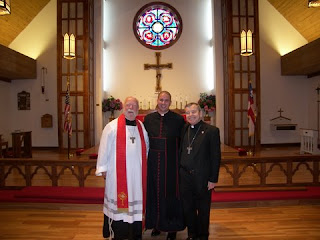




Subscribe to:
Posts (Atom)
Comprovincial Newsletter and Video - September 2026
The Anglican Province of America Comprovincial Newsletter and Video - September 2026

-
MEDIA RELEASE FULL COMMUNION AGREEMENT (COMMUNIO IN SACRIS) BETWEEN THE ANGLICAN PROVINCE OF AME...
-
Pope Leo IX, Last of the Bishops of Rome in communion with the rest of Christendom. The Bishop of Rome is historically the first Bi...
-
 Following on the intriguing discussion at The Continuum , below is the carefully-researched essay by Father John Jay Hughes found in his 197...
