Sunday, March 20, 2011

Mid-Lent: The Eucharist as Refreshment

For us as we approach the Fourth Sunday in Lent...

Our Lord Jesus Christ calls us, beckons us, to refreshment this day as we take a hopefully well-deserved pause from our Lenten discipline, and lighten the mood with the festal vestments and colour of rose. It is time to allow Christ to refresh us, and to take away our burdens, and to renew us, as we yet offer ourselves in self-denial and penance. The Lord desires us to turn to Him, and Him alone, to Him who is the true refreshment of the human person. Christ is our rest, our renewal, our new Life.

He speaks of Himself in comforting terms, as One who nourishes, who refreshes, who revitalises, and ever makes new.

‘Come unto me all ye that travail and are heavy laden, and I will refresh you.’ ‘Take my yoke upon you, and learn of me, for my yoke is easy, and my burden is light.’ ‘But whosoever drinketh of the water that I shall give him shall never thirst; but the water that I shall give him shall be in him a well of water springing up into eternal life.’ ‘He who followeth me shall have the light of life.’

The classic definition of refreshment is simply - to make stronger, more energetic, to replenish, to renew, to revive, to re-enliven.

Jesus Christ, Who is Life and Light, revivifies the body and soul, restoring to man’s nature and being the very Life of God, divine grace, making us partakers of the communion of God’s life - the Life God gives, receives and shares eternally as the Tri-Hypostatic Communion of Love, Father, Son and Holy Ghost. Christ communicates to man the life of the Trinity, unending life, everlasting life, eternal life.

Christ offers Himself to us as our ‘re-fresh-ment,’ the One who restores, who makes whole, who makes us new and alive.

Jesus says: ‘I am the way, the truth, and the life.' Life.

Jesus Christ is the New Life. Jesus has come, he says, so that we may ‘have life, and have it more abundantly.’

On Refreshment Sunday, the Fourth Sunday in Lent, Holy Church proffers once again an opportunity to meditate on the greatest and most sublime of all God’s gifts to us on earth, the most unfathomable of mysteries, the Holy Eucharist, the true living Body and Blood of Jesus Christ, the verity of which is summarised in Saint John’s Gospel, chapter 6. The New Moses gives the New People of God the New Manna, the Bread from heaven, to refresh those who are weary, to feed them supernaturally.

The unforgettable feeding of the five thousand, the feeding miracle of Our Lord so familiar to us, actually reveals to us a dimension of our lives as Christians which we perhaps infrequently examine: Jesus Christ refreshes, renews, energises, revitalises us as members of His mystical Body the Church, through the Holy Eucharist, which is nothing less but the entire Person of Our Lord, God and Man, under the form of bread and wine. The Eucharist makes each one of us personally one with God and with one another. The Eucharist feeds us with Divine Life.

The Eucharist, the Body and Blood of Christ, creates and sustains the Church, which is Christ’s own Body. The Eucharist is the Lord’s Own Service, the supreme act of Christian worship to be faithfully attended every Lord’s Day. It is not just a symbol or a sign - it is Jesus Christ Himself. It is our Sacramental God, present to us under the veil of a mystery. It is our refreshment, our life, our source of being. The Eucharist is the closest any of us will ever come to God this side of heaven. The Holy Eucharist is truly ‘heaven on earth.’

The historical event of the Last Supper, the New Passover, which fulfils the prefigure, the coming attraction of the feeding of the five thousand, is daily reproduced on the Altars of the Holy Catholic Church: Jesus comes to us in that Holy Sacrament which the feeding miracle is intended to image and prophesy for us. However St John 6 carries us back to the Old Testament, Exodus chapter 16, the institution of God’s Passover meal and covenant.

Manna - what is it? - the heavenly bread with which God miraculously fed the children of Israel in the wilderness. Jesus Christ is the Bread from Heaven, the Bread of God of which if anyone eats of It, he shall live forever. Receiving Holy Communion is renewal, re-creation, the gift of eternal life. The Eucharist should be the nourishment and stay of our daily lives, the meat and drink of our supernatural existence in Christ.

We must eat Christ’s Flesh and drink His Blood in Holy Communion in order to be saved and have eternal life. This is the teaching of Jesus Christ, not just of the Church Fathers or the medieval theologians. The Supper of the Lord is generally necessary to salvation (BCP, 581).

Saint John 6 sums it all up:

‘Verily, verily, I say unto you: Except ye eat the flesh of the Son of Man and drink His blood, ye have no life in you. Whoso eateth my flesh and drinketh my blood hath eternal life, and I will raise him up at the last day; for my flesh is meat indeed, and my blood is drink indeed. He that eateth my flesh and drinketh my blood dwelleth in me and I in him.’

Echoed in the writing of that genius of Anglicanism, Archbishop Thomas Cranmer, the truth is reiterated in the Eucharistic liturgy of the Anglican Church; ‘Grant us therefore, gracious Lord, so to eat the flesh of thy dear Son Jesus Christ, and to drink his blood, that our sinful bodies may be made clean by his body, and our souls washed through his most precious blood, and that we may evermore dwell in him, and he in us.’

The Eucharist is refreshment, nourishment for the body and the soul, an often-neglected teaching of our sacred Faith.

The Anglican Prayer Book Catechism, an authoritative document, teaches:

Q: What are the benefits whereof we are partakers thereby in the Holy Communion?

A: The strengthening and refreshing of our souls by the Body and Blood of Christ as our bodies are by the Bread and Wine.

What precisely are Anglicans to believe about the Holy Eucharist, our Refreshment, our true Manna which feeds us unto eternal life? The Prayer Book calls the Eucharist ‘these holy mysteries.’ It cannot be defined - we cannot define the indefinable. We can only maintain a reverential awe in the face of such mystery.

From Queen Elizabeth I, a reasonably Anglican voice, we hear:

Christ was the Word that spake it. He took the bread and brake it. And what His word doth make it, I do believe and take it.

Ours is not a religion based on a system of ethics or morality, ours is not a sophisticated philosophical school or lyceum of ideas, ours is not a mutual appreciation society -- our religion is a Person, ours is a religion of the God-Man Jesus Christ. Ours is a religion with a Body broken and Blood shed, a Blood-bought religion, a Body religion. And that Body broken and Blood shed are given to us every day through the hands of Christ’s chosen men, His apostolic ministers, in the Blessed Sacrament of the Altar. Jesus Christ is the Refreshment of all men.

Saturday, March 12, 2011

Anglicanism - Western Orthodoxy


When, in the sixteenth century, ecclesia Anglicana – ‘the English Church’ – was reformed, those, like Bishop John Jewel, who defended that reformation, did so not by saying it was adapted to contemporary culture, but by a return to the faith and order of the early church. Very deliberately, unlike the Protestant reformers of continental Europe, the Church of England maintained the historic, apostolic, three-fold ministry of bishops, priests and deacons. The Church of England did not abandon the historic apostolic ministry but sought to reform it. Ever since Anglicans have held that those ordained as bishops, priests and deacons, are ordained as bishops, priests and deacons of the Church of God. Change in that ordering of ministry is therefore a matter not just for the Church of England or the Anglican Communion but for all those churches who claim to share that ministry. Developments in faith and order need this wider reference....

The Anglican patrimony is not just a matter of hymn-books and liturgy, of Evensong and the English choral tradition, important as those things are. It is a sacramental way of living out a catholic identity, expressed in relation to the community and in a wise application of moral ideals to personal and pastoral realities. It is what the churches of the East have sometimes recognized as a Western Orthodoxy. Above all it is about a faithfulness in a way of Christian living that expresses the beauty of holiness, which is about transfiguration into the likeness of Christ, living out the maxim often attributed to St Augustine but originating in the theological conflicts of Reformation Europe – ‘in essentials unity, in doubtful things liberty, and in all things charity.’

Wednesday, March 09, 2011

Ash Wednesday


The Ash Wednesday Altar at Saint Barnabas Anglican Church, Dunwoody, Georgia, with a little sample photograph from last night's Shrove Tuesday Pancake Supper.
A blessed and holy Lent to you all!


Friday, March 04, 2011

Moravian-Episcopal Communion

On 10th February 2011, the Northern and Southern Provinces of the Moravian Church in the United States formally entered into a full communion agreement with The Episcopal Church.

During the ceremony of inauguration, the participating bishops of The Episcopal Church laid their hands on the Moravian bishops present, with prayer; immediately beforehand, the Moravian bishops imposed hands on the Episcopal bishops present, with prayer, in the same manner. The act appears to be a mutual recognition of ministries rather than a quasi-ordination rite.

Confusing and perplexing nevertheless.

The Moravian Church does not possess the Sacrament of Holy Orders, but rather a presbyteral succession of ministers:

So they decided to ask Priest Michael to travel to the oldest of the elders of the Waldensiens and to receive from him anew the ordination as priest. They didn't know whether this Waldensien priest would be willing to do so, but if he did, they would consider it a confirmation from God. When Michael returned he would ordain Matthias as their bishop. And that is the way it happened. According to ecclesiastical law Michael admittedly had no power to do so. Only a bishop could exercise the right to ordain, the ius ordinis. But the brothers were of the opinion that according to biblical apostolic order there was no difference between the ordination of a priest and a bishop. The bishop was only differentiated by his duties. Thus Matthias was ordained as bishop among brothers. He then ordained Brother Elias and Brother Thomas as priests. Michael relieved himself of the office of priest and reverted to the status of brother.

What the historical essays demonstrate is that the Moravian Church originated in 1467 at the so-called Synod of Lhotka when some sixty individuals from the Utraquist Church of Bohemia—that more conservative, and by that date the dominant, section of the Hussite movement that accepted most traditional Catholic doctrine, but insisted on communion in two kinds, and that considered itself in communion with Rome, although Rome did not consider itself in communion with them—who wished to distance themselves further from Rome organized themselves into a 'church.' They drew lots to select three men to be their priests. Among the larger group was a Catholic priest; this Catholic priest was then (supposedly) consecrated a bishop by a visiting Waldensian elder, and went on to consecrate as bishop one of the three men selected by lots, who then ordained as priests the other two men so selected. Then the Catholic priest renounced his Catholic orders and was (re)ordained by the man whom he had himself consecrated a bishop—and then the whole lot were rebaptized by their new clergy (for some sixty years they received all converts by baptism, although they practiced infant baptism of their members’ offspring). As the author of the essay, the Anglican Dr. Colin Podmore, writes: 'The Waldensians did not possess the "apostolic succession" as traditionally understood, and, in any case, the Brethren rejected this and wanted nothing to do with it. In obtaining ordination from the Waldensian elder they neither intended to acquire the sign of the historic episcopate nor believed that they had done so.'

They did, however, retain the offices of bishop and priest, and soon revived that of deacon. However, in both 1500 and 1553 their episcopate died out, and new bishops had to be elected and consecrated by their priests, so that the 'episcopal succession' of the Moravian Church goes back only to 1553.


Wednesday, March 02, 2011

Saint Chad of Lichfield


Almighty and everlasting God, who on this day dost gladden us with the feast of blessed Chad thy Confessor and Bishop: we humbly beseech thy mercy; that we which here do honour him with our devout observance, may by his intercession obatin thy healing unto life eternal: through Jesus Christ our Lord, who liveth and reigneth with thee, in the unity of the Holy Ghost, ever, one God, world without end. Amen.

Saint Chad, pray for us!

Tuesday, March 01, 2011

Saint David of Wales


Grant, we beseech thee, Almighty God: that the devout prayers of blessed David, thy Confessor and Bishop, may in such wise succour and defend us, that we which on this day observe his festival, may follow his constancy in the defence of thy true religion; through Jesus Christ our Lord, who liveth and reigneth with thee, in the unity of the Holy Ghost, ever, one God, world without end. Amen.

Saint David, Enlightener of Wales, pray for us!

Monday, February 28, 2011

Healey Willan at Evensong and Benediction


A glimpse of Healey Willan (1880-1968) accompanying the Anglo-Catholic liturgy of the Church of St Mary Magdalene, Toronto. Recorded live at Vespers and Benediction in 1966.

The Magnificat with Antiphon - (plainsong with Willan fauxbourdons)
Psalm 117 with Antiphon (5:52)
Improvised postlude. (7:16)

Sunday, February 27, 2011

Our Lady of Kursk


On Tuesday 15th February 2011, the Feast of the Purification of Our Lady in the Old Calendar, I was delighted and honoured to be invited to venerate the Kursk Root Icon of the Mother of God at Saint Mary of Egypt Russian Orthodox Church in Roswell, Georgia. This holy icon is considered the most sacred relic in the possession of the Russian Orthodox Church Abroad, and the devotion to Our Lady of Kursk is one of the most beloved in Russian Orthodoxy: Our Lady of Kursk is to the Russian Church what Our Lady of Walsingham is to Anglicanism. You may read about the devotion here. Let us continue to pray for the restoration of full communion between the Eastern Orthodox and orthodox Anglican Churches.

Video courtesy of the Eastern American Diocese of ROCOR.

Friday, February 25, 2011

Accipe Spiritum Sanctum

Father John Hunwicke provides us this week with a splendid meditation on rites of Episcopal Consecration old and new, and cites the writing of the eminent theologian, canonist and Church historian Cardinal Pietro Gasparri.

Father Hunwicke states: [Gasparri] was writing at a time when the universal opinion was that the Form of Episcopal Consecration was the formula Accipe Spiritum Sanctum, said by the consecrator as he imposed hands... and then quotes the Cardinal.

'Among all these rites which the Roman Pontifical prescribes in Episcopal Consecration, the common opinion is that the Matter is the imposition of the hands of the consecrating bishop (rather, of the consecrating bishops) and the Form is the related words Receive the Holy Spirit.

We think ... that, in the hypothesis of the imposition of the bishop's hands with the Preface alone, without those words Receive the Holy Spirit, the Consecration is valid, just as it was valid in the ancient liturgy; for how could you prove that the Church had taken its consecratory power away from this Prayer?

Equally, in the hypothesis of the imposition of the bishop's hands with those words alone Receive the Holy Spirit, without the Preface, we admit, with the common opinion, that the ordination is valid, since, although those words alone, considered in themselves, are indeterminate and do not sufficiently express the conferring of the episcopal order, nevertheless they are made sufficiently determinate not only by the Preface but by the caeremonia itself without the Preface.'

Cardinal Gasparri's sensible and historically-grounded theological explanation of the form of Episcopal Consecration, had it been applied generously in the deliberations of the Papal Commission of 1896 concerning Anglican Orders, would have likely produced a different result from the said Commission. Good liturgical theology has always recognised the reality of the moral unity of a rite, in which all the varying parts, acts and ceremonies together as an organic whole determine the meaning of the sacramental action. The convoluted and confusing theological method of Apostolicae Curae, shifting as it does from ground to ground in an effort scholastically to pinpoint a defect in the rites of Anglican ordination, could have been cleanly swept away or corrected by the use of Gasparri's historical-liturgical examination of the facts.

In other words, Anglican Orders are valid.

That in this and subsequent ordinations there are found in their fullness those orthodox and indispensable, visible and sensible elements of valid episcopal ordination - viz. the laying on of hands, the Epiclesis of the All-Holy Spirit and also the purpose to transmit the charisma of the Episcopal ministry.
Meletius, Patriarch of Constantinople, 1922

Monday, February 21, 2011

Septuagesima and Pre-Lent

Septuagesima: A funny sounding word that signals the ensuing approach of our Lenten discipline as we embark on the journey known as Pre-Lent, a mini-Lent before Lent, which is designed to ready us and gear us in the direction of the Lenten fast. As children, we might have thought ‘Septuagesima’ probably referred to a laboratory experiment or a very challenging mathematical formula found in algebra books; it actually means ‘Seventy Days before Easter.’ Beginning even now in Pre-Lent, we are mindful of the distant dawn of the Feast of Feasts, the Paschal Mystery of Our Blessed Lord’s Resurrection. By the route of these seventy days, through the Cross of Lent, we emerge victorious from the Tomb in Easter joy with Jesus Christ our Redeemer.


Holy Mother Church in her good pastoral sense recognises that we need preparatory time to adjust to the sometimes jarring painful reality of Lent, its hopeful yet real sombreness, its renewed intensity and concentration on self-denial, its self-sacrificial discipline. Pre-Lent, a liturgical season now almost entirely unique to orthodox Prayer Book Anglicanism, offers a stage-by-stage, incremental way of getting ready for Lent. Advent, Christmas, Epiphany, such a glorious trinity of celebration and feasting -- the message of Pre-Lent heralded to us is this; it is now time to lay aside our seasons of festivity and equip ourselves for sacrifice, for union with Our Lord in His mysterious offering of Himself for our sake, His voluntary passion and suffering.


Pre-Lent is a time for taking stock of our spiritual lives, of beginning the process of our spiritual inventory. We must begin again to examine our souls, consciences and lives -- to root out sin, to reject evil, to purge ourselves of that which does not belong to God, in short, to repent.

Only by the grace of God our Father, through Jesus Christ, in the Holy Ghost, are we saved from our sins, and only by the exercise of our free-will, our correspondence and co-operation with grace, can we enable the free gift of God’s Life within us to take hold and bear fruit. God created our freedom, and He loves and respects it as being in us an indispensable aspect of His Image. He does not want automatons or robots in His Family, His Kingdom, but sons of God in freedom, in His Likeness. He wants synergy; He wants us to love Him and worship Him in freedom and delight. Salvation is free gift; and it can be lost without perseverance, faith and obedience. Happy Pre-Lent!


Saint Paul announces that we enter into communion with God through the ‘obedience of Faith’ (Romans 1.5, 16.26). And our Book of Common Prayer asserts the theological virtue of Hope in relation to salvation: ‘I heartily thank our heavenly Father, that he hath called me to this state of salvation, through Jesus Christ our Lord. And I pray unto God to give me his grace, that I may continue in the same unto my life’s end’ (page 284).


Pre-Lent’s liturgical theme reminds us that we are saved by grace through faith, and that in the wondrous love of God, we cannot save ourselves, although God never forces us to be saved. The gift must be received, it must be used, it must be prayed, lived, experienced, actualised. On one hand, salvation, freedom from sin and union with God, is entirely the action of the divine initiative: ‘But God commendeth his love toward us, in that, while we were yet sinners, Christ died for us’ (Romans 5.8) ‘For by grace are ye saved through faith: and that not of yourselves: it is the gift of God, not of works, lest any man should boast. For we are his workmanship, created in Christ Jesus unto good works, which God hath ordained that we should walk in them’ (Ephesians 2.8-10).


On the other hand, the Word of God written tells us in no uncertain terms: ‘work out your own salvation with fear and trembling’ (Philippians 2.12) ‘Faith without works is dead’ (Saint James 2.20, 26). God’s free gift of salvation in Jesus Christ, unmerited and undeserved on our part, requires and demands a life - once liberated from the power of sin and death and supernaturally regenerated in Christ - lovingly conformed and subjected to the will of God, seeking to imitate Christ, to be Christ-like.


Father Ronald Knox, the famous English priest and theologian writes,

Septuagesima has an epistle that warns us that it is never too late to be damned and a gospel that reminds us that it is never too late to be saved’ -- fitting food for thought as we now engage in the process of preparing ourselves for the great revelation of the Risen Christ, who is always prepared to receive our repentance. The Christian life requires the acceptance of the divine gift, and good works proceeding from a living faith, if we are to be saved and go to heaven. Pre-Lent is about our response, our side of the divine-human equation; it is about the ‘D’ word: discipline.


1 Corinthians 9: Saint Paul gives us the whole Lenten theme in one fell swoop, and admonishes us to maintain discipline in our lives, without which we may slip and fall from grace. He cleverly uses the image of the arena of his day, track and boxing, to describe the process of subjecting the body to the spirit, and most importantly, to the Spirit of God. Prayer, almsgiving and fasting are exercises in self-control, and are critical to the conforming of our lives to the will of God. We can break the standards that we require of others, and thus lose our salvation. We must ever be vigilant for our own souls, ever on-guard through prayer and good works.


Real Christianity demands a real struggle, a real effort, real sacrifice. ‘Armchair Christianity’ is a deceptive impostor of the genuine article. The essence of the Christian life is ascesis, training, practice, effort, exercise. Orthodox Christianity is not only aesthetic, beautiful, it is ascetic, active.


Saint Matthew 20: Jesus Christ shows us in His parable of the labourers that God is limitless in love and mercy, forgives all sins, and, transcending all concepts of human justice, shows mercy on whom he shows mercy. The Kingdom of God is a free gift of God’s love, a pouring-out of the abundance of God’s generosity, which demands of us a proper response and a thankful return in the offering of our lives to Him. The Kingdom cannot be merited or deserved; it is given to us by Him who alone knows our own good actions and failures.


From the earliest Septuagesima sermon we possess, that of Saint Gregory the Great, the imminent reformer of the sixth century, we discover these words, more applicable today than when they were first uttered: ‘Many arrive at faith, but few are led into the heavenly kingdom. Behold many there are in the Church - they fill Churches throughout creation, yet who knows how few they are who shall be numbered in that chosen company of the elect? Behold the voices of all that proclaim Christ, but the lives of all do not proclaim Him. And many keep company with God in word, but shun Him in deed. At the call of the Lord are multiplied those without number; however, the unfaithful are mingled with the faithful, but because of their way of life they shall not merit to be partakers of the lot of the faithful. No one shall receive a Kingdom, who though formed in heavenly faith, with all their hearts seek the things of earth. Two things there are upon which we should carefully reflect. Because many are called but few chosen, the first is: let no one presume his own salvation; for though he be called to faith, whether he is worthy of the eternal kingdom he knows not. The second is: let no one presume to despair of his neighbour, who he perhaps sees lying in sin; for he knows not the riches of the divine grace.’


The days with the odd names beckon us to practice what we preach, to ‘walk the walk’ as well as to ‘talk the talk.’ Does our life, in its fruits, labours, works and prayers, match our profession? Saint Paul commands us to ‘walk worthy of our calling.’ Are we? If we are, we have the hope of being saved, of rejoicing on that heavenly shore, in that greater light, with Blessed Mary and all the Saints on that heavenly Easter Day which lasts for all eternity.


May the Lord Jesus Christ, the Suffering Servant Who fasted, prayed and gave for us men and our salvation, grant you a productive and transformative Pre-Lent.


Anglican Communion Heresy Alerts

First this, from Sydney...

I would like to argue that Sydney ought not go ahead with lay administration in the foreseeable future. I don’t think that there are any theological objections insofar as I would (and have) happily receive the Lord’s Supper in a Baptist church from a lay person and consider that the sacrament was in no way deficient – in fact, I would find it offensive were any Anglican to suggest it was in some way incomplete celebration. However, I do think it is not wise or necessary to proceed with this innovation at this time...

First, despite what some of its proponents claim, it is not in fact a ‘gospel issue’. Calling it a gospel issue posits an either-or that is simply not accurate. It confuses gospel issues with church order issues. The reason for calling it a gospel issue is that reserving the act of administration at the Supper for the ordained priest/presbyter allegedly communicates a view of the sacrament which sets it apart from the Word and makes it a special means of grace in addition to the gospel in some way – along the lines of a Roman Catholic theology of the sacraments. However, there is no sense in which a Communion service run in the evangelical parishes of the diocese of Sydney could ever be confused in that way. The usual practice communicates anything but a sacerdotal view of the Supper - and there is no evidence that anyone thinks that it does. The ministers do not normally robe or even wear collars these days. The locally authorised liturgies specifically rule out a sacerdotal interpretation of the Communion. Who administers at the Supper becomes then a matter of church order rather than of the gospel itself...

...It is simply the case that no practical necessity drives lay administration in Sydney. There are plenty of candidates for ministry, and plenty of serving presbyters – certainly compared to other dioceses. The current practice is for a monthly communion or perhaps less. Almost every practical concern could be overcome. The current policy of only ordaining as presbyters those who are rectors is perhaps an obstacle, in that congregational leaders may frequently not be presbyters. I would be in favour of returning to the old system. Nevertheless, diaconal administration - which is currently in place – has made this need less urgent.

And then this...

THE ANGLICAN Diocese of Cyprus and the Gulf will now be able to ordain women as priests, appointing them to serve in churches in the region, and one of the first could be in Cyprus.

The announcement was made at the annual Synod of the diocese in Larnaca last week, and was warmly welcomed by members. Rt Rev Michael Lewis, bishop of Cyprus and the Gulf, reported that his request to have permission to ordain and appoint women had been granted by the Province of Jerusalem and the Middle East. The other dioceses of the Province: Egypt, Iran and Jerusalem will not be affected by the change....

Monday, February 14, 2011

Evangelical Mary

By Bishop Michael Nazir-Ali

There is a difference in culture in the two Churches in how we approach the Blessed Virgin Mary. And this difference in culture may also be a difference in theological culture. From the earliest days of the Christian Church there had been two 'tempers', one associated with Alexandria which is speculative and dogmatic, and one associated with Antioch which is historical and biblical, and inductive rather than deductive. If you wanted a crude guess about where I think the Roman Catholic Church's approach is, I would say that it is much more Alexandrian, particularly in its relation to Mary, and the dogmas and beliefs about Mary which have been developed over the years. Whereas the Anglican approach, even that of the Caroline divines and the Non-Jurors, has been more inductive; biblical, historical and patristic. We are discovering more and more that each approach can enrich the other. But it is worth recognizing the difference.

Since the second Vatican Council the Roman Catholic Church has shown a welcome tendency in all of its pronouncements to examine first the biblical background to any particular doctrine. And so we found it easy in ARCIC to consider, first of all, 'Mary and the Bible'. Pretty straightforward? Actually it raises all sorts of questions about how we read the Bible. Many of the reformers were critical of ways of reading it that had developed in the middle ages: the allegory and even the typography had got so florid you could make any part of the Bible mean anything at all. The Reformers were calling the Church back to a historical and literary seriousness, and the Anglican side were well aware of this. So we were delighted that the Roman Catholics also wanted to begin with the Bible and with some discussion about how typology, for example, could validly be used.

Of course, with the Older Testament, we must use typology with regard to Mary, as with Jesus. Anglicans sometimes sing Bishop Thomas Ken's hymn 'Her virgin eyes saw God incarnate born', which compares Mary to Eve. What was said about Eve in Genesis 3.15, about her offspring crushing the serpent's head, must apply in any kind of typological approach to the Blessed Virgin Mary. So not all allegory and typology is wrong and having got rid of the excesses we can now see where, from the Older Testament, we can validly talk of Mary.

When we came to the New Testament we were faced immediately with the question of how to treat the birth narratives. In both communions there is a spectrum of opinion in this matter. We felt that behind the two very different birth narratives there stands a common tradition that there was something highly unusual about the birth of Jesus. Beyond the narratives themselves, in Mark for instance, Jesus is described as the 'son of Mary'; in John when there is a discussion between Jesus and some of the Jewish people, they tell him, 'we were not born of fornication' and then, St Paul in Galatians speaks of the Saviour being 'born of a woman.

Staying with the birth narratives for the time being, I think the integrity of the tradition is shown by their differences. Although we conflate them at Christmas (and confuse everybody) they are different stories with different settings and different personae. So Joseph plays a major role in the Matthean narrative but not in the Lucan one. You have the magi in Matthew and the shepherds in Luke and so on. Positively in Matthew, we have this constant repetition of the 'Mother and the Child', never the one without the other, and this has been picked up in Christian iconography.

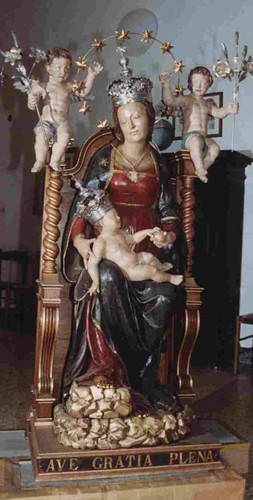
In Luke, we have first of all the Annunciation: Ave Maria gratia plena. The reformers did not like this, it seemed to be claiming too much of Mary and so the early English translations, including the King James version, tended to translate this as 'Hail Mary thou who art highly favoured' or some such phrase, Actually the word used, kecharitomene, means the one who has been fully endowed with grace. So Ave Maria gratia plena is correct, or more correct than somebody highly favoured, whatever that might mean, as long as it is understood that God endowed her with grace.

All sorts of questions arise about this. If Mary is so fully endowed with grace, how far back does that endowment go? Was it at the time when the angel came to see her? A little bit earlier? How much earlier? Right back to the beginning? And what was the beginning anyway? There has been fierce debate in the Church for centuries about this. There are, of course, other persons in the Bible about whom it is said that 'God had been preparing them for his calling from the very beginning of their lives.' Jeremiah. Samson, if you mean in the way that Samson was born. John the Baptist. St Paul himself says this about his own preparation for his calling.

There is no reason for us to want to deny such preparation of Mary from the beginning, especially because of what is said at the time of the Annunciation. And, indeed, that is the line that we have taken in Mary, Grace and Hope in the Church, that we cannot set limits to when God began to prepare Mary. It must have been from the beginning and even before the beginning in divine providence and wisdom.

We decided to say that the Virgin Birth, conception and birth, are important because they are about the new thing that God was about to do in the Incarnation of Our Lord. Here was something quite new which God was about to do and, in fact, if you read the narratives both Lucan and Matthean, you find that there is both continuity and newness.

The evangelists keep a balance, so the genealogies in both point to the continuity of David's line, of being part of the story of Israel, but the newness is concentrated in God being the chief agent in the work of the Incarnation. But Luke has so much else about him. Of course, there is the Visitation to Elizabeth and Elizabeth's cry when she sees Mary and recognizes her blessing. Mary, herself, speaks of this in the Magnificat, and at Evensong every day we recognize that ever blessedness of Mary first seen by Elizabeth. Luke is also conscious that Mary was reflecting on what was happening and it may be that a lot of what we know about the birth narratives somehow comes from Mary's reflection. In this sense Mary is also the first theologian, if you like, not just the first Christian but the first theologian who was thinking about the things that God was doing with her and for her and in her.

Then there is John's gospel and in the report we consider the two events in which Mary is present, Cana and Calvary. At Cana she seems to be there in her own right, Jesus arriving afterwards with the disciples. She says to Jesus 'there is no wine' and then there is that dialogue you know where he says 'my time has not yet come' but then Mary says to the stewards 'do as he tells you' and they do and you know what happens. But then there is something very telling at the end of it all where it says that Mary, now goes down with Jesus and the disciples back to Capernaum. She is seen for the first time as part of the company of disciples.

And, then, there is Mary at the Cross and the tremendous amount of reflection there has been on the Mother being handed over to the care of the beloved disciple and the beloved disciple to the mother. What are the theological implications of this relationship? Language about Mary being Mother of the Church can be based also on the perception that the Church is the Body of Christ, but the story about the disciple and Mary is a nice way of thinking of Mary's motherhood for those who are disciples of Christ.

Just as in John she is with Jesus and the disciples, so also in Acts at the time of the Pentecost, Mary is there with the disciples. We also considered the figure of the woman in the apocalypse in Revelation ch. 12 and its relevance for Mary. Generally speaking this imagery has been thought to be of God's people primarily rather than of Mary, but there have been some Fathers, like Epiphanius, who have thought that it could refer to Mary as well as the Church, so this might be another way of thinking of Mary as a type for the Church. It is difficult if one reads ch. 12, not to think of this if one were fair minded, for clearly the child is the Messiah.

Having examined the Bible we then looked at the early Church and we discovered two main concerns that involve Mary. The first typified by Ignatius of Antioch is that Mary is necessary for the Incarnation. To believe that Jesus was truly man you must take seriously the figure of Mary. Jesus was not just someone who appeared to be a man and so Ignatius in his letter to the Ephesians (interestingly enough they must have known quite a lot about it if Mary had lived among them) tells us that Jesus is both God and man both eternally begotten of the Father and born of Mary. Mary's virginity, along with the birth of Jesus and the Cross, are seen by him as the three great mysteries of the Christian Faith.

The other concern in the Early Church was of the unity of the two natures of Christ, that he was both human and divine. This is shown in the ascription of the title Theotokos or God-bearer, or Deipara to use the old Latin word, of Mary. Mary is God-bearer because the human and the divine are united in the one Christ and this is why what we say of the human is also true of the divine, and vice versa. This description of Mary as Theotokos became really quite central, not so much about Mary, but about Jesus and who he is.

As you know, through the Middle Ages there were all sorts of developments about belief regarding Mary. Some of them were faithful to the Bible and to the Fathers and some were not. Devotion to Mary got detached from thinking about Christ. Mary could become someone who dispensed grace in her own right, to whom people could pray in her own right, and so forth. At the Reformation the protests that took place were about these excesses – to give an example, Bonaventura, where he substituted Our Lady for every reference to God in the Psalms. Tyndale was particularly vicious about this kind of thing, whatever the intention might have been. But it was not just the Reformers. Erasmus and St Thomas More who both remained in communion with Rome were also critical of the cults that had arisen about the Blessed Virgin Mary. If you read More about Walsingham and Ipswich, it is difficult to tell whether it is Thomas More or William Tyndale! His point is that people have made the cults and the places and the shrines and the statues and the 'stocks' as he calls them, a substitute for Christ and for his Mother. Erasmus, after he visited Walsingham, was equally critical. So the Reformers were not alone. I mean that there was awareness that the cults had become excessive on both sides.

However, what we are perhaps not so familiar with is the extent to which there was continuity among even the most radical reformers. So, for example, Hugh Latimer, one of the most outspoken of the Reformers, said when asked about Mary, 'I go not about to make Mary a sinner but Christ her saviour.' And funnily enough many centuries later that is exactly what the definition of the dogma of the Immaculate Conception does; it pleads the merits of Christ saving work for the preservation of Mary from sin.

Thomas Cranmer, and many other Reformers, take their stand on the sinlessness of Mary on the basis of what Augustine had said. But there is more than that and this is shown in the liturgy, in the Christmas Collect and the Christmas Preface, Mary is referred to as 'a pure Virgin.' What does that mean? It is not the technical language of the Immaculate Conception but there is this sense that she is somehow free from sin.

There was widespread recognition of her sinlessness among the Anglican Reformers and in the early catechisms, for example in Nowell's Catechism and Thomas Becon and so on. They are almost unanimous about perpetual virginity. The reason that they give very often is the verse in Ezekiel ch. 44, which says 'the gates from which the Lord has come no man should enter.' This is their reasoning for the perpetual virginity of Mary but also, of course, the nearly unanimous testimony of the Church. Even Jewel who knows that there was some dissent about this in the patristic period is happy to affirm the perpetual virginity of Mary. This is the case in the sixteenth century when so much was being overthrown and rejected. Nor should we neglect the liturgical and other aspects that were retained. For example, although in 1552 only two feasts having to do with Mary were retained, the Purification and the Annunciation, in 1561 three further feasts were recognized, the Conception, the Nativity and the Visitation.

When we come to our own day, the most significant thing for us as a Commission was that the Second Vatican Council decided not to issue a separate document on Mary but to subsume what they had to teach about Mary in their document on the Church, Lumen Gentium. This showed that they wanted to go back to the earliest insight of Mary being with the disciples rather than Mary being enthroned, as it were above the Church. They wished to see Mary in the midst of the Church. And this has signalled a new interest in the Roman Catholic Church in the historical, in the patristic situation, which, as Anglicans of course, we welcome very much and so there was a sort of meeting of minds in these areas.

What then can we say together so far? We can say that Mary is the recipient of divine grace not the originator of it; that whatever role Mary has it should not distract from the centrality of Christ's person and work in the Church and in the world; that Mary was prepared by the divine grace from the beginning for the work to which she had been called; in the light of Revelations 12, for example, that Mary can be spoken of as in glory with her son.

These things we can say together, but what about the dogmas? Where are we on that? The story of the dogmas is enormously complex and there are not only many Fathers but also many medieval scholars and saints who did not believe, for example, in the Immaculate Conception. Irenaeus, Augustine himself, Chrysostom and Aquinas. But I think that the promulgation of the dogma of the Immaculate Conception was an attempt by the Roman Catholic Church to foreclose discussion on what it might mean; in that sense it was an unfortunate step because the language used is that of nineteenth century Rome, and hardly understandable today and sometimes embarrassing even to Roman Catholics. However, what we can say about Mary is that she was a pure virgin; that she was prepared by God from the very beginning in what she had to do. If, for some, that means 'Immaculate Conception then that is their language. Similarly with the Assumption, notwithstanding the particular language of the dogma, we can say surely that Mary reigns with Christ in glory. With Bishop Ken we can say, 'Heaven with transcendent joys her entrance graced, Next to his throne her Son his Mother placed.'

Friday, February 11, 2011

'First Millennium Church' Ecclesiology

From a Russian Orthodox Archbishop, the classical Catholic and Anglican ecclesiological position, Eucharistic ecclesiology, Church as Eucharistic Communion of Eucharistic communions, the faith and doctrinal tradition of the undivided Church of the first thousand years of Christian history, primus inter pares primacy, collegial episcopate and conciliar church government - in short, the Church of the First Millennium.

'...Full Christian unity is the Eucharistic communion. We do not need to reshape our Church administration, our local traditions. We can live with our differences within one Church, participating from one bread and one cup. We need, however, to rediscover what united us and what brought us to disunity, particularly in the 11th century.

So the basis for the restoration of the full communion would be, I believe, the faith of the Church east and west in the first millennium...'

'...In any case, we do not believe that there could be a bishop above all other bishops whose decisions would be binding for the entire Church. We believe that the bishop of Rome in the first millennium was obviously first in honour but he was first among equals. He did not have direct jurisdiction, for example, over the East. Therefore, when we come to the discussion of the primacy we would argue that the universal jurisdiction of the Pope is something that didn’t exist in the first millennium and that if we restore, for example, Eucharistic communion, we would accept his role as first among equals but not as the universal bishop...'

'...We still discuss the role of the bishop of Rome in the first millennium, and even on this issue we see clear differences between the Orthodox and the Catholics. If we come to the discussion of the second millennium, the differences will become much more obvious. Therefore we should not pretend that we are close to solving this problem.

I think, however, that we should discuss it honestly; we should describe the differences in our positions, and we should see what would be the way out. For us, as I said, the way out would be the return to what we had in the first millennium...'


Tuesday, February 08, 2011

'And with your spirit'

Courtesy of my brother, Father Brandon Jones, and the Roman Catholic Diocese of Charlotte, North Carolina, comes this first video installment in a series of presentations on the new English translation of the Novus Ordo Roman Missal. The liturgical changes about to be introduced into the Roman Rite as of 27th November 2011 will bring the English version of the Novus Ordo Missae Roman liturgy back to its own tradition in many respects and bring the modern English Roman Mass much closer to the venerable antiquity and beauty of our Anglican Rite. The theology demonstrated in this first video accords entirely with the orthodox Anglican liturgical heritage and, hence, the ancient Western Rite of the Church.

Monday, February 07, 2011

The Anglican Church in America

UPDATE: From the ACA website...

February 7, 2011

Dear Brothers and Sisters in Christ,

We bid you greetings in the name of our Lord Jesus Christ.

Recently, because of questionable and possibly irregular episcopal actions that have taken place in both Florida and California, we asked the chancellors of the Anglican Church in America to render an opinion regarding temporal and corporate issues related to the ACA, particularly as concerns the Patrimony of the Primate. The chancellors' decision, released in a letter dated February 5, 2011, has been widely disseminated. It appears on the ACA web pages. The chancellors' letter contains pointed language; it represents a solid, legal opinion and should inform further discussions as we move forward. Opinions expressed in that document, whether temporal, corporate or ecclesiastical, are advisory in nature and should be regarded as such.

The chancellors' letter emphasizes the state of broken communion in which we presently find ourselves. The Patrimony of the Primate was initially established as a temporary entity to allow for the smooth transition to the Roman Catholic Ordinariate for those so inclined. It was the expectation that the Patrimony would exercise no diocesan functions, but would respect the established diocesan structures within the ACA. Indeed, the Patrimony of the Primate was envisioned as an entity for those who wished to leave their existing diocese while waiting for the Ordinariate to be formed. Although it was our hope that we all might remain together under the umbrella of the ACA, that now seems impossible. Those who wish to enter the Ordinariate have engaged in activities that suggest they have begun to operate as a separate jurisdiction. We understand that our brothers wish to move forward on the path they believe is right. We understand their sense of urgency and their commitment to the cause they believe is correct. We pray for them, just as we seek their prayers for us. But we must also recognize and respond to the situation as it presently exists.

An amicable and immediate separation between the Patrimony and the ACA is indeed necessary. It is necessary in order to reduce the tensions and reestablish collegial bonds. This separation will formalize what already exists in practice. Though we may find ourselves in different jurisdictions, it is vital that we part in a spirit of generosity and Christian love. Above all, we must recognize that we are children of God struggling to understand God's call to each of us.

We ask your continuing prayers as we serve as your Bishops, praying that the Holy Ghost may guide us as we make decisions that enable us to serve God's people in the particular places where we have been called.

+Brian
+Daren
+Stephen

Also from the website of the Anglican Church in America...

'...I would like to inform you that the Anglican Church in America shall remain as a continuing Anglican church. Notwithstanding what you may have heard, this church is not going to collapse or disappear. It will, by the Grace of God, continue its important and essential witness as part of God's holy church.

Second, we would like to advise you as to the situation in the Diocese of the Eastern United States which has been the one diocese most gravely affected by what has happened.

As all of you may know, the Bishop of this DEUS has elected to abandon his diocese when the diocese refused to go to the Roman Catholic Ordinariate. Of the twenty-five parishes and missions in the diocese, approximately ten parishes and missions have elected to remain with this church. These ten parishes and missions, effectively abandoned by Bishop Campese, will form the nucleus of a new diocese. While the majority of the parishes and missions chose to go with Bishop Campese, the majority of the laity has elected to remain with the diocese. Bishop Campese brought a number of missions into the diocese in the eighteen (18) months prior to leaving the diocese. We have chosen to stay together, to remain with the ACA, and should shortly be conducting a search for a new bishop...'

Monday, January 31, 2011

The Eucharistic Presence

Our Lord's proclamation of the truth of the Real Objective Presence in Saint John chapter 6 is certainly not symbolical or metaphorical, and He is not speaking in figurative terms, as the context of the Scripture makes clear. In our day, when a significant percentage of American Roman Catholics do not believe in the Real Objective Presence of Christ in the Eucharist, and probably an even greater percentage of Anglicans (at least of the evangelical variety) doubt and struggle with this divine truth, I think it is better to emphasise the corporeal and incarnational dimension of the Eucharistic Presence rather than place emphasis on the more symbolic or representative aspects of the Eucharistic Mystery: one can never affirm or assert too strongly the fact that the Blessed Sacrament is Jesus Christ, a Divine Thing, the glorified Body and Blood of Christ under the consecrated elements of bread and wine, so that the fullness of Our Lord's human nature, as well as His Divinity, is present in the form of the sacred species, in an abiding and permanent way after Consecration. We should reject as contrary to Holy Tradition the doctrine of memorialism, which makes the Eucharist a mere mental psychological act of remembrance devoid of presence and grace, and the doctrine of virtualism, which holds that only the believing faithful receive the subjective grace or power of the Body and Blood through the elements, but not the Thing Itself objectively present in the elements. Historically, Anglicanism has, at sundry times, been confused by these two insufficient doctrines on the Eucharistic Presence, and it is up to us to clarify the biblical and patristic truth for our own tradition.

Since the Reformation, Anglicans have insisted, with the consensus of the early Fathers, Saint Irenaeus of Lyons, Saint Theodore of Mopsuestia and Saint Theophylact especially amongst them, that the materiality of the Bread and Wine remains in its original physical state after Eucharistic Consecration, but that to it is joined by Consecration the supernatural totality of the Incarnate God-Man, by a 'hypostatic union,' a Personal Union extending the Incarnation, a sacramental unity of the outward and visible sign with the Divine Thing, Our Lord, Who is signified and contained in the sign. The Holy Ghost, through the Consecration of the Mass, effects a sacramental change, an ontological change, in the forms of bread and wine on a supernatural metaphysical level, so that the outward forms become the Spirit-filled Body and Blood of Christ in an 'immaterial' but essential manner. The Body and Blood of Christ in the Eucharist are the Body and Blood of His mighty Resurrection and glorious Ascension, a spiritual Body vivified by the Holy Spirit (I Corinthians 15.44). The afore-described doctrine is plainly laid out in the Prayer Book Catechism, the Prayer Book Offices of Instruction and in the Prayer Book Eucharistic Liturgy, as well as Articles of Religion XXVIII and XXIX. All communicants receive the outward and visible Sign and the Thing Signified; only the faithful receive the Benefit or virtue of the Sacrament, as the wicked receive not benefit but condemnation (I Corinthians 11.27-29). We do indeed need to be careful about Eucharistic language, so as to avoid on one hand a monophysiticism wherein the elements are believed to be destroyed and absorbed into Christ, and a Nestorianism often found in Calvinism and 'reformed' protestantism on the other, wherein the sign is divorced and entirely separated from the Divine Reality.

Saint Irenaeus says, 'in the Eucharist there is an earthly thing and an heavenly thing,' hence, the outward signs of Bread and Wine and the Thing Signified, the Body and Blood of Our Lord. Other Fathers describe the Eucharist as the prolongation of the Incarnation, a Mystery like an iron thrust into the fire - the iron does not lose its own properties or reality, but it takes on the reality and properties of the fire. Both remain complete in themselves and yet are perfectly united, and each takes on the property of the other: True God and True Man in the Incarnation, earthly elements and the Person of Christ in the Eucharist. The consecrated Elements are not destroyed, but elevated, not replaced, but perfected into a new Thing. Grace builds upon nature, and does not destroy, but perfects, nature. Our Lord is incarnated in the sacramental species, mystically present. I say all of this to concur with what many authors basically teach about the Real Presence, while carefully governing how we would assert that same truth in language consistent with the Scriptures and Fathers. Eucharistic miracles are just that, miracles, like the Real Presence itself, beyond our intellectual explanation and understanding.

That there is 1. a supernatural, glorified, metaphysical yet corporeal (of a Body) Presence of Our Lord's Incarnate Person in the Eucharist, the Risen and Exalted Lord, and 2. a Change in the Eucharistic Elements upon Consecration, is beyond doubt for all Catholic Christians; but as Anglicans we believe we cannot attempt dogmatically to define the exact manner of the Presence or the process of how the Presence comes about at Mass without adding to the Catholic Faith. We cannot rationally explain the inexplicable or define the indefinable. The Real Presence is Mystical - the ultimate Holy Mystery. The Presence is more real than that found in our own material physical plane, but it is not material and physical as understood in the limited field of our empirical experience.

Sunday, January 30, 2011

Saint Charles, King and Martyr


On 30th January 1649, Saint Charles Stuart I of England was martyred - he died to save the English Church, the English Liturgy and the English Succession of Apostolic Faith and Order. Let us gratefully REMEMBER before Almighty God the witness, life and sacrifice of England's Martyr King.

BLESSED Lord, in whose sight the death of thy Saints is precious; We magnify thy name for the abundant grace bestowed upon our martyred Sovereign Charles; by which he was enabled so cheerfully to follow the steps of his blessed Master and Saviour, in a constant meek suffering of all barbarous indignities, and at last resisting unto blood; and even then, according to the same pattern, praying for his murderers. Let his memory, O Lord, be ever blessed among us, that we may follow the example of his courage and constancy, his meekness and patience, and great charity. And grant, that this our land may be freed from the vengeance of his righteous blood, and thy mercy glorified in the forgiveness of our sins, and all for Jesus Christ's sake, our only Mediator and Advocate. Amen.

Saint Charles, King and Martyr, pray for us!

Monday, January 24, 2011

To Life!

In commemoration of today's March for Life and for the restoration of reverence for the sanctity of all human life from conception to natural death in our country and culture...

O MERCIFUL Father, whose face the angels of thy little ones do always behold in heaven; Grant us stedfastly to believe that these thy children hath been taken into the safe keeping of thine eternal love; through Jesus Christ our Lord. Amen.

ALMIGHTY and merciful Father, who dost grant to children an abundant entrance into thy kingdom; Grant us grace so to conform our lives to their innocency and perfect faith, that at length, united with them, we may stand in thy presence in fulness of joy; through Jesus Christ our Lord. Amen.

O GOD, whose most dear Son did take little children into his arms and bless them; Give us grace, we beseech thee, to entrust the souls of these children to thy neverfailing care and love, and bring us all to thy heavenly kingdom; through the same thy Son, Jesus Christ our Lord. Amen.

Pastoral Letter of the Bishops of the Mission Society of Saint Wilfrid and Saint Hilda

We write as bishops within the Church of England, who seek both to maintain and promote its Catholic heritage, believing that this demands maintaining the ministry of bishops, priests and deacons in a manner consistent with the tradition of the Church, East and West. We address all those, ordained and lay, who look to us at this time for pastoral guidance.

In July 2010 the General Synod of the Church of England took yet another decisive step in the direction of enacting legislation that would make it possible for women to be admitted to the episcopate. At the same time General Synod declined to make any appropriate provision that would satisfy the consciences of those of us who cannot accept that such ordinations would be a legitimate development in the life of the Church. Some have already decided that they can no longer remain within the Church of England. We genuinely wish them Godspeed as, heeding the call of conscience, they embark on a new episode in their Christian discipleship. We, too, in similar obedience to conscience, seek, if at all possible, to remain faithful members of the Church of England and undertake to support all who seek to do likewise.

Even at this late hour we are seeking a way forward that would enable us with integrity to retain such membership. We are passionate in our commitment to the mission of the Church of England and urgently seek a settlement through which we would be free to play our part to the fullest measure. We believe this could be done by the formation of a society within the Church of England, overseen by bishops committed to our viewpoint. Such bishops would need, of course, the necessary ordinary jurisdiction that would enable them to be the true pastors of their people and to be guarantors of the sacramental assurance on which we all depend for our authentic sharing within the Body of Christ. Given that our parishes are also constituent parts of local dioceses we also understand that some way would have to be identified for sharing jurisdiction with the diocesan bishop. We understand it to be something of this nature that our archbishops were trying to achieve in their ill-fated amendment at the July meeting of the General Synod. That amendment, though narrowly defeated in the House of Clergy, was widely supported elsewhere in the Synod and, indeed, a majority of members supported it. It might well be that a revisiting of the archbishops’ proposals, with some further development of them, could still help our Church to find a way forward that enabled us all to remain faithful members of it.

To this end we have set about forming ‘The Society’. It is under the patronage of Saint Wilfrid and Saint Hilda. Two of our number, the Bishops of Blackburn and of Gibraltar in Europe, have agreed to serve as episcopal protectors of The Society. The Bishop of Beverley will be the co-ordinating bishop. We are still in the process of giving more substance to its constitution. It may well be that the latter cannot be finally resolved until we know whether or not the House of Bishops and then the General Synod will be prepared to build further on our initiative. You can find more details as to our thinking by visiting The Society’s website. Many have already enrolled as prospective members of The Society and we now encourage all who support us to do so. We need to discover whether such a way forward commands the support of those who look to us for guidance. If that were to be so then it would be good to demonstrate to the wider Church just how many of its members need such provision in order to remain faithful members of it.

We do not want to build up false hopes. Every attempt we have made so far to persuade the Church of England to make the kind of provision that would enable us in good conscience to remain within its fellowship has been thwarted. We feel, nevertheless, duty bound, once again to seek a way out of the impasse that otherwise would make it impossible for many of us to remain faithful members of our Church. We recognise the huge change of heart that would need to happen for us to succeed. We ask you to pray fervently that such a change of heart might take place and encourage you to support us by enrolling in The Society.

+ Nicholas Blackburn
+ John Cicestr
+ Geoffrey Gibraltar
+Martyn Beverley
+John Burnley
+Peter Edmonton
+Mark Horsham
+John Plymouth
+Anthony Pontefract
+Martin Whitby
+Lindsay Urwin
+Robert Ladds

Saturday, January 15, 2011

The Preface of the Anglican Ordinal

THE PREFACE.

IT is evident unto all men, diligently reading Holy Scripture and ancient Authors, that from the Apostles' time there have been these Orders of Ministers in Christ's Church,—Bishops, Priests, and Deacons. Which Offices were evermore had in such reverend estimation, that no man might presume to execute any of them, except he were first called, tried, examined, and known to have such qualities as are requisite for the same; and also by public Prayer, with Imposition of Hands, were approved and admitted thereunto by lawful Authority. And therefore, to the intent that these Orders may be continued, and reverently used and esteemed in this Church, no man shall be accounted or taken to be a lawful Bishop, Priest, or Deacon, in this Church, or suffered to execute any of the said Functions, except he be called, tried, examined, and admitted thereunto, according to the Form hereafter following, or hath had Episcopal Consecration or Ordination.

Comprovincial Newsletter and Video - September 2026

  The Anglican Province of America Comprovincial Newsletter and Video - September 2026