By Mary Ann Mueller in Belleville, Illinois
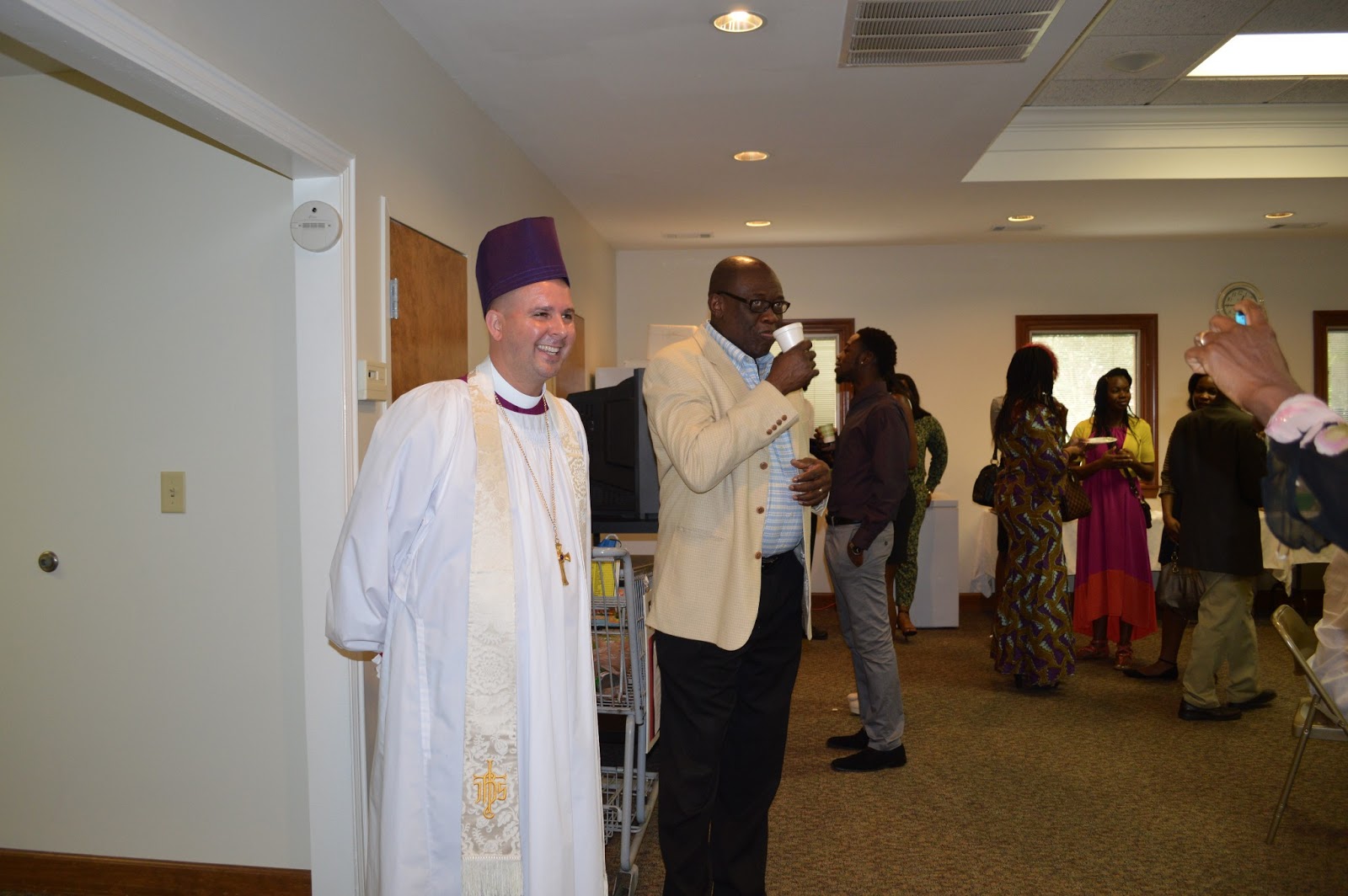
Some of the heaviest Anglo-Catholic hitters in the Anglican realignment were in the shadow of the St. Louis arch last week. They travelled from near and far to celebrate their connectiveness as Christians and to rejoice in their joy at being Anglicans with a common history and shared prayer as Forward in Faith-North America's (FiF-NA) 2013 Assembly played out near the banks of the upper Mississippi River.
Bishops in purple shirts, priests and deacons in black shirts, monks in flowing black or brown serge habits, and the laity, all sporting a wide spectrum of colors, fabrics and patterns, descended on the 200-acre Our Lady of the Snows, a national Catholic shrine dedicated to providing an oasis for spiritual renewal in an atmosphere of Christian hospitality.
Some of the bishops present included: ACNA Archbishop Robert Duncan, FiF-NA President Bishop Keith Ackerman, Anglican Province of America Presiding Archbishop Walter Grundorf, Anglican Church in America Bishop Stephen Strawn, ACNA Missionary Diocese of All Saints Bishop William Illgenfritz, Diocese of the Holy Cross Bishop Paul Hewett, APA Diocese of the Eastern United States Bishop Chandler Jones, ACNA Bishop Richard Lipka, ACNA Diocese of San Joaquin Bishop Eric Menees, Reformed Episcopal Diocese of the West Bishop Winifield Mott, and three venerable elderly bishops of the American Anglicanism - William Wantland, Donald Parsons, and Ed Mac Burney, all now slowed and bent with age but representing the image of Forward in Faith at its initial flowering.
Forward in Faith is an over-arching umbrella that draws together those from various parts in the Anglican renewal who seek to live out their spirituality the Catholic stream of Anglicanism. More than 150 Anglo-Catholics travelled to the Midwest from throughout the United States and across the Anglican spectrum to join together in unified prayer, joyful worship and lessons taught by one of the greatest teaching speakers in Anglicanism today.
The special orator for the event was a Church of England bishop who has travelled far and wide mesmerizing audiences wherever Anglicanism has been planted and is celebrated.
Bishop Michael Nazir-Ali, the 106th Bishop of Rochester (England) and now the director for the Oxford Centre for Training, Research, Advocacy and Dialogue, chose as his topic"Ecclesiology at the Crossroads." For three one-hour sessions, the English bishop kept his audience in rapt attention as he spoke eloquently and knowledgably all without benefit of notes. He was thoroughly conversant with his topic and was able to bring forth a wide variety of facts and weaving in dates and personages as he fleshed out his topic. He was also very much a part of the overall experience of Forward in Faith. He blended in as one of many bishops and was accepted as an equal participant, rubbing shoulders with one and all throughout the days and evenings.
The three-day event was undergirded in prayer. The OLS conference room became many things during the three days, which sped by with incredible speed - change a wall here or move a table there, and, presto, the room is transformed. It was used as a chapel for the recitation of Daily Office, a classroom when Bishop Nazir-Ali was teaching, an assembly hall during FiF-NA business sessions, a comfortable parlor when Bishop Ackerman was with his beloved FiF-NA family, a television studio for Anglican TV's recording of the event, an exhibitor's hall for various FiF-NA and Anglo-Catholic ministries and movements, a movie theatre for the playing of the short film "Surprising Merrily," a banquet hall for the breaking of bread, a parish hall for fellowship and snacks, and a cathedral for the celebration of the closing Eucharist by a Bishop Wantland.
Forward in Faith participants not only looked back over their collective shoulders to see where they have come out of the spiritual desert of Egypt but also peered forward to see where the Lord is leading them today, tomorrow and beyond.
Bishop Ackerman realized that as a living entity, FiF-NA has changed from being a rigid rule-based organization to an organism that grows and changes, develops and learns as it matures. Therefore, the canons and constitution of the group have to reflect the new reality. Rather than trying to remold the FiF-NA Assembly into an organization, the bylaws need to reflect the liveliness of an organism. So they were tweaked to mirror the fact that Forward in Faith is a loving spiritual family and not an ecclesial legislative body.
FiF-NA's early DNA goes back to 1972 and the Committee (later Coalition) for the Apostolic Ministry. It then is traced through the Evangelical Catholic Mission and the Episcopal Synod of America, finally morphing into Forward in Faith in 1989. Through it all, the Anglo-Catholic voice has remained loud and strong and uncompromising in the face of decadence and decay. Next time the Forward in Faith Assembly meets, it will be to celebrate its silver anniversary with jubilation and prayer. Next year, all eyes will turn toward celebrating FiF-NA's silver anniversary as the strong Anglo-Catholic voice in the reforming face of American Anglicanism.
Bishop Ackerman has called for help. He has developed a plan where participants can become adjunct members of the FiF-NA Council and focus on one specified project. The specialized auxiliary ministries include: marketing, securing advertizing for the Forward in Christ publication, Mission and Outreach for the Myanmar Project, various children's ministries, writing tracts, interacting with social media such as Facebook and Twitter, fundraising and development, maintaining the FiF-NA website, developing regional Festival in Faith mini-conferences, and preparing for next year's joyful silver jubilee celebrating what God has done and is continuing to do with Forward in Faith.
Monday, July 22, 2013


Friday, July 19, 2013
The Declaration of Common Faith and Purpose of Forward in Faith North America

Affirmed unanimously at the Assembly of Forward in Faith North America, held at the Shrine of Our Lady of the Snows, Belleville, Illinois, Thursday 18th July 2013.
In its basic theological affirmations, this declaration is virtually identical with the Affirmation of Saint Louis, the foundational document of the Continuing Anglican Churches accepted at the Congress of Saint Louis (1977).
1. I believe our Lord Jesus Christ has given His Church an Order which claims the loyalty of faithful Christians above and beyond any deviation sanctioned by any humanly-invented institution, whether secular or ecclesiastical.
2. I accept the Holy Scriptures of the Old and New Testament as 'containing all things necessary to salvation,' and as being the rule and ultimate standard of faith and morals.
3. I accept the Apostles' Creed as the Baptismal Symbol; and the Nicene Creed as the sufficient statement of the Christian faith.
4. I accept the historic episcopate, locally adapted in the methods of its administration to the varying needs of the nations and peoples called of God into the Unity of His Church. I affirm the Christian ministerial priesthood as male and that the churches of the Anglican Communion have no authority to change the historic tradition of the male priesthood. I pray that God grants me the strength and ability to uphold the Church's Order, both materially and spiritually as concerns the ministerial priesthood of His holy Church. Accordingly, I will reject any and all actions that might signify acceptance of a deviation from the Church's Order regarding the Christian ministerial priesthood.
5. I recognize the seven Sacraments of the One, Holy, Catholic, and Apostolic Church - Baptism and the Supper of the Lord - ministered with unfailing use of Christ's words of institution, and of the elements ordained by Him, Confirmation, Matrimony, Ordination, Reconciliation of a Penitent, and Unction of the Sick.
6. I believe that, in the Sacrament and mystery of the Holy Eucharist, Jesus Christ is truly, really and substantially present in the Body and Blood in the outward and visible sign of Bread and Wine. (cf. 1 Corinthians 10.16-17, 11.23-29, Saint John 6.32-71).
7. I affirm our Lord's teaching that the Sacrament of Holy Matrimony is in its nature the exclusive, permanent and lifelong union of one man and one woman.
8. I believe all Seven Councils are ecumenical and catholic on the basis of the received Tradition of the ancient Undivided Church of East and West.
9. I affirm that God, and not man, is the creator of human life. Believing that the unjustified taking of life is sinful, I will promote and uphold the sanctity of life from conception to natural death.
Recession at the FIFNA Solemn High Mass
At the Assembly of Forward in Faith North America, held at the Shrine of Our Lady of the Snows, Belleville, Illinois, Wednesday 17th July 2013...
Sunday, July 14, 2013
Russian Orthodox Church Outside Russia Eliminates Its Western Rite?

Bishop Jerome of Manhattan,
formerly Western Rite Bishop-Vicar of the Russian Orthodox Church Outside Russia.
A sad and unwelcome development, but an instructive reminder...
Traditional Anglicanism is Western Orthodox Christianity.
Update: Metropolitan Hilarion has issued the following decree on the Western Rite in ROCOR.
Update: Metropolitan Hilarion has issued the following decree on the Western Rite in ROCOR.
Wednesday, June 26, 2013
Orthodox Anglicanism for Today

A helpful reminder from the Affirmation of Saint Louis (1977). If one might be tempted to think that the Affirmation is dated or not useful to the present theological and moral formation of orthodox Christians and Traditional Anglicans, please read on...
Sacraments
The Sacraments of Baptism, Confirmation, the Holy Eucharist, Holy Matrimony, Holy Orders, Penance and Unction of the Sick, as objective and effective signs of the continued presence and saving activity of Christ our Lord among His people and as His covenanted means for conveying His grace...
II. PRINCIPLES OF MORALITY
The conscience, as the inherent knowledge of right and wrong, cannot stand alone as a sovereign arbiter of morals. Every Christian is obligated to form his conscience by the Divine Moral Law and the Mind of Christ as revealed in Holy Scriptures, and by the teaching and Tradition of the Church. We hold that when the Christian conscience is thus properly informed and ruled, it must affirm the following moral principles:
Individual Responsibility
All people, individually and collectively, are responsible to their Creator for their acts, motives, thoughts and words, since "we must all appear before the judgment seat of Christ . . ."
Man's Duty to God
All people are bound by the dictates of the Natural Law and by the revealed Will of God, insofar as they can discern them.
Family Life
The God-given sacramental bond in marriage between one man and one woman is God's loving provision for procreation and family life, and sexual activity is to be practiced only within the bonds of Holy Matrimony.
Christian's Duty to be Moral
We believe, therefore, it is the duty of the Church and her members to bear witness to Christian Morality, to follow it in their lives, and to reject the false standards of the world.
The Church as Witness to Truth
We recognize also that, as keepers of God's will and truth for man, we can and ought to witness to that will and truth against all manifest evils, remembering that we are as servants in the world, but God's servants first.
Friday, June 14, 2013
Anglicans and the Filioque

Most interesting news from the Anglican Church in North America as recorded in its Provincial Meeting Journal of June 2013...
In it, this footnote is placed within the provided liturgical texts:
The filioque clause “and the Son” may be added here. It is not included in the text above for ecumenical purposes, in accordance with the 1978 Lambeth Conference, though the ACNA does not disagree with the theology of the filioque.The following statement is recorded in the minutes of the Journal:
Bishop Dobbs asked about the Filioque clause and whether it is wise for us to be the Province to champion this issue at this point in our new history. This is a fairly significant change to a historic document of the church. The Archbishop stated that this is the agreed position of our joint dialogue with the Orthodox Church in America. It is their recommendation to the College of Bishops and will be reviewed at their January 2013 meeting. In October, when he next gathers with the GAFCON primates, he will approach the subject. There has been no official decision made and he noted that the liturgies weAnd this Resolution was passed:
are using at this gathering have not been altered.
Resolution Concerning the Nicene Creed
Bp. Anderson moves, Bp. Wood seconds,
Resolved,
The normative form of the Nicene Creed for the Anglican Church in North America
is the original text as adopted by the Councils of Nicaea (325 A.D.) and
Constantinople (381 A.D.). This form shall be rendered in English in the best and
most accurate translation achievable.
Resolved,
The Anglican Church in North America acknowledges that the form of the Nicene
Creed customary in the West is that of the 1662 Book of Common Prayer, including
the words “and the Son” (filioque), which form may be used in worship and for
elucidation of doctrine.
Resolved,
Because we are committed to the highest level of global unity possible, the College
of Bishops of the Anglican Church in North America seeks advice of the Theological
Commission of the Global Fellowship of Confessing Anglicans concerning
implementation of the recommendation of the Lambeth Conference of 1978 to use
the normative form of the Nicene Creed at worship.
Adopted unanimously.The ACNA Provincial Council is to be commended for its openness to ecumenical relationships with branches of the wider Church Catholic, and in particular, with those Churches that use the unaltered original version of the Creed of Constantinople (AD 381), the Eastern Orthodox Churches, the Oriental Orthodox Churches and the orthodox Old Catholic Churches. An Anglican movement to restore the use of the original Nicene-Constantinopolitan Creed could, if successful, produce a future breakthrough in ecumenical relationships, as the Western filioque remains an insuperable barrier to communion with the Eastern Churches. The serious difficulties posed by the historically Western (and Latin) insistence of maintaining a phrase in the Ecumenical Creed not sanctioned by the undisputed Ecumenical Councils of the Undivided Church have been acknowledged and contemplated by many eminent Anglican theologians.
A quintessential example is Dr C. B. Moss, in his book The Christian Faith, 1957:
The Anglican Communion has inherited the Filioque clause. Probably the Creed has never been recited here without it. In 1689 a proposal to omit it was part of the abortive Prayer Book put forward as part of the Revolution Settlement. In 1875 after Dollinger and the Old Catholics had been excommunicated by the Pope because they refused to accept the decrees of the Vatican Council of 1870, a conference of Old Catholic, Orthodox, Anglican, and some Lutheran divines was held at Bonn, and the Filioque clause was the chief subject of discussion.
The theologians present (who were not sent by their churches but came by Dollinger's invitation) produced a written agreement. Since then Anglican theologians have again and again assured the Orthodox churches that Anglican teaching does not differ from Orthodox teaching on this subject.
The Old Catholic churches, which are now in full communion with the Church of England, have long since dropped the Filioque clause, which in their books is printed in brackets. The opposition of Dr. Pusey defeated a proposal that the Church of England should drop the Filioque.
The Orthodox churches, however, continue to regard this question as a serious hindrance to reunion.
They cannot understand how churches can be in communion with one another while they recite the Creed differently. The Uniat churches (Eastern churches in communion with Rome) are permitted to recite the Creed without the Filioque. For this reason Orthodox controversialists accuse Rome of inconsistency.
The late Patriarch Barnabas of Yugoslavia, in a conversation with me, raised the same objection to the union of the Anglican and Old Catholic communions. "How can they be united," he asked, "when they recite different creeds?" It seems certain that the Anglican Communion, if it is ever to return to union with the Orthodox Eastern churches, will have to drop the Filioque, as the Old Catholics have done.
There are two questions involved, the doctrinal question and the canonical question. To the first we have often replied that when we say "from the Father and the Son" we mean what St. John of Damascus and other Greek Fathers meant by "from the Father through the Son". But the Filioque, with the emphatic "que", does not express this at all well. If we believe what they believe, we ought to use the same words.
The Orthodox view of the canonical question is that since the Creed was imposed by an Ecumenical Council, it can be altered only by an Ecumenical Council, and therefore the Latins had no right to alter it by adding the Filioque. It is true that Constantinople was for centuries in full communion with the French and Spanish churches that used the Filioque, but in those days the distances were immense. There was little contact between the Greeks and Latins, and the question had not become sharply controversial. There is only one real answer to the Orthodox case, and it is an answer that we cannot make: "the Pope is above an Ecumenical Council and can add to its Creed if he wishes." The Filioque clause is inseparably connected with the Papal Supremacy.
Dr. Liddon opposed the omission of the Filioque for two reasons: it would place a further hindrance to reunion between Rome and Canterbury, and it would weaken the authority of creeds in general.
The answer to the first is, that since Rome allows the Uniat churches to recite the Creed without the Filioque, we might be allowed to do the same; that the omission of the Filioque would do much more to promote reunion with Constantinople than to hinder reunion with Rome; and that the obstacles to reunion with Rome are so vast already that the addition of this one, even if it were a real obstacle, would make no practical difference. The answer to Dr. Liddon's second objection is that the omission of the Filioque, if it led to reunion with the Orthodox churches, would enormously strengthen the authority of the Nicene Creed and of Creeds in general.
Therefore I agree with the late Dr. Goudge that the Anglican Communion would do well to omit the Filioque from the Creed. The break with our tradition would be well worthwhile, for it would do more to promote reunion than anything else we could do. The view of some modern Russian theologians, that the Filioque is an error against love rather than against truth, has much in its favour (N. Zernov, Church of the Eastern Christians, p. 96).Dr Moss certainly appears to be philorthodox and wants to reconcile Anglicanism to the Eastern Churches, and is willing to give up the filioque to do so. To that degree, so are many Traditional Anglicans today.
He rightly distinguishes between:
A. the theological issues implied by a double procession of the Holy Ghost and
B. the canonical question of the legality and universality/ecumenicity of the filioque clause qua clause.
The filioque is not heretical doctrinally - but is uncanonical, illegal, lacking the consensus fidelium of an undisputed ecumenical council.
I am compelled to agree with him. The Old Catholics removed the filioque in the 19th and 20th centuries to appease the Orthodox; if given the opportunity, at the right time in the right way, I think Anglicanism should do the same, and restore the original Nicene-Constantinopolitan Creed.
We recall that in 1716 the Non-Jurors, or as they called themselves, the Catholic Remnant of the British Churches, submitted proposals for communion with the Eastern Churches in which they professed Eastern Orthodox doctrine concerning the Procession of the Holy Ghost: 'They [the Catholic Bishops of Britain] agree that the Holy Ghost is sent forth by the Son from the Father; and when they say in any of their confessions that He is sent forth or proceedeth from the Son, they mean no more than what is and always has been confessed by the Orthodox Oriental Church, that is, from the Father by the Son.' In 1722, the Non-Juring Bishops formally agreed with the Orthodox and consented in principle to remove the filioque from the Creed. After 1732, the Non-Jurors in fact removed the filioque from the Athanasian Creed (although, apparently, not from the Nicene) in order to solidify and promote their negotiations with the Eastern Orthodox.
It should be noted that the 1874 Bonn Conference (mentioned above), the first major gathering together in modern times of Anglican, Old Catholic and Eastern Orthodox ecumenical delegations and representatives, unanimously adopted the following statement regarding the filioque phrase:
We agree that the way in which the Filioque was inserted into the Nicene Creed was illegal, and that, with a view to future peace and unity, it is much to be desired that the whole Church should set itself seriously to consider whether the Creed could possibly be restored to its primitive form, without sacrifice of any true doctrine which is expressed in the current Western form.In 1921, Archbishop Randall Davidson of Canterbury approved the following term of intercommunion proposed to the Eastern Churches:
And whereas in the Western Church at some time in the sixth or seventh century the words filioque were added to the Creed, we agree in acknowledging that this addition was not made 'in an ecclesiastically regular manner'; and that in assemblies of Easterns and Westerns the one Creed of the Universal Church ought to be recited without those words...The 1976 Moscow Agreed Statement of Anglicans and Orthodox says this:
The question of the Filioque is in the first instance a question of the content of the Creed, i.e. the summary of the articles of faith which are to be confessed by all. In the Nicaeno-Constantinopolitan Creed (commonly called the Nicene Creed) of 381 the words 'proceeding from the Father' are an assertion of the divine origin and nature of the Holy Spirit, parallel to the assertion of the divine origin and nature of the Son contained in the words 'begotten not made, consubstantial with the Father'.
The word ekporeuomenon (proceeding), as used in the Creed, denotes the incomprehensible mode of the Spirit's origin from the Father, employing the language of Scripture (John 15.26). It asserts that the Spirit comes from the Father in a manner which is not that of generation.
The question of the origin of the Holy Spirit is to be distinguished from that of his mission to the world. It is with reference to the mission of the Spirit that we are to understand the biblical texts which speak both of the Father (John 14.26) and of the Son (John 15.26) as sending (pempein) the Holy Spirit.
The Anglican members therefore agree that:
(a) because the original form of the Creed referred to the origin of the Holy Spirit from the Father,
(b) because the Filioque clause was introduced into this Creed without the authority of an Ecumenical Council and without due regard for Catholic consent, and
(c) because this Creed constitutes the public confession of faith by the People of God in the Eucharist, the Filioque clause should not be included in this Creed.The 1984 Dublin Agreed Statement of Anglicans and Orthodox says this:
Further discussions on the Filioque led to the reaffirmation by both Anglicans and Orthodox of the agreement reached in Moscow in 1976 that this phrase should not be included in the Nicene-Constantinopolitan Creed. Certain Anglican Churches have already acted upon this recommendation, whilst others are still considering it.
From the theological point of view the Orthodox stated that the doctrine of the Filioque is unacceptable, although as expressed by Augustine, it is capable of an Orthodox interpretation. According to the Orthodox understanding the Son cannot be considered a cause or co-cause of the existence of the Holy Spirit. In spite of this we find in certain Fathers, for example St Maximus the Confessor (7th cent.), as explained by Anastasius the Librarian (9th cent.), the opinion that the Filioque, as used in early Latin theology, can be understood in an Orthodox way.
According to this interpretation a distinction should be made between two senses of procession, one by which the Father causes the existence of the Spirit and the other by which the Spirit shines forth from the Father and the Son. This second sense of procession must be clearly differentiated from the later Western use of the Filioque which observed no such distinction but rather confused 'cause of existence' with 'communication of essence'.
Some Orthodox theologians, while affirming that the doctrine of the Filioque is unacceptable for the Orthodox Church, at the same time, having in mind the position of Professor Bolotov (1854-1900) and his followers, regard the Filioque as a 'theologoumenon' in the West.
On the Anglican side it was pointed out that the Filioque was not to be regarded as a dogma which would have to be accepted by all Christians. It was emphasized, however, that the following points are important for a correct understanding of its intention:
1. Although the Western tradition has spoken from time to time of the Son as a 'cause' (causa) of the Spirit, this language has not met with favour and has fallen into disuse;
2. The Western tradition has continued to maintain that the Father is the sole 'fount of deity' (fons deitatis) at the same time as it has associated the Son with the Father as the 'principle' (principium) of the Spirit;
3. The Western tradition, in speaking of the Father and the Son as 'one principle', has not meant to imply that the Spirit proceeds from some undifferentiated divine essence, as opposed to the persons of the Father and the Son.
The Anglicans on the Commission put on record that they do not wish to defend the use of the term 'cause' in this context.
We agree that the original form of the Nicene-Constantinopolitan Creed referred to the origin of the Holy Spirit from the Father. For this reason, and because the Filioque was introduced into the Creed without the authority of an Ecumenical Council and without due regard to catholic consent, the Anglicans agree with the Orthodox that the Filioque should not be included in the Creed.
We have discussed how far the doctrine implied by the Filioque (as distinguished from the inclusion of the Filioque in the Creed) is acceptable to our two churches. Here we have failed to reach full agreement. The Anglican delegates regard the Filioque as a valid theological statement, though not as a dogma. The Orthodox delegates regard the doctrine of the Filioque as unacceptable, but they note that according to some Eastern Fathers, the use of the Filioque in early Latin theology can be understood in an Orthodox way.
Let us continue to pray for the reunion of all Christians in the Faith and Fellowship of the One, Holy, Catholic and Apostolic Church!
Thursday, June 13, 2013


Monday, June 03, 2013


Sunday, June 02, 2013
60th Anniversary of the Coronation

Today marks the actual date of the 60th anniversary of the Coronation of Her Majesty Queen Elizabeth II.
The following exquisite prayers were featured in the 2nd June 1953 Coronation Rite, a most remarkable liturgy suffused with the language of Holy Scripture in the Authorised Version and the theology and praxis of the Catholic Faith as expressed in the traditional Book of Common Prayer. The Holy Communion Service from the 1662 Prayer Book was celebrated.
(Collect) O God,
who providest for thy people by thy power,
and rulest over them in love:
Grant unto this thy servant ELIZABETH, our Queen,
the Spirit of wisdom and government,
that being devoted unto thee with her whole heart,
she may so wisely govern,
that in her time thy Church may be in safety,
and Christian devotion may continue in peace;
that so persevering in good works unto the end,
she may by thy mercy come to thine everlasting kingdom;
through Jesus Christ, thy Son, our Lord,
who liveth and reigneth with thee
in the unity of the Holy Ghost,
one God for ever and ever. Amen.
(Anointing) O Lord and heavenly Father,
the exalter of the humble and the strength of thy chosen,
who by anointing with Oil didst of old
make and consecrate kings, priests, and prophets,
to teach and govern thy people Israel:
Bless and sanctify thy chosen servant ELIZABETH,
who by our office and ministry
is now to be anointed with this Oil,
and consecrated Queen:
Strengthen her, O Lord, with the Holy Ghost the Comforter;
Confirm and stablish her with thy free and princely Spirit,
the Spirit of wisdom and government,
the Spirit of counsel and ghostly strength,
the Spirit of knowledge and true godliness,
and fill her, O Lord, with the Spirit of thy holy fear,
now and for ever;
through Jesus Christ our Lord. Amen.
Be thy Hands anointed with holy Oil.
Be thy Breast anointed with holy Oil.
Be thy Head anointed with holy Oil:
as kings, priests, and prophets were anointed:
And as Solomon was anointed king
by Zadok the priest and Nathan the prophet,
so be thou anointed, blessed, and consecrated Queen
over the Peoples, whom the Lord thy God
hath given thee to rule and govern,
In the name of the Father, and of the Son, and of the Holy Ghost. Amen.
Our Lord Jesus Christ,
the Son of God,
who by his Father was anointed with the Oil of gladness
above his fellows,
by his holy Anointing pour down upon your Head and Heart
the blessing of the Holy Ghost,
and prosper the works of your Hands:
that by the assistance of his heavenly grace
you may govern and preserve
the Peoples committed to your charge
in wealth, peace, and godliness;
and after a long and glorious course
of ruling a temporal kingdom
wisely, justly, and religiously,
you may at last be made partaker of an eternal kingdom,
through the same Jesus Christ our Lord. Amen.
(Sword) Receive this kingly Sword,
brought now from the Altar of God,
and delivered to you by the hands of us
the Bishops and servants of God, though unworthy.
With this sword do justice,
stop the growth of iniquity,
protect the holy Church of God,
help and defend widows and orphans,
restore the things that are gone to decay,
maintain the things that are restored,
punish and reform what is amiss,
and confirm what is in good order:
that doing these things you may be glorious in all virtue;
and so faithfully serve our Lord Jesus Christ in this life,
that you may reign for ever with him
in the life which is to come. Amen.
(Ring) Receive the Ring of kingly dignity,
and the seal of Catholic Faith:
and as you are this day
consecrated to be our Head and Prince,
so may you continue stedfastly
as the Defender of Christ's Religion;
that being rich in faith
and blessed in all good works,
you may reign with him who is the King of Kings,
to whom be the glory for ever and ever. Amen.
(At the Offertory) Bless, O Lord, we beseech thee, these thy gifts,
and sanctify them unto this holy use,
that by them we may be made partakers of the Body and Blood
of thine only-begotten Son Jesus Christ,
and fed unto everlasting life of soul and body:
And that thy servant Queen ELIZABETH
may be enabled to the discharge of her weighty office,
whereunto of thy great goodness thou hast called and appointed her.
Grant this, O Lord, for Jesus Christ's sake,
our only Mediator and Advocate. Amen.
(The Proper Preface) It is very meet, right, and our bounden duty,
that we should at all times, and in all places,
give thanks unto thee,
O Lord, Holy Father,
Almighty, Everlasting God:
Who hast at this time consecrated thy servant
ELIZABETH to be our Queen,
that by the anointing of thy grace she may be
the Defender of thy Faith
and the Protector of thy Church and People.
Therefore with Angels and Archangels,
and with all the company of heaven,
we laud and magnify thy glorious Name;
evermore praising thee, and saying:
Holy, holy, holy, Lord God hosts...
Friday, May 31, 2013
'Forward in Faith' from the Eastern Orthodox to Anglicans
A fascinating presentation given to the Fellowship of Concerned Churchmen on 25th May 2013 in Fredericksburg, Virginia by Father Anthony Bondi, Pastoral Vicar for the Western Rite of the Russian Orthodox Church Outside Russia:
Some interesting quotes:
The unique point here was that the Anglican Community had long sought rapprochement with the Orthodox Church. Many Orthodox Christians recognized the existence of apostolic continuity in Anglicanism.
From the 19th century, Anglican members of the Association of Eastern Churches sought 'mutual recognition' with the Orthodox Church and its members believed that 'both Churches preserved the apostolic continuity and true faith in the Saviour and should accept each other in the full communion of prayers and sacraments'.
I can say with certainty that the introduction of the female episcopate excludes even a theoretical possibility for the Orthodox to recognize the apostolic continuity of the Anglican hierarchy. We are also extremely concerned and disappointed by other processes that are manifesting themselves in churches of the Anglican Communion.
'Tradition is the life of the Holy Spirit in the Church - the life giving to every member of the Body of Christ the ability to hear, accept and know the Truth in its inherent shining, not in the natural light of human reason'.
In the 19th and 20th centuries, Orthodox communities discussed seriously the recognition of Anglican priesthood based on its recognized apostolic continuity.
And to the Continuing Churches: ...So the first suggestion is that you need to hold the same faith and practice....
But the creation of Anglican Rite Dioceses or groupings by the Eastern Orthodox Churches has been characterised by some commentators a Western Rite uniatism. Is it? Traditional Anglicans would be compelled to say that such a movement is not the restoration of the full sacramental communion between equal and duly-constituted sister Churches for which Traditional Anglicans have long prayed and worked, L'Eglise Anglicane Unie non Absorbee, 'united not absorbed,' but is rather precisely that which orthodox Anglicanism cannot accept on theological, historical and moral grounds - absorption.
Saturday, May 11, 2013
APA Deanery of Appalachia Confirmations and Receptions


At Saint Matthew's Church, Weaverville, North Carolina on Saturday 4th May with
the Very Reverend John Lathrop, Rector.
Sunday, May 05, 2013
The Holy Ghost and You

In May this year, we celebrate the great festival commonly described as the Birthday of the Church, the Feast of Pentecost or Whitsunday, fifty days after Our Lord’s glorious Resurrection from the dead. Although the Church, the Body and Bride of Christ, was truly conceived and born by Our Lord on the Cross of Calvary, when the water signifying Holy Baptism and the blood signifying the Holy Eucharist gushed forth from His wounded side (Saint John 19.34), the New and Second Eve vivified by the Dominical Sacraments of the Gospel, the Church, taken from the side of the New and Second Adam, the New Creation Himself (Genesis 2.20-25, I Corinthians 15.47), that Church was filled with the power, grace, life, light and divinity of God the Holy Ghost, the Third Person of the Holy Trinity, on Pentecost, when the Comforter descended on the Apostles, the Blessed Virgin Mary and the other holy men and women gathered in the Upper Room awaiting ‘the promise of the Father.’ (Acts of the Apostles 1 and 2).
But when does the Spirit of Truth, the Comforter Whom the Father sends in the Name of the Son (Saint John 14.26), descend upon us and fill our souls with His power and presence? Do we receive Him in the same way as did the Primitive Church, with tongues of fire and a rushing mighty wind? Or do we receive Him personally, corporately, individually in another less dramatic but equally powerful way?
The answer is: we receive the fullness of the Holy Ghost, the operation and presence of theHoly Ghost in a unique way, in the Sacrament of Confirmation. Some people know much about this Sacrament, but others, especially those outside the Churches of the Apostolic Succession, may know nothing about it all. Many Anglicans may not realise or recognise the import of this Sacrament. Like all of the Seven Sacraments, Confirmation has two parts; the part one can see and the part one cannot see. One can see the Bishop placing his hands on the head of a person who has already been baptised, and one can hear him praying. This is the outward part of the Sacrament. Perhaps one has seen a Bishop confirming; if one has, one will remember how in a short service the children, and perhaps some adults as well, went and knelt before him. One may even remember the prayer the Bishop said:
Defend, O Lord, this thy child with thy heavenly grace; that he may continue thine forever; and daily increase in thy Holy Spirit more and more, until he come unto thy everlasting kingdom. Amen.
In different branches of the Church Catholic the words are different; but the important element is the laying-on-of-hands by a Successor of the Holy Apostles. The part which none can see is what God does in the souls of those who come to be confirmed. When the Bishop lays on his hands, God sends the Holy Ghost to make their souls strong. This is the inward part of the Sacrament. Our Lord Jesus Christ calls the Holy Ghost the Comforter, παράκλητος – the Paraclete, literally, ‘He who is called along side,’ ‘He who strengthens, who makes strong’ - Advocate, Guide, Helper, Encourager, Consoler, Intercessor, Refresher, Summoner, Liberator, Supporter (Saint John 14.16, 15.26, 16.7). The Holy Ghost comes to our souls to make us strong to keep the promises that we made when we were baptised into Christ.
We cannot see the Holy Ghost coming – just as we cannot see the wind, only its effect. Therefore, we should be able to see the result of the Holy Ghost in our souls, although we cannot see His descent: the result of the Holy Ghost’s indwelling should be a good and holy life. When we have been confirmed, we belong to God even more than before. The Holy Ghost seals us as His own – as we would seal a letter we want to send to our friend. The Holy Ghost seals and marks our souls as His own, to make especially sure we get to Heaven. ‘And grieve not the Holy Spirit of God, whereby ye are sealed unto the day of redemption’ (Ephesians 4.30). As the Bishop may say at Confirmation when he administers the chrism: The seal of the gift of the Holy Ghost. In Confirmation, Christ chrismates Christians with the chrism of the Holy Spirit. The Anointed One anoints the anointed ones with the One who is the Unction from above. Confirmation is our personal Pentecost, for each and everyone one of us (Acts of the Apostles 8.14-23, I9.1-7).
The Holy Ghost remains in our souls always, and we should always remember that we possess this special Strengthening Gift. When we were baptised, we became God’s Children by adoption and grace. When we are confirmed, we become God’s Soldiers in a new and special way. When we were baptised, we were given the gift of spiritual Regeneration and New Life in Christ by the Holy Ghost. When we are confirmed, we are given the gift of strength to make perfect the life of grace.
We more fully understand what a wonderful mystery and Sacrament Confirmation truly is when we recall Who the Holy Ghost is. The Third Person of the Godhead, the Holy Ghost, proceeded forth and fell upon the Church on the first Whitsunday. He filled the Church with His strength so that she could go and do wonderful works for God. When we are confirmed, the Holy Ghost fills us with strength so that we too can go and accomplish wonderful achievements for God.
We can only be baptised once, and we can only be confirmed once. In fact, it is very much like being born and then growing up. The new-born child (the baptised) needs strength to grow into adulthood and maturity (the confirmed).
If we have not yet been confirmed, we should look forward to the day we shall be. If we have been confirmed, we should consider how we are using that marvellous Gift of God the Holy Ghost that we have within us.
God bless you and keep you in this holy Whitsuntide!
+Chad
Wednesday, May 01, 2013
The Episcopal Consecration of James Randall Hiles
The Right Reverend James Randall Hiles was consecrated Bishop Suffragan of the Diocese of the Northeast of the Anglican Church in America on Saturday, April 27th 2013 at Saint Paul's Church, Brockton, Massachusetts.
The Most Reverend Brian R. Marsh, Presiding Bishop of the ACA and Bishop Ordinary of the Diocese of the Northeast, was Chief Consecrator.
The seven Co-Consecrators were:
The Right Reverend Stephen D. Strawn, Bishop Ordinary, Diocese of the Missouri Valley, ACA
The Most Reverend Walter H. Grundorf, Presiding Bishop of the Anglican Province of America, and Bishop Ordinary of the Diocese of the Eastern United States, APA
The Right Reverend John Vaughan, Bishop Ordinary, Diocese of the Eastern United States, ACA
The Right Reverend Michael Gill, Bishop Ordinary, Diocese of Pretoria, Anglican Church of Southern Africa
The Right Reverend Edward H. Macburney, retired Bishop Ordinary of the Diocese of Quincy, The Episcopal Church
The Right Reverend Juan Garcia, Bishop Ordinary, Diocese of Puerto Rico and the Caribbean, ACA
The Right Reverend George D. Langberg, retired Bishop Ordinary, Diocese of the Northeast, ACA


Sunday, April 28, 2013
The Episcopal Consecration of Owen Rhys Williams

The Consecration of the Very Reverend Owen Rhys Williams to Bishop Suffragan of the Diocese of the Northeast in the Anglican Church of America took place on the Feast of Saint Mark the Evangelist, Thursday, April 25th 2013 at Trinity Anglican Church Pro-Cathedral, Rochester, New Hampshire.
Father Williams is in the centre kneeling before the Most Reverend Brian R. Marsh, Chief Consecrator and Presiding Bishop, Anglican Church in America. Standing in the foreground (left to right) are the Right Reverend George D. Langberg, Retired Bishop Ordinary, Diocese of the Northeast, ACA and the Right Reverend Juan Garcia, Bishop Ordinary of the Diocese of Puerto Rico and the Caribbean, ACA. In the background (left to right) the Very Reverend Samuel Logan, Rector, Saint Paul's Church, Portland, Maine; the Right Reverend Shane B. Janzen, Metropolitan and Bishop Ordinary, Anglican Catholic Church of Canada, Victoria, British Columbia, Deacon Ian Dunn, Saint Thomas Church, Ellsworth, Maine; the Right Reverend Michael Gill, Bishop Ordinary, Diocese of Pretoria, Anglican Church of Southern Africa; the Right Reverend John Vaughan, Bishop Ordinary, Diocese of the Eastern United States, ACA (hidden behind Bishop Marsh); the Right Reverend Stephen D. Strawn, Bishop Ordinary of the Diocese of the Missouri Valley, ACA; the Most Reverend Walter H. Grundorf, Presiding Bishop of Anglican Province of America and Bishop Ordinary of the Diocese of the Eastern United States, APA; and the Right Reverend Craig Botterill, Suffragan Bishop and Chancellor, Anglican Catholic Church of Canada, Halifax, Nova Scotia.
Monday, April 22, 2013


Monday, April 15, 2013
Prayers for Boston
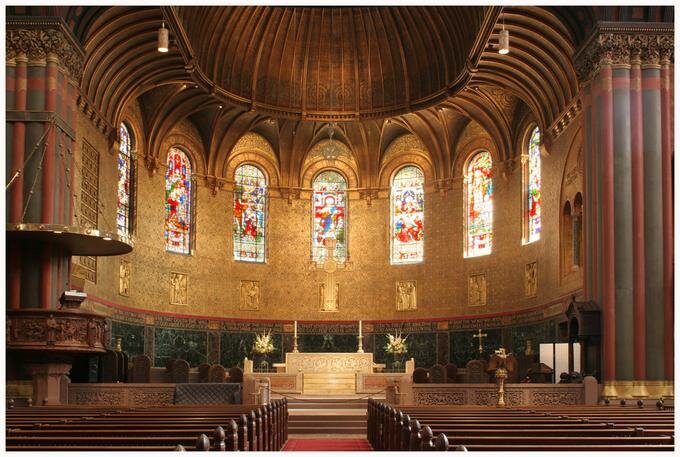
Let us pray for the victims and their families, and the people of Boston:
O GOD, merciful and compassionate, who art ever ready to hear the prayers of those who put their trust in thee; Graciously hearken to us who call upon thee, and grant us thy help in this our need; through Jesus Christ our Lord. Amen.
Jesus mercy. Mary pray.
Subscribe to:
Posts (Atom)
Comprovincial Newsletter for November 2026
The Comprovincial Newsletter of the Anglican Province of America for November 2026...

-
Pope Leo IX, Last of the Bishops of Rome in communion with the rest of Christendom. The Bishop of Rome is historically the first Bi...
-
 Following on the intriguing discussion at The Continuum , below is the carefully-researched essay by Father John Jay Hughes found in his 197...
-
 Being a Tractarian, ressourcement, patristically-minded, first millennial, conciliarist, philorthodox kind of Anglo-Catholic, I have always ...
