 The Right Reverend Brian Marsh, Presiding Bishop of the Anglican Church in America and Ordinary of the Diocese of the Northeast, made an address at the Congress of Continuing Anglicans in Victoria, British Columbia, Canada, 1st June. The text of this address is available at this link.
Sunday, June 26, 2011
Address of Bishop Marsh to Continuing Anglicans
The Right Reverend Brian Marsh, Presiding Bishop of the Anglican Church in America and Ordinary of the Diocese of the Northeast, made an address at the Congress of Continuing Anglicans in Victoria, British Columbia, Canada, 1st June. The text of this address is available at this link.


Sunday, June 19, 2011
Super Synod - from the Dunwoody Reporter
Anglican church leaders to gather in Dunwoody in July
Anglican clergy and leaders from across the country are scheduled gather in Dunwoody in July.About 150 delegates will take part in the gathering, called a synod, scheduled for July 11 through 15, said Bishop Chandler Jones of St. Barnabas Anglican Church in Dunwoody. During the synod, clergy and church leaders conduct church business.
“A synod is basically the ecclesiastical legislative body of the church,” Jones said, “but it’s also a family reunion. This is really an opportunity for people to come together.”
Most of those attending will come from the eastern United States. But Anglican clergy and lay delegates from as far as Arizona and California are expected to take part because the gathering will include representatives from the Diocese of the Eastern United States, the Diocese of Mid-America and the Diocese of the West, the three dioceses that cover the U.S., Jones said. A delegation from the Philippines also may attend, he said.
“Our meetings are really devoid of any controversy,” the bishop said. “We’re looking at strengthening our ties with Anglicans worldwide.”
The group will meet at the Holiday Inn, Perimeter and at St. Barnabas, Jones said.
The meeting will be held in Dunwoody, Jones said, because St. Barnabas is one of the larger Anglican congregations in the country. Also, Jones was installed as a bishop, the Anglican church’s youngest, last year.
St. Barnabas hosted a similar synod in 2001. One reason for the return this summer, Jones said, is that the church sanctuary and nave have been renovated since that 2001 meeting.
The Dunwoody congregation, founded in 1979, calls itself “a traditional Anglican Church” that bases its services on the1928 Book of Common Prayer. Anglicans split from the larger Episcopal Church in the 1970s because they believed the American version of the denomination had become too liberal and strayed too far from its original teachings, members say.
Friday, June 17, 2011
Consecration of the new Bishops of Richborough and Ebbsfleet
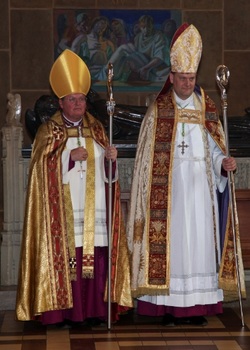 The Catholic Tradition of the Church of England lives on...
Congratulations and blessings to Bishop Norman Banks (left) and Bishop Jonathan Baker (right).
The Rt Revd Jonathan Baker and The Rt Revd Norman Banks were Ordained and Consecrated Bishop of Ebbsfleet and Bishop of Richborough respectively
by The Most Revd Rowan Williams, Archbishop of Canterbury and other Bishops
at Southwark Cathedral on 16th June 2011
Friday, June 10, 2011
Synod 2011

ALMIGHTY and everlasting God, who by thy Holy Spirit didst preside in the Council of the blessed Apostles, and hast promised, through thy Son Jesus Christ, to be with thy Church to the end of the world; We beseech thee to be with the Council of thy Church here assembled in thy Name and Presence. Save us from all error, ignorance, pride, and prejudice; and of thy great mercy vouchsafe, we beseech thee, so to direct, sanctify, and govern us in our work, by the mighty power of the Holy Ghost, that the comfortable Gospel of Christ may be truly preached, truly received, and truly followed, in all places, to the breaking down the kingdom of sin, Satan, and death; till at length the whole of thy dispersed sheep, being gathered into one fold, shall become partakers of everlasting life; through the merits and death of Jesus Christ our Saviour. Amen.
Saint Barnabas Church is wonderfully privileged and blessed to welcome the triennial Provincial Synod of the Anglican Province of America from Monday 11th July until Friday 15th July 2011. Additionally, the Diocesan Synods of the Eastern United States and Mid-America will also gather here concurrently in Dunwoody for their annual deliberations. It has been almost exactly ten years ago since Saint Barnabas last hosted our Diocesan Synod, and we are certainly honoured to be able to welcome the wider Church back to our parish and the metropolitan Atlanta area. Of your Christian charity, please pray earnestly for the impending Synods and for their ministry and work, as they seek to conduct the administrative business of the Church according to the mind of Christ and His Gospel and to advance the mission, governing, formation, preaching, teaching and evangelistic outreach of our unique branch of Christ’s Holy Catholic Church. We especially wish to thank our many volunteers who have made our sponsorship of the Synods possible; in particular, we thank the members of the Synod Planning Team: Rette Ledbetter, Al Duncan, Lynn Ledbetter, Barbara Shoaf, Elizabeth Raffa, Gordon Bigg, Cathey Eves, Oz Baptist, Ben Badejo, Bill Storey, DJ Fulton, Jack Wilson, Angie Patterson and Father Paul Rivard.
The word Synod, which term may be new or unfamiliar to many, is taken from the Greek word σύνοδος (sunodos) meaning ‘assembly’ or ‘meeting,’ and it is synonymous with the Latin word concilium, meaning ‘council.’ Synod literally means ‘to journey with’ or ‘the way together.’ No better description of the annual meeting of the Church’s authorised representatives, lay and clergy, could possibly be offered! Synod is not merely a business meeting, an ecclesiastical legislative body or a social event, although it is all of these things; it is the Church herself gathered, the Church at worship, in communion, in service and ministry, the Church in movement together. Synod powerfully and tangibly demonstrates the unity of the Body of Christ, the catholicity and universality of the Church, what is called in the Russian language sobornost, from the root word meaning ‘to gather,’ wholeness and inner completeness, wherein the many are brought together into free and organic unity by the power of love, a perceptible manifestation of the Holy and Undivided Trinity in Whom there is both unity and diversity in communion of love.
In short, Synod is the Church, one in heart, mind, and soul, on pilgrimage.
All of the Christian life is described in Apostolic Tradition as being a pilgrimage: we are on a pilgrimage through this mortal world to our true heavenly homeland. We are the Pilgrim People of God, the Church, making our way as God’s ecclesia, His ‘called-out ones’, through this world to the next. Everything we do, pray, say and think as Christians should orientate us towards the ultimate, final goal, the final reward and promise, which is eternal life in Our Lord Jesus Christ, in the heavenly Jerusalem.
If the vocation of the Christian in this life is pilgrimage, the wayfaring journey through this vale of tears to heaven, then the gathering of the Church in Synod, journeying together, should be seen as a microcosm of what the whole of the Christian life genuinely entails.
Pilgrimage is an essential part of life and living. Christians, filtering their existence through the data of the Holy Scriptures, see life itself in terms of a journey, coming from God and returning to God. In her earthly state, the Church needs places where her sacred society can gather together. Our visible churches, holy places, are images of the holy city, the heavenlyJerusalem, toward which we are making our way on pilgrimage. Ours is a daily pilgrimage in Word and Sacrament in the Church. Holy Mother Church is for us the Sign of the Kingdom and the Sacrament of our pilgrimage to Jesus Christ. He is the Mystery lived out at our Altars, Eucharistically, day by day. Synod is thus an intensification, a focus, of that Sign and Mystery which is Our Blessed Lord in His Church.
We encourage everyone at Saint Barnabas to take a decided interest in the meetings and events of Synod and to volunteer where possible to assist in the organisation of this intensely gratifying and important occasion in the life of our Church. Most critically, we invite everyone to enter into the spirit, significance and purpose of Synod by prayer. Thank you all so very much for your loving support and encouragement during this special time in our corporate life together.
God bless you!
Saturday, June 04, 2011
Twin Brothers and Friars

A very moving story indeed, all the more personal since my brother, a priest of the Roman Rite, and I are identical twins...
From the moment of their birth in Buffalo 92 years ago, twin brothers Julian and Adrian Riester rarely left each other's side.
They played together, went to school together, as young men traveled cross-country together -- and, in their 20s, joined the Franciscan order together.
And on Wednesday, after 65 years as identical twins wearing the identical brown robes of the Franciscans -- mostly at St. Bonaventure University -- Brother Julian Riester and Brother Adrian Riester died together at St. Anthony Hospital in St. Petersburg, Fla. Julian died Wednesday morning, followed by Adrian in the evening.
Those who knew the Riesters best say they are not surprised at all.
"If ever there is a confirmation that God favored them, this is it," said their cousin and close friend Michael Riester of Buffalo. "They weren't even separated for 12 hours."
The biological brothers were also religious brothers, committed to the monastic life of Franciscan friars, not as priests but in roles as physical laborers.
During two stints at St. Bonaventure, from 1951 to 1956 and from 1973 to 2009, "the twins" were a common sight strolling in lockstep across campus -- or, in later years after a few "incidents" resulted in loss of their driver's licenses, on identical bicycles wearing identical helmets.
They became known as accomplished artisans who expressed their talents as gardeners and woodworkers, turning out tables and cabinets from their workshop in the garage of St. Bonaventure's Franciscan Friary.
Yvonne Peace, former secretary to the university's Franciscan community, remembers them as handymen and "fixers" who repaired all sorts of items brought to them by many on campus.
"They were always busy," she said.
Brother Julian, whose given name was Jerome, and Brother Adrian, whose given name was Irving, were part of a family of seven children born to Dr. Julian Riester and his wife, Clara. Their father was a prominent obstetrician who as a medical student observed surgery on President William McKinley after he was fatally shot in Buffalo in 1901, according to Michael Riester, who is the historian of St. Louis Catholic Church.
The attended St. Joseph's Collegiate Institute in Buffalo (where they had a reputation for fooling teachers by their identical looks) and then a radio technology school in Los Angeles before applying to the Franciscans' Holy Name Province.
Toward the end of World War II, after mutually pledging to reply to whichever came first -- an acceptance from the Franciscans or an expected induction notice from the Army -- the morning mail brought an invitation to join the friars, and the afternoon mail "greetings" from the draft board.
God's call, they told interviewers in later years, took priority.
They were separated only twice, once from 1946 to 1951 when Brother Adrian was a sacristan at St. Francis of Assisi Church in Manhattan and Brother Julian was general manager of St. Anthony Shrine in Boston. Later they were not far apart in the 1950s when Brother Julian was assigned to St. Patrick's Parish in Buffalo and Brother Adrian to Bishop Timon High School in South Buffalo. But from 1956 on, the Riester brothers were together.
Michael Riester remembers them as family men who used the money given them by friends to travel to Buffalo on their day off to take their mother -- who lived to 103 -- to dinner at fine restaurants such as Salvatore's Italian Gardens or Romanello's. "They liked a good time," he said.
Indeed, in 2003 Brother Julian told the Bona Venture, the university's student newspaper, that they confounded the friars' seniority system by often claiming they "walked in the door together" and by never divulging which twin was born first.
"We don't tell," Brother Adrian told the newspaper. "We like to keep them guessing."
Michael Riester said his cousins will be remembered as "exemplary men and holy men," who lived their lives in a truly Franciscan spirit. When word came earlier this week that both were seriously ill in the Franciscans' retirement home in St. Petersburg, where they had lived for the last two years, Michael Riester and many in the St. Bonaventure community said they almost expected that the pair would leave together.
Now they will be buried together Monday in Olean.
"They had this intimate bond, in which neither was selfish at all," Michael Riester said. "And because they were so in tune to God and to each other, it's not surprising at all."
Tuesday, May 31, 2011
Sunday, May 22, 2011
From the Daily Report
CHURCH BATTLES OVER PROPERTY
A split Savannah congregation has high court weighing which side should own historic site
By Alyson M. Palmer, Staff Reporter
Thorny theological differences that have divided a historic Savannah church gave way to secular legal arguments before the Georgia Supreme Court on Monday as the justices weighed which side of the split should control property that has been in the church's name since 1733.
The dispute, which has drawn competing amicus briefs from a spectrum of Christian denominations, stems from a decision by the majority of Savannah's Christ Church to leave the national Episcopal Church in 2007.
The departure followed similar moves in other Episcopal congregations since 2003, when the national church made a gay man a bishop.
In Savannah, Christ Church's reverend, also known as the rector, informed the bishop in charge of Episcopal churches in Georgia that the breakaway church had placed itself under the authority of the more conservative Anglican Province of Uganda. Rector Marc Robertson has said in press releases the dispute is about the "freedom to choose to follow the Jesus of Holy Scripture and not a culturally-manufactured Jesus."
The national Episcopal Church released the rector from his duties and appointed a new priest to minister to the remaining congregants who had elected to remain loyal Episcopalians. And the national church would not let go of the considerable earthly possessions amassed by the parish over the past 278 years.
Along with the Georgia diocese and the Christ Church members who stayed, the national church filed suit. They asserted ownership over the land on which Christ Church parishioners have worshipped for centuries, as well as the congregation's endowment and other real estate. The national church argues that the local congregation has held title to the property in trust for the mission of the greater church.
The breakaway church members, who have been allowed to remain in the historic church building during the course of the litigation while the minority members of Christ Church have been meeting in borrowed church space elsewhere in Savannah, argue that they could not have been holding the property in trust for the larger church because Christ Church predates the existence of a national Episcopal church.
Christ Church, whose early leaders included colonial religious figures John Wesley and George Whitefield, was granted the land on which the church building now sits by the English king and didn't become affiliated with the national Episcopal Church until 1823.
But the breakaway congregation has lost its legal fight, both before Judge Michael L. Karpf of the Chatham County Superior Court and a panel of the state Court of Appeals. The state Supreme Court in January agreed to take a look at the case, over the dissents of Justices Robert Benham and Hugh P. Thompson.
Besides garnering national media attention, the case has drawn numerous amicus briefs, signaling that the importance of the case goes beyond resolving a local congregation's squabble. The Becket Fund for Religious Liberty, the Presbyterian Lay Committee and the American Anglican Council have filed briefs backing the breakaway church. The African Methodist Episcopal Church, the Greek Orthodox Church, the United Methodist Church and the Church of God have filed briefs supportive of the national Episcopal Church.
Courts have been cleared to handle church property disputes since a landmark 1979 decision by the U.S. Supreme Court. In that case, which was from Georgia, the nation's highest court said the First Amendment does not bar secular courts from resolving church property disputes, as long as the courts apply "neutral principles of law."
The Georgia Supreme Court has signed off on disciplinary rules of the Holiness Baptist Association and the United Methodist Church that imposed trusts on local church property for the benefit of the greater denomination.
The bench was fairly quiet at Monday's argument. Most of the court's remarks and questions came from Justice David E. Nahmias, who seemed more receptive to the arguments of the national church, and Bibb County Superior Court Judge S. Phillip Brown, who sounded inclined to vote in favor of the breakaway congregation. Brown was sitting in for Presiding Justice George H. Carley, who recused from the case for reasons not announced by the court. (Carley's official court biography says he is a member of St. Barnabas Anglican Church in Dunwoody.)
Appearing for the breakaway church, Savannah lawyer Paul W. Painter Jr. argued that the state Court of Appeals had applied too broadly a state statute, O.C.G.A. § 14-5-46. The law says that "[a]ll deeds of conveyance" for "any lots of land" for the purposes of building a church or meeting house shall be valid for the purposes contained in the deeds.
Painter said the statute was merely a "deed validation statute," one that "does not cover what the Court of Appeals was recognizing."
"It does not cover any and all property a church may hold," he added.
Brown, the visiting judge from Macon, said the meaning of the statute was clear: Church property must be used for the purposes set forth in a deed, not a church canon promulgated in New York (an apparent reference to the site of the Episcopal Church's headquarters).
"I'm just wondering why you're fighting this statute," he told Painter.
"Your honor's points are excellent points," Painter responded, explaining the statute was simply the only way the national church could win the case.
The national church also has relied on a 1979 church canon, known as the Dennis Canon, that purports to place parish property in trust for the national church and local diocese. Painter argued Monday that, if such a stipulation is not in a deed, it must be in the denomination's constitution or the next closest thing.
But Nahmias questioned that argument, noting that at various points in Christ Church's history it had formally acceded to not only the larger church's constitution, but also its canons. "Why do we say constitutions matter and canons don't, when you accede to both?" asked Nahmias, whose campaign biography says he's a member of Holy Innocents' Episcopal Church in Atlanta.
Episcopal Church rules require giving congregations three years to consider a constitutional change, Painter replied, while the record is clear that neither individual churches or dioceses were given advance notice that the Dennis Canon would be on the 1979 meeting's agenda.
Nahmias questioned how a secular court could require certain church procedures without violating the rule that it must apply neutral legal principles.
Brown helped Painter out on that one. "Bylaws come and go with board meetings," said Brown. "Constitutions have more stability to them."
Appearing for the national church, Valdosta attorney James L. Elliott argued that O.C.G.A. § 14-5-46 was meant to apply to any written document conveying property and did not apply to worship space alone. Elliott insisted that the court could look at church documents to back up the national church's stance, if the statute doesn't apply.
Nahmias asked Elliott why his side was trying to "squeeze" this case into the statute.
When Elliott responded that the interpretation of the statute was the question posed by the court in agreeing to hear the case, Nahmias turned to his colleagues on the bench, grinned and shrugged, garnering laughter from the galley.
Elliott presented the national church's argument along with Mary E. Kostel, a Washington-based in-house lawyer for the Episcopal Church. She noted that the dispute was not simply a local-versus-national-church dispute, arguing that the Christ Church members who have elected to stay as Episcopalians deserve access to their property.
Kostel argued that, when Christ Church joined the Georgia diocese in 1823, Christ Church relinquished its separate congregational identity.
When Brown noted that the Dennis Canon didn't exist then, Kostel said that the tradition of the local church holding property in trust for the larger church, while codified by the church over time, dates back to the Church of England.
"The building stays within the larger church," she said.
The case is Rector, Wardens and Vestrymen of Christ Church in Savannah v. Bishop in the Episcopal Diocese of Georgia, No. S10G1909.
Tuesday, May 17, 2011
The Decalogue, or Ten Commandments
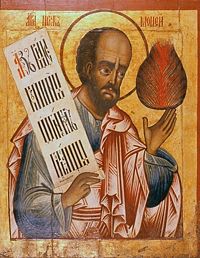
Why does the Anglican Rite include the Decalogue, or Ten Commandments, at the beginning of the Eucharistic Liturgy?
A brief history: In 1552, the Ten Commandments were introduced in a litany form with the expanded Kyrie response, which text replaced the ancient ninefold Kyrie eleison of the Latin Rite. Archbishop Thomas Cranmer sought by doing so, practically, to settle objections from some reformers that the 1549 First English Prayer Book Mass too closely resembled the old Roman Rite Mass. He rearranged the Eucharistic liturgy and introduced a corporate preparatory penitential act of examination of conscience at the very beginning of the liturgy (not unlike the 1970 Roman Novus Ordo Missae). He retained the Kyrie as being penitential in character, as he also desired to include in the Mass those three things which Christians 'ought to know and believe to their souls' health': the Ten Commandments, the Creed and the Lord's Prayer. The use of the Decalogue at the beginning of the Eucharistic liturgy began with some of the early Lutheran liturgies on the continent. Archbishop Cranmer, in this, as in so many other instances, simply borrowed this practice from the Lutherans. The tropes found in our liturgy, 'incline our hearts to keep this law' and 'write all these thy laws in our hearts, we beseech thee' were based on medieval custom and tradition, in which additional petitions were frequently added to the Kyrie eleison for different feasts and occasions: the ancient Sarum Use in England was filled with such liturgical embellishments. And so the precedent was set for the Anglican liturgy from henceforth.
Theological purpose: The Commandments are included to confront us immediately with the fundamental truth that God demands our entire obedience to His holy and righteous will, in love, adoration, and service of Him for His own sake as Lord of all, and in love of our neighbour for the love of God. Submission to the Law of God, in Christ by the Holy Ghost, is the necessary condition for the fulfilment of our true selves as children of God made in His Image and Likeness. Our continual breaking of the Law severs that communion with God and our neighbour for which we were created, redeemed and sanctified. We beg God to enter us, therefore, into that one and only obedience and sacrifice by which we alone are enabled truly and rightly to keep the Commandments, the perfect filial love and obedience of Jesus Christ, whose perfect love of the Father is the fulfilment and completion of the Law. We plead the merits and sacrifice of Our Lord, through whom we now can and must obey God's holy will. No communion with God or our neighbour is possible until we are prepared and ready to accept God's demand placed upon us and to acknowledge and confess our sin, to ask for God's mercy and to beg His grace to incline our hearts to keep His Commandments.
The rite of the Holy Eucharist is a rehearsal for judgement day, and a vivid presentation of the entire history of salvation: the Mass recaptures for us and liturgically expresses the drama and economy of redemption. In the beginning, Original Sin occurred when man disobeyed God by transgressing His will; so too now, we are personally and corporately guilty of disobeying God and transgressing His Commandments - and therefore we acknowledge at the beginning of the Liturgy that we have all sinned and fallen short of the glory of God, pleading for God's mercy and forgiveness, and for His grace to live holier and better lives. We have been given the Law of God, and we have not kept it - our confession of this fact at the beginning of the Mass places us in the right spiritual disposition to worship the Blessed Trinity and to receive the gift of the Blessed Sacrament, the true Body and Blood of Christ, for the forgiveness of sins and eternal life. At the outset, we admit our sins and failings, recognising with Saint Paul that the Law of God is a 'schoolmaster that brings us to Christ so that we may be justified by faith' (Galatians 3.24). The Law shows us that we are all sinners in need of a Saviour and Redeemer. The Law cannot of itself save - its purpose is to reveal to us our sinful nature and demonstrate that we must receive remission of sins from Jesus Christ as grace and gift. Only through Christ's Atonement and only by our incorporation into Christ's Body can we love and obey God in Christ by the power of His Spirit. The Ten Commandments instantly point us to Christ - and thus we say 'Lord, have mercy upon us.' The whole Liturgy of the Eucharist sacramentally applies the Person and Work of Jesus Christ to us.
The human race fell into sin, was judged worthy of death, was sent the Law and the Prophets to call us back to God (Collect for Purity, Ten Commandments, Summary of the Law, Kyrie eleison) , was readied and prepared for the coming of the Messiah (Collect, Epistle), and in the fullness of time was redeemed by Jesus Christ, the Incarnate Lord, true God and true Man, who freely offered Himself for our salvation through His atoning death on the Cross and His Resurrection and Glorification (Gospel, Creed, Prayer of Consecration, Agnus Dei, Thanksgiving), and who now freely gives Himself for salvation in the Blessed Sacrament (Holy Communion) to those who truly repent and believe the Gospel (Confession, Absolution, Comfortable Words). By reliving and re-experiencing this Mystery day in and day out under a veil, in a Sacrament, we prepare for our death and the judgement, wherein we shall plead the mercy of Jesus Christ at the Last Day and inherit the promise of the heavenly Kingdom. And all of this is contained in the traditional Anglican Holy Communion service!
Missal Moment III
Courtesy once again of my sacerdotal and biological brother, Father Brandon Jones, and the RC Diocese of Charlotte, North Carolina: this video discusses the Ecce Agnus Dei, the traditional form of which is also found in the Anglican Rite. Another restoration back to the Anglican translation!
Saturday, May 14, 2011
The 21st May 'Rapture' from the Atlanta Journal-Constitution

That’s when, according to some predictions, Jesus will return.
Last year, WeCanKnow .com, a Christian-based website in North Carolina, selected metro Atlanta as the site for dozens of billboards proclaiming Christ’s imminent return and the Rapture of Christian believers. In Nashville, similar billboards were paid for by Harold Camping, a Christian author and radio broadcaster in California, who is pushing the idea that May 21 is the date. He mistakenly predicted the same series of events in 1994. He bases that date on an analysis of Scripture.
With so many people skeptical about the date for various reasons, what’s behind the choice of May 21?
Tom Evans, media representative for Family Stations Inc., of which Camping is president and general manager, said, “All the signs that Jesus warned of in the Bible that would precede his return have taken place, and are evident in our world. For example, the re-establishment of the nation of Israel; the complete decay of the church; the dismal state of our world; and the moral breakdown of all of society.”
The belief holds that not only will the Rapture occur next Saturday, but the end of the world will occur on Oct. 21.
Bishop Chandler Jones, however, won’t be holding his breath. Instead, the rector at St. Barnabas Anglican Church in Dunwoody will be performing a wedding May 21 “that will go on exactly as planned.”
“I think it’s very presumptuous to try to predict the time and hour of Jesus’ return because our Lord says in the Gospel that even the Son does not know the hour of his return,” he said.
Jones said he thinks some people may buy into that theory, though, because of the recent number of natural disasters around the world, including earthquakes, tsunamis and floods, and the “anxiety of our times,” including the economy, politics and society....
Friday, May 13, 2011
Our Wedding Anniversary - 13th May 2000
Today, eleven years ago, Megan and I were married on the
Feast of Our Lady of the Blessed Sacrament. The Lord has blessed us wonderfully!
+++
The Prayer Book's service for Holy Matrimony preaches the most effective sermon possible on the subject. God and Jesus and St. Paul all agree, for various reasons, that Christian marriage is a good thing. As a result, following the Prayer Book, each member of the couple makes promises to God and to each other which concern his moral will.
They are promises he cannot possibly keep on his own. So by blessing the marriage God says, "As long as you have the will to keep these promises, I will give you the grace and the help you need to do it."
Today's wedding points out a custom which the Church of England and her lineal descendents share which is unlike the custom of any other Catholic church on earth. That is the custom that her clergy may marry. In the Roman Communion priests are not to marry, but married men can in some cases serve as priests. In Eastern Orthodoxy a married man may be ordained priest, but no priest may get married.
Our church's rule is that, since Holy Scripture in no way forbids it, the clergy are permitted to apply to themselves the same standards which St. Paul lays out for all Christians in his First Epistle to the Corinthians. St. Paul says some people are called to be married, and some people are called not to be married. Each state of life is a gift which carries its own advantages and disadvantages.
God doesn't think that either of the states is superior to the other. He leaves it to you and the Holy Ghost to figure out which gift you have and then act accordingly.
Father Chad stood before me when I made him a deacon and ordained him a priest, and he promised that his home and his family would be wholesome examples and patterns to the flock of Christ. Today he and Megan are taking a momentous new step in that direction.
Article of Religion XXXII, titled "Of the Marriage of Priests," says that it is lawful for the clergy as it is "for all other Christian men, to marry at their own discretion, as they shall judge the same to serve better to godliness."
Let us pray that the marriage begun here today will indeed serve Megan and Father Chad better to their own personal godliness, and that it will always stand as a wholesome example and pattern to us.
-The Most Reverend John Thayer Cahoon, Junior


Thursday, May 12, 2011
Confusion in Canada: An Ordinariate Crisis?

From VirtueOnline.
From the Catholic Herald.
From the Continuum.
Let us all pray for the Anglican Catholics of the great nation of Canada.
Monday, May 09, 2011
The Comforter
 Who is the Comforter, the Spirit of Truth?
On the eve of His passion and death, on the first Maundy Thursday, Our Lord Jesus Christ instructs His Apostles about the Holy Ghost, and He does this to comfort them in their sorrow. Our Lord has announced that He is to leave them; to reassure them and give them hope, He tells them that it is good for Him to be departing, for only by His death and resurrection, only by His glorification, can the Holy Spirit come to the Church. The Holy Ghost’s coming, the gift of the Spirit, is the completion of Our Lord’s mission: Jesus Christ comes in order to communicate the Holy Ghost to His Body, risen, glorified, mystical, corporate.
We await the coming of the Holy Ghost liturgically as we approach the mysteries of Christ’s Ascension into Heaven and the outpouring of the same Spirit at Pentecost, or Whitsunday. The Holy Ghost, according to Christ, is not a replacement for Jesus, not an ‘extra frill’ for the Christian. Our Lord’s entire Incarnation and Sacrifice is provided so that we may receive the Holy Ghost. The Holy Ghost makes Christ within us. He reproduces the life of Jesus the Head in the members of His Body. He makes us one with God.
The Comforter, or the Paraclete in Greek, means ‘Strengthener,’ ‘Helper,’ ‘Advocate,’ ‘Guide,’ ‘Witness,’ ‘Counsellor,’ ‘Defender,’ ‘Pleader.’
The Holy Ghost has often been called the ‘neglected Person of the Trinity.’ He seems sometimes ignored, because He does not appear as concrete to us as the Jesus of the Gospels. ‘The wind bloweth where it listeth, and thou hearest the sound thereof, but canst not tell whence it cometh, and whither it goeth: so is every one that is born of the Spirit’ (Saint John 3.8). And yet, He is just as real and just as divine and alive. He is the Conglorified One, the One who proceeds from the Father through the Son, and is worshipped with the Father and the Son. The Holy Ghost is God. ‘We know the Holy Ghost is God, because only God can make man partake of the divine nature, and that is what the Holy Ghost does for man,’ says Saint Basil the Great. In other words, the Holy Ghost, the Third Person of the Godhead, makes man godlike, thus proving His own divinity. Jesus teaches His disciples that the mission of the Holy Ghost is to reveal the Father and to glorify the Son. And the Holy Ghost has a mission towards us: to make us the Likeness of God, the children of God, God’s Saints!
We believe in the Indefectibility of the Church. Our Lord’s promise of the Holy Ghost to His Body, the Church, is given so as to preserve her from error and keep her always in the truth. The Church is the Home of the Holy Ghost, the permanent abode of the Spirit of God. The Church is the unique sphere in which the Holy Ghost now lives, works and sanctifies. ‘Where there is the Church there is the Spirit, and where the Spirit is, there is the Church and all grace,’ proclaims Saint Irenaeus of Lyons (AD 150), Bishop of Lyons, France, one of the most eminent of the earliest apologists for orthodox Christianity. Jesus Christ promised the Holy Ghost to the Church, to be hers forever, the Source of union with the Father and the Son.
The Holy Spirit comes with a two-fold purpose. First, He will judge the world, convicting the world of its sin. He shows us the truth about sin - that sin consists of the rejection of Jesus Christ as God and Saviour – and about righteousness - which is demonstrated by Christ’s Resurrection and Ascension into glory - and judgement - for Christ the King has destroyed the power of the devil. The Holy Spirit is the Spirit of Truth.
Second, the Holy Spirit is the Teacher of the Church. He does not teach a new revelation of a new truth, but deepens and extends the Church’s understanding of the Faith once delivered unto the Saints (Saint Jude 3). The Holy Comforter, our Teacher, shows us the import of the ‘things to come’ of Christ’s death and glorification, and of the end of the world, death and judgement day. Christ shows Himself through His Spirit.
We can be certain, therefore, when the Holy Catholic Church of the Creeds, to which we as Anglicans belong, teaches a doctrine through her unbroken two-thousand year continuous Tradition, tradition with a capital T, that doctrine is absolutely, positively true. The Church’s very existence and teaching authority rest in the existence and teaching authority of the Holy Ghost. The Spirit guarantees that our Faith is that found in all places, in all times, faithful to the Apostles and Fathers, and acknowledged by the consent of the whole Church. The Scriptures and Creeds hold a stamp of divine approval and dependability. We have Our Lord Jesus Christ’s Word, Himself the Word of God, on it - literally.
Our Blessed Lord did not leave us without guidance or direction for the application and practice of the Christian Faith. His most precious gift to us, the Holy Ghost who bears revelation, commends to us the Faith by which we are saved and come to God, which Faith is perpetually ensured and offered to us. We can be assured that Christ lives and saves through His Body, the Church, into which we have been wonderfully incorporated. This Body, the Church, is the Spirit-possessed Body of Christ; in this Body, the Holy Ghost lives, moves and now has His being. The Holy Ghost is the Soul of the Church. The Holy Ghost is Christ’s divine authentication that the One, Holy, Catholic and Apostolic Church will be faithful to what Christ is and has taught, not by her own merits and power, but by the promise of Christ and the power of Him Who is the Spirit of Truth. Bishops, who succeed the Apostles and inherit the fullness of the priesthood and the Apostolic Ministry, possess as a collective body, an episcopal college, this Comforter who was first given to the Apostles, the Charism of truth, that they may faithfully teach and defend the Catholic, or universal Faith.
‘Holy Scripture is interpreted, fulfilled and completed by Holy Tradition.’ ‘Holy Tradition is the Life of the Holy Ghost in the Church’ (Saint Basil the Great). The Church trusts utterly in the omnipotent promise of Jesus Christ and in the Person and Work of the Holy Ghost. The Spirit takes all those things which belong to the Eternal Son, which are in turn the Father’s, and makes them known to us, to the Church. Our faith calls this divine teaching and preservation indefectibility, safety from error and false doctrine.
The Holy Ghost comes to each of us personally. Christ redeems our nature. By His Incarnation, the Eternal Word has assumed all that makes us human and has raised it to God. God has put on our flesh and made it divine. Now, the Holy Ghost comes to our persons, individually, through the divinised humanity of Jesus we share, to fill us with God’s very Life and to make us godlike, so that we may participate in the Communion of the Holy Trinity and partake of the divine nature. The Church and Sacraments are the covenanted means of grace by which we are given the Comforter, the Spirit of Truth.
The Holy Ghost is Jesus’ Gift to us, to make us holy. Our Holy Baptism causes us to become one Body by one Spirit and to ‘drink of one Spirit’ (I Corinthians 12.13). By Baptism we receive the Holy Ghost for the remission of sins (Acts 2.38). Our Holy Confirmation serves as our own ‘personal Pentecost.’ Confirmation is the single moment in our lives when the Holy Spirit enters into us in His fullness, in a new and profound way, and seals us with His own Presence. It is the Sacrament by which the strengthening Sevenfold Gift of the Comforter is given to us by the imposition of Apostolic hands (Acts 8.14-25). The Holy Ghost is Christ’s Sacramental Gift to us, by Whom we become the Temple and dwelling-place of God.
The Holy Ghost is our Sanctifier and our Teacher. Let us forever adore Him our God, with the Father and the Son, and with ceaseless gratitude celebrate the coming Pentecost solemnity. ‘Come Holy Ghost, our souls inspire, and lighten with celestial fire...’
Friday, May 06, 2011
On Predestination
Anglicans, like all biblical Christians, believe in predestination, which doctrine is clearly taught in the Old and New Testaments, and especially by Saint Paul, but we hold the positive doctrine of election to salvation in tension with the rest of the Catholic Faith, in which predestination is considered an aspect of salvation provided by Christ freely to all men in His Word and Sacraments. Like Saint Augustine of Hippo, we must not divorce the Church's doctrine of grace, salvation and election from the Church's doctrine of the objective grace communicated by the Church and her Sacramental System. For orthodox Catholics, the promise of election to salvation is conferred in Holy Baptism: we are elected to salvation and remain in such a state of election insofar as we are baptised and persevere in the grace and state of our Baptism. Our election or predestination to life, affirmed in Article of Religion XVII, is inseparably tied and linked to our union with Jesus Christ our Head in His Mystical Body, the Church, through the regenerative grace of Baptism. We are personally elect to salvation because we are incorporated into Christ by Baptism and made living members of the elect, prophetic, priestly, royal Body of Christ, the People of God, the Temple of the Spirit, the Ark of Salvation, the Church.
Which sometime were disobedient, when once the longsuffering of God waited in the days of Noah, while the ark was a preparing, wherein few, that is, eight souls were saved by water. The like figure whereunto even baptism doth also now save us (not the putting away of the filth of the flesh, but the answer of a good conscience toward God,) by the resurrection of Jesus Christ: Who is gone into heaven, and is on the right hand of God; angels and authorities and powers being made subject unto him (I Saint Peter 3.20-22).
This doctrine is clearly taught in the Baptismal Office of the English Book of Common Prayer:
We beseech thee, for thine infinite mercies, that thou wilt mercifully look upon this Child; wash him and sanctify him with the Holy Ghost; that he, being delivered from thy wrath, may be received into the ark of Christ's Church; and being stedfast in faith, joyful through hope, and rooted in charity, may so pass the waves of this troublesome world, that finally he may come to the land of everlasting life;
Sanctify this Water to the mystical washing away of sin; and grant that this Child, now to be baptized therein, may receive the fulness of thy grace, and ever remain in the number of thy faithful and elect children;
I learn to believe in God the Father, who hath made me, and all the world. Secondly, in God the Son, who hath redeemed me, and all mankind. Thirdly, in God the Holy Ghost, who sanctifieth me, and all the elect people of God.
And the American Prayer Book Catechism teaches:
And I heartily thank our heavenly Father, that he hath called me to this state of salvation, through Jesus Christ our Saviour. And I pray unto God to give me his grace, that I may continue in the same unto my life's end.
Predestination to life, or election, is based on God's dealing with His chosen people through Covenant, both in the Old Law and in the New Dispensation. In the Epistle to the Romans, Saint Paul describes the election of the Old Covenant people, in which God consecrated to Himself a chosen people, in which body salvation was promised and through which God was glorified and manifested Himself to the world: that reality of communion and corporate life in God, foreshadowed in the Old Law, is fulfilled and completed in the New Testament through the Church, which Body is elect to salvation and through which the proclamation of the Gospel is achieved. Election is covenantal, ecclesial and sacramental. All that God established for and promised to Israel of old is now perfected and fulfilled in the Holy Catholic Church. The Church is Israel complete and accomplished in her fulness; she is the true and spiritual Israel, a holy nation, a peculiar people, a royal priesthood. And as many as walk according to this rule, peace be on them, and mercy, and upon the Israel of God (Galatians 6.16). We are elect insofar as we are elect members of Christ is His covenantal, baptismal Body:
But ye are washed, but ye are sanctified, but ye are justified in the name of the Lord Jesus, and by the Spirit of our God (I Corinthians 6.11).
For whom he did foreknow, he also did predestinate to be conformed to the image of his Son, that he might be the firstborn among many brethren. Moreover whom he did predestinate, them he also called: and whom he called, them he also justified: and whom he justified, them he also glorified (Romans 8.29-30).
Our common salvation then depends on our continuing in the state of grace conferred upon us by the Church, wherein we are corporately adopted as the sons of God by grace and adoption in the Holy Ghost. In the grace of Baptism and the Sacramental System, we become by grace what God is by nature; we receive divine sonship; we become 'sons in the Son' and 'partakers of the divine nature.' Such is the basis of the catholic, and biblical, doctrine of predestination. We can refuse and lose our election if we reject the grace of our Baptism and lapse into mortal sin. Called to salvation, even the elect members of Christ, members of the Church, can exercise their free will and repudiate the gift. God saves no one by force, and the mystery of free will is preserved in election. We are called to 'make our election sure' (II St Peter 1.10) by 'walking in the good works prepared beforehand by God' (Ephesians 2.10)
Conversely and negatively, the Church has always rejected 'double predestination,' or the idea that men are reprobated to eternal punishment apart from their exercise of free will, by an eternal decree of God that does not take into account man's actual use or rejection of divine grace. The Second Council of Orange and the subsequent theological reflection of the Church through the course of centuries have definitely excluded from the Church's Faith the heretical notion that God would condemn men to Hell without any consideration of their actual moral state. The judgement of the Church in this respect certainly 'reprobates' the excesses of the Calvinist theological method and system. 'God desires all men to be saved and to come to the knowledge of the truth,' ( I Timothy 2.4) yet 'many are called but few chosen' (Saint Matthew 22.14) because many reject the call and do not accept the free gift of salvation.
As one commentator has described it: 'through God's grace of eternal salvation being offered as a gift through His Son, we can choose to select eternal salvation by exercising our free will or we can choose to reject the gift of grace and select eternal damnation through exercise of our free will.' That is the historic position of all those Communions which comprise the Undivided Church, the Great Church Catholic of the ages. We share this view in all essentials with the Eastern Orthodox Churches and the Latin Church. The Lord Christ has a universally salvific will for all men; He desires and wills that all men might be saved, and the objective Atonement was offered by Christ for the remission of sins of all men who have ever lived or ever will live - but only those who subjectively receive the free gift of grace won by Christ's Incarnation and Atonement will inherit eternal life. Tragically, some men will reject God's grace, and His holy will and commandments, and choose not to be saved, although the offer is available to all. For the cause, when Our Lord instituted the Holy Eucharist, he said, 'For this is My Blood of the New Testament, which is shed for you and for many.' Many will ultimately receive the gift of eternal life in the New Testament of His Blood, but not all - for some will choose not to receive it. So the ancient Faith is neither universalist nor double predestinarian; it recognises that the Image of God in man is freedom, and that man is free to cooperate and correspond with grace, empowered and aided to do so by grace itself, of course, or is free intentionally and persistently to reject grace, which act leads to spiritual death. God's sovereignty and human free-will co-exist in a paradox, in holy mystery.
Subscribe to:
Posts (Atom)
Comprovincial Newsletter for November 2026
The Comprovincial Newsletter of the Anglican Province of America for November 2026...

-
Pope Leo IX, Last of the Bishops of Rome in communion with the rest of Christendom. The Bishop of Rome is historically the first Bi...
-
 Following on the intriguing discussion at The Continuum , below is the carefully-researched essay by Father John Jay Hughes found in his 197...
-
 Being a Tractarian, ressourcement, patristically-minded, first millennial, conciliarist, philorthodox kind of Anglo-Catholic, I have always ...

