Wednesday, September 25, 2013

First Irish and South Indian Bishopesses

The Church of South India appointed its first bishopess on 25th September 2013.

The Church of Ireland appointed its first bishopess on 19th September 2013.

And the Church in Wales introduced legal provision for bishopesses on 12th September 2013.

As I have written previously...

The male character of Holy Orders is of divine institution, will and revelation, given by God as a gift to His Church and central to the Gospel of Our Lord Jesus Christ as transmitted in Word and Sacrament. With the legal creation of bishopesses for these ecclesial bodies, their Apostolic Succession is now cast under an irreversible cloud of doubt and uncertainty. Where sacraments are uncertain or possibly invalid, orthodox moral theology always demands that the Church take the safest and surest course, which is the refusal to recognise such dubious sacraments as valid or efficacious. Otherwise sacrilege might occur, or yet, the deprivation of sacramental grace for the faithful. Women who will soon receive the rite of episcopal consecration will be the fontes sacramentorum, the fount and origin of the sacramental life, within their future respective dioceses. Future episcopal consecrations held within these bodies will likely be conferred with at least the co-consecrating participation of those whose priestly and episcopal orders the Holy Catholic Church has never recognised and cannot and will not recognise as sacramentally valid. No Bishop, no Priesthood, no Eucharist, no Church. The Apostolic Succession of once-Catholic Churches is now in unmistakable jeopardy. The problem is strictly sacramentological, quite distinct from the personal beliefs and views of those women yet to be consecrated. They could be perfectly orthodox, biblical, in their moral and doctrinal teaching; the problem of their orders or lack thereof still exists. By virtue of these decisions, the bodies in question will slowly and inescapably introduce over time a plainly suspect sacramental system into every diocese and province concerned.


Ironically, it appears that Apostolicae Curae of Pope Leo XIII (1896) will apply 
in these bodies in future, not specifically because of a defect of form or a defect of intention, but because of a clear defect of minister. Pope Leo claimed the Anglican Succession died with Archbishop Matthew Parker in 1559 - that judgement was patently erroneous, from every conceivably objective theological examination. But now, tragically enough, a scenario described by Leo, the termination of Succession, will be set to happen in these ecclesial groups. This is a theological consideration, not a social, cultural or political one. Sacramental assurance, the very assurance of grace and supernatural life for which Our Blessed Lord Jesus Christ instituted the sacraments, will evaporate from whole dioceses and provinces, because the chief minister of the sacraments in the local church, the Diocesan Bishop, could be one whose status casts doubt on the validity of subsequent sacramental actions in her diocese. A break in the Succession will occur in years to come once male bishops consecrated by women attempt to pass on their ministerial line and orders to others. Male presbyters and deacons ordained by women do not possess orders recognised by the historic Church. The end result of these innovations will be the cessation of an undoubtedly valid sacramental structure. The Sacrament of Holy Orders as understood by the Church Catholic would then no longer subsist in these bodies. The realities of mutual reciprocity, interchangeability and recognition of ministry, and of communicatio in sacris, were long ago shattered in the Lambeth Communion.

Tuesday, September 24, 2013

Institution of the Very Reverend William H. Perkins Junior

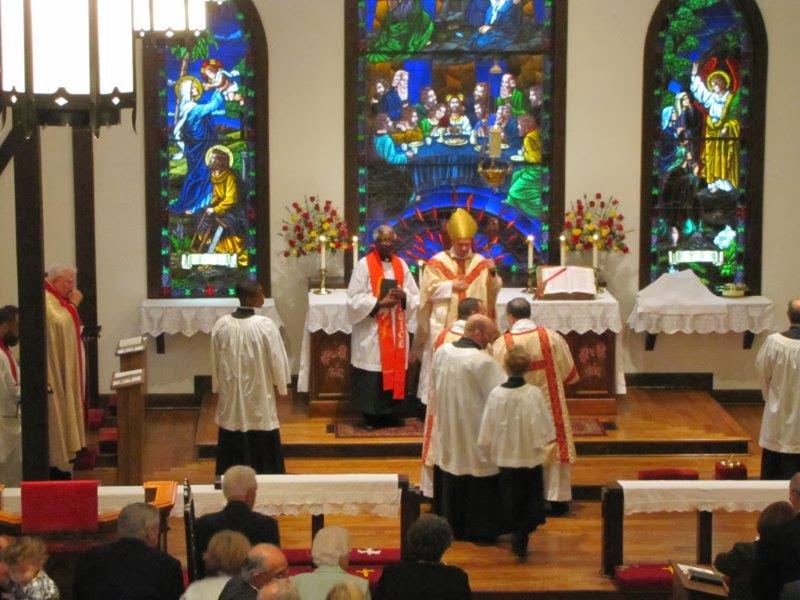
On Sunday 8th September 2013, the Very Reverend William H. Perkins, Junior was instituted by the Most Reverend Walter H. Grundorf as the fourth Rector of Saint Mary the Virgin Church in Delray Beach, Florida.


Groundbreaking for New Building at Christ the Redeemer Church, Warner Robins, Georgia

Congratulations to the Church of Christ the Redeemer, 
and her Rector, the Reverend Father Paul Gerlock - 
Sunday 22nd September 2013!


Saturday, September 07, 2013

Let us pray for the peace of Syria...


 Sanctus Ephraem populi tui Syrus, ora pro nobis advocatus.


ALMIGHTY God, our heavenly Father, guide, we beseech thee, the Nations of the world into the way of justice and truth, and establish among them that peace which is the fruit of righteousness, that they may become the Kingdom of our Lord and Saviour Jesus Christ. Amen.

Friday, September 06, 2013

American Anglicans increasing aid to Syrian refugees as airstrikes near

While President Barack Obama weighs punitive airstrikes and increased military action against Syria, American Anglicans are increasing their humanitarian aid to the huge flow of Syrian refugees that have already fled to nearby countries.
White House spokespersons said today that it is no longer a question of whether the US would lead European allies in an attack on the regime of Bashar al-Assad, but only a matter of "where or when" it would occur.
Some concerned local parishes in North Carolina and Virginia from the Diocese of the Eastern United States, Anglican Province of America (APA) are already involved in a month-long campaign to collect emergency offerings to aid refugees in partnership with the Christian Aid Mission based here. Over 1.3 million refugees, 80% of which are women and children, have fled to nearby states where local indigenous churches and missions are involved in first-response aid to refugees.
Meanwhile the Most Rev Walter Grundorf, Presiding Bishop of the APA, is studying a proposal submitted to the Bishop's Advisory Committee to make Syrian Refugees the designated cause for the 2014 Lenten Offering Campaign for Foreign Missions. The annual Lenten appeal is the primary source of funding for the global outreach of the church.
Fr. David Haines, the Vicar General of Foreign Missions for APA is continuing to study the proposal presented to the APA Annual Synod by Christian Aid Mission staff last month in Annapolis, Maryland. The proposal would increase help to indigenous missions and church organizations in Iraq, Jordan, Lebanon and Turkey.
Fr. Glenn Spencer, rector of All Saints Anglican here in Charlottesville, says that this is the most crucial humanitarian crisis right now. His parish missions committee is already contributing to the emergency relief effort.
"We have to help in this," he said in support of the proposal for partnership with Christian Aid, "we cannot stand by and do nothing."
The church's local missions committee and members of the men's group are already collecting aid. The proposal from Christian Aid Mission asks the APA to provide grants for additional delivery vans and support for the "Tents of Peace" and "Meals for Peace" outreach programs already being supported by the mission.
Until recently, refugees have streamed across the borders into Lebanon and Jordan at a rate of from 5-6,000 a day. In both countries, refugees make up nearly a fifth of the current population. On Wednesday, reports from Israel and nearly every frontline state say that the threat of imminent American missile attacks on the regime of President Bashar al-Assad are already increasing the flow of refugees.

Tuesday, August 20, 2013

A Pastoral Letter


From the Presiding Bishops of the Anglican Church in America and The Anglican Province of America

Dear Brothers and Sisters in Christ,


Grace and Peace to you all in the Name of Our Lord Jesus Christ.

This Pastoral Letter comes to you with every good wish for you and for the parish churches of the Anglican Church in America and the Anglican Province of America. It is our expectation that this letter will be read in every parish within our sister jurisdictions and distributed to all who may wish to share the news of our ongoing reconciliation process.

Nearly two years ago, bishops of the Anglican Church in America and the Anglican Province of America signed an agreement of reconciliation between our two national churches. This reconciliation agreement represents a historic step forward in the realignment of Classical Anglicans in the United States and, indeed, throughout the world. It has been a catalyst for closer cooperation between groups of Anglicans who share a common theology and a unity of purpose. The reconciliation agreement and the attendant cooperation that has been engendered by it cannot be minimized. It is an important document and will no doubt be long regarded as a necessary step in the reunion of Classical Anglicans.

At the present time, both the ACA and the APA have agreed to hold concurrent synods at a common location in October, 2014. These synods will bring our two jurisdictions together for worship and fellowship. Business sessions will be held separately, as is appropriate to individual jurisdictions. This is yet another way in which we may join together as Christians in an atmosphere of mutual support and cooperation. Some have suggested that these meetings will result in the complete reunion of our two jurisdictions. This is not the case. It is premature to enter into serious talk of such reunion when there are many preliminary details that must be worked out and many other issues resolved. Complete reunion between our jurisdictions, if and when it happens, must be left to the grace of God. It is our task to discern, as best we can, God's will, placing ourselves at His service and in the service of His church.

There are many things that have been achieved up to now. The Reconciliation Committee has produced a common Constitution to be proposed for adoption by the synods of both jurisdictions. The committee is also working on a unified set of canons. 

Such practical work is being done faithfully by those who are committed to accomplishing the work of the church in a cooperative manner. There are, we confess, historical issues, as well as issues of the heart, that must be dealt with first. As many of us know, the past history of our churches has often involved considerable heartbreak. The many fractures, schisms and improper activity have all caused great pain and injury within God's church. Much pain, along with its attendant trust issues, still remains. These should be discussed in a forthright and transparent manner. But we need also remember that, as Christians, we must be prepared to adopt an attitude of forgiveness for those who we perceive have injured us, just as we must also adopt a penitential approach to those we may have harmed. This is God's way. And we pray that He will be pleased with our work, as we seek to promote healing and full reconciliation.

Lastly, we have no particular plan aside from doing the work of God. Rumors may abound. It is perhaps natural, given our past history, to assume that there is some hidden strategy that is being covertly put forward. Such is not the case. Although many options may be discussed in various committees and among individuals and small groups, we remember that we are synodical churches; any final decisions on important matters must come before the councils of the church for ratification. But it is in the discussions, as well as within the small and large groups and committees of our churches, that we will most certainly discern the voice of God. He will speak to the unification of His church and lead us to the way and manner of that unification. But until full reconciliation is finally achieved, we must seek only to greet each other in love, working to heal the church and seeking to do no harm to any of God's people. We must embrace each other as faithful Christians and committed Anglicans. And we must always pray to God to teach us the way. Because we can never find our way without the certain guidance of Our Lord.

Your Brothers in Christ,


The Most Rev. Walter Grundorf           The Most Rev. Brian Marsh 

Sunday, August 18, 2013

The Church as Mission


‘The Church does not have a mission: the Church is a mission. The members of Christ in His Church are the Emissaries and Ambassadors of Christ in our age, the light and salt of our generation, the hands and feet of Christ in the world. The Church is nothing less than the extension of Christ’s own Ministry in time and space – that is what it means to be the Body of Christ, which phrase is not merely a metaphor, but the description of a mysterious reality. Ye are the Body of Christ and members in particular. We are the whole Christ, totus Christus, Head and Body together, Head and members together. The Holy Eucharist, the Body of Christ, is given to the Church, the Body of Christ, so that she may truly be the Body of Christ. The Blessed Sacrament empowers us to ‘do all such good works as thou hast prepared for us to walk in.’ It makes the Church to be the Church, so that the Church may fulfil the calling and the very Work of Christ.’

I am delighted to inform you on behalf of the Vestry of Saint Barnabas Church that we have, as a parish, recently dedicated ourselves anew in a vital way to the Great Commission of Our Saviour Jesus Christ (Saint Matthew 28.16-20) to make disciples of all nations and to serve Christ’s little ones, the poor and needy, according to the blessing which we have been given by the Lord. We have lately been graced to offer support to the following ministries: the Norcross Cooperative Ministry, the Community Assistance Centre, Pregnancy Resources of Doraville, Christ the Redeemer Anglican Church in Fort Valley/Warner Robbins, Georgia, a sister parish which is planning the construction of a new building, the Clergy Training Centre of the Anglican Church in the Philippines, and two parishes of the Church of Nigeria (Anglican Communion). Our parish corporately has again committed itself to this kind of outreach. Now we ask individual members and friends to unite with us in this journey of faith, hope and love, the Way of Christ’s Pilgrim People.

The challenge which the Lord now places before each of us is personal involvement. No baptised and confirmed Christian should ever be ashamed to confess the Faith of Christ Crucified and should be willing manfully to fight under His banner against sin, the world and the devil, to be Christ’s faithful soldier and servant. Each and every Christian bears the mantle of Christ’s Ministry of Prophet, Priest and King to all creation. Every baptised Christian is set apart to be a missionary, an evangelist, a bearer of the Gospel. Every member of Christ’s Church is called to serve Him in our neighbour. We are the embodiment of the Love of Christ, which constraineth  us.

Each of the local ministries listed above stands in continual need of our own ministry and service; they need us to help - and all that is required of us is our own precious time, talent and energy. We encourage all of our faithful to become more engaged and invested in the work of Jesus Christ to those who need us, especially to those who may be afflicted or distressed in mind, body or estate. May it please God that through us those in need may be comforted and relieved according to their several necessities and may even find a happy issue out of all their afflictions. (Saint James 2.14-26).

To love one’s neighbour as oneself, and thus to fulfil the Lord’s Commandments, is not a sentiment or feeling, but an action. Faith that is not put into action cannot transform, does not become a ‘living faith.’ Faith in action, faith that acts upon what it professes it believes, is love. Real love demands something of us, a real gift of self to the other, a genuine self-donation, sacrifice. Love means willing and doing what is best for the other person without considering the consequences for oneself. Our time, talent and energy are indeed exquisite and beautiful gifts, valuable beyond reckoning – and that is surely why the Lord rejoices in our offering of them to Him in and for His own. Please consider ways in which one can become more active in fulfilling the desire of the Lord Jesus’s heart – and join us in our quest! The Clergy will be privileged to assist one if one is interested in participating in local ministry.

Finally, a most important notice for the month of September: please join us for the Annual Parish Meeting of Saint Barnabas Church on Sunday 29th September! The Holy Communion, the one liturgy for the day, will be celebrated at 10am and will be immediately followed by the Annual Meeting, during which reports on the parish will be given, and the business of the congregation (including the adoption of the proposed annual budget) conducted. A splendid luncheon will be served to the parish following the meeting. Please be certain to join us for this important occasion. In addition to parish reports at the Annual Meeting, we shall elect two Vestry members (3 year terms), two Diocesan Synod (2014 only) delegates, and one Provincial Synod (2014 only) delegate. Nomination forms may be found in the narthex and must be submitted to the Rector by Saturday 7th September.
God bless you!

Saturday, August 17, 2013

On the Orthodox Faith: Saint John of Damascus on Our Lady


We proclaim the holy Virgin to be in strict truth the Mother of God, the Theotokos, the God-bearer. For inasmuch as He who was born of her was true God, she who bare the true God incarnate is the true mother of God. For we hold that God was born of her, not implying that the divinity of the Word received from her the beginning of its being, but meaning that God the Word Himself, Who was begotten of the Father timelessly before the ages, and was with the Father and the Spirit without beginning and through eternity, took up His abode in these last days for the sake of our salvation in the Virgin's womb, and was without change made flesh and born of her.

For the holy Virgin did not bare mere man but true God: and not mere God but God incarnate, Who did not bring down His body from Heaven, nor simply passed through the Virgin as channel, but received from her flesh of like essence to our own and subsisting in Himself. For if the body had come down from heaven and had not partaken of our nature, what would have been the use of His becoming man? For the purpose of God the Word becoming man was that the very same nature, which had sinned and fallen and become corrupted, should triumph over the deceiving tyrant and so be freed from corruption, just as the divine apostle puts it, For since by man came death, by man came also the resurrection of the dead. If the first is true the second must also be true.

The Apostle says: God sent forth His only-begotten Son, made of a woman. He did not say made by a woman. Wherefore the divine apostle meant that the only-begotten Son of God is the same as He who was made man of the Virgin, and that He who was born of the Virgin is the same as the Son of God.

But He was born after the bodily fashion inasmuch as He became man, and did not take up His abode in a man formed beforehand, as in a prophet, but became Himself in essence and truth man, that is He caused flesh animated with the intelligent and reasonable to subsist in His own subsistence, and Himself became subsistence for it. For this is the meaning of ‘made of a woman.’ For how could the very Word of God Himself have been made under the law, if He did not become man of like essence with ourselves?

Hence it is with justice and truth that we call the holy Mary the Mother of God. For this name embraces the whole mystery of the dispensation of salvation. For if she who bore Him is the Mother of God, assuredly He Who was born of her is God and likewise also man. For how could God, Who was before the ages, have been born of a woman unless He had become man? For the son of man must clearly be man himself. But if He Who was born of a woman is Himself God, manifestly He Who was born of God the Father in accordance with the laws of an essence that is divine and knows no beginning, and He Who was in the last days born of the Virgin in accordance with the laws of an essence that has beginning and is subject to time, that is, an essence which is human, must be one and the same. The name in truth signifies the one subsistence and the two natures and the two generations of our Lord Jesus Christ.

When the fullness of time had come, the messenger of the Lord was sent to her, with the good news of our Lord's conception. And thus she conceived the Son of God by the good pleasure of the Father and co-operation of the Holy Spirit. She ministered to the Creator in that He was created, to the Fashioner in that He was fashioned, and to the Son of God in that He was made flesh and became man from her pure and immaculate flesh and blood, satisfying the debt of the first mother. For just as the latter was formed from Adam without connection, so also did the former bring forth the new Adam.

For He who was of the Father, yet without mother, was born of woman without a father's co-operation. The Son of God incarnate, therefore, was born of her, not a divinely-inspired man but God incarnate; not a prophet anointed with energy but the Anointed One in His completeness, so that the Anointer became man, not by a change of nature but by union in subsistence. For the Anointer and the Anointed were one and the same, anointing in the capacity of God Himself as man. Must there not therefore be a Mother of God who bore God incarnate? Assuredly she who played the part of the Creator's servant and mother is in all strictness and truth, in reality, God's Mother and Lady and Queen over all other created things.

This blessed woman, called blessed by all generations, who was deemed worthy of gifts that are supernatural, suffered those pains which she escaped at Christ’s birth, in the hour of the passion, enduring from motherly sympathy the rending of the bowels, and when she beheld Him, Whom she knew to be God by the manner of His generation, killed as a malefactor, her thoughts pierced her as a sword, and this is the meaning of this verse: Yea, a sword shall pierce through your own soul also. But the joy of the resurrection transforms the pain, proclaiming Him Who died in the flesh, to be God.

Comprovincial Newsletter for November 2026

The Comprovincial Newsletter of the Anglican Province of America  for November 2026...