This site is dedicated to the traditional Anglican expression of the One, Holy, Catholic and Apostolic Church of Our Lord Jesus Christ. We profess the orthodox Christian Faith enshrined in the three great Creeds and the Seven Ecumenical Councils of the ancient undivided Church. We celebrate the Seven Sacraments of the historic Church. We cherish and continue the Catholic Revival inaugurated by the Tractarian or Oxford Movement. Not tepid centrist Anglicanism.
Monday, September 27, 2010
Sunday, September 26, 2010
Saturday, September 25, 2010
Photographs of the Consecration
Friday, September 24, 2010
Saint Wilfrid and Saint Hilda Society
Saint Wilfrid and Saint Hilda
Open to Anglican laity, clergy and religious committed to the full visible unity of the Church
for its mission in the world and also to holding central the gift of the three fold order of ministry
shared with others, received from the first millenium and held in trust for an ecumenical future.
The Society of Saint Wilfrid and Saint Hilda is an initiative supported by
the Bishop of Chichester, the Bishop of Gibraltar in Europe,
the Bishop of Beverley, the Bishop of Edmonton, the Bishop of Horsham,
the Bishop of Plymouth, the Bishop of Pontefract,
Bishop Lindsay Urwin OGS and others.
In Omnibus Caritas
I take grave exception to the characterisation on one blog of the Anglican Province of America (APA) as 'latitudinarian' and 'protestant' and of the Continuing Churches as 'sects.' Such language is deliberately inflammatory and achieves absolutely nothing, save needlessly to raise ire and provoke anger and discord. The Anglican Province of America is an orthodox Church, and faithfully preserves and proclaims the Anglican Tradition of the Catholic Faith. Any other characterisation is simply unfair and unjust. And the phrase 'No Way APA' is certainly no more charitable.
Electronically lashing out in exasperation at a body of fellow Christians not directly connected to one's own ecclesial difficulties and conflicts does nothing whatever to promote the Gospel of Our Lord Jesus Christ. And so I beg all Anglicans of every position to remember and embody that Gospel: in omnibus caritas.
God bless you!
Thursday, September 23, 2010
On the Validity of Holy Orders in the Reformed Episcopal Church

Republished in reference to an ongoing conversation at The Continuum blog:
The only cogent arguments I have ever encountered opposing the sacramental validity of REC Orders have been developed from the autobiographical writings of Bishop Charles C. Grafton of Fon du Lac, a great Saint of the Church, who maintained REC Orders were absolutely invalid based on defective ministerial intention. PECUSA as a whole opposed the said Orders on canonical grounds at Lambeth Conference 1888 but did not seem to have very compelling arguments from a sacramentological point of view. The arguments then put forth have more to do with Bishop Cheney's PECUSA deposition from Holy Orders and his solus consecration at the hands of Bishop Cummins than from any defective liturgical and theological position. Bishop Grafton held that the REC's 1873 changes made to the Anglican Ordinal, in which all references to the word 'Priest' and all statements affirming the conveyance of the Holy Ghost through the imposition of hands were purportedly expunged, rendered the REC Ordination rite incapable of validly conferring the Sacrament of Holy Orders. Hence the liturgical changes purportedly demonstrated and manifested a defective intention regarding the Sacrament. Bishop Grafton's line of argument is virtually identical to that of Pope Leo XIII in Apostolicae Curae (1896) and thus seems extremely dangerous indeed for any Anglican to use. By so invalidating REC Orders with such an approach, we hazard the danger of declaring our own Orders invalid, or so warned the Archbishops of Canterbury and York in their Response to the Pope in 1897 concerning Rome's position vis-a-vis Anglicanism.
I am not an expert sacramentologist: but I am a committed Anglican Catholic, a bishop of the Society of the Holy Cross, who believes in the Seven Sacraments, the Real Objective Presence, the Eucharistic Sacrifice and the Catholic Sacramental Priesthood, and who also believes that the episcopal orders of the Reformed Episcopal Church are valid. To take one precedent from our Anglo-Catholic side of things, the saintly Bishop of Lincoln, Edward King, held, as I do, that the sacramental orders of the REC are 'valid but irregular.' The following reflections were written some time ago precisely in order to address the concerns which have been raised. You may find my line of thinking thoroughly unconvincing, but I have tried very diligently to apply only the most orthodox standards of Catholic sacramental theology to this controverted question. In the following words I assert that indeed the necessary minimal intention of 'doing what the Church does' is in fact what is exactly present in the REC transmission of Holy Orders. Please bear with me.
The episcopate of the Reformed Episcopal Church depends for its sacramental validity upon those same five components which are necessary for any valid consecration and ordination: proper minister, matter, form, subject and intention. The necessary intention for a valid ordination is, simply, 'generally to do what the Church does.' This is not to intend what the Church intends, but to do what the Church does, i.e., ordain. This general intention suffices, even if the minister and the subject hold to an heretical doctrine of the sacrament being conferred. So long as one intends seriously to perform and receive the rite of ordination, that is, seriously to perform the Christian rite however understood, the intention is valid for the administration of the sacrament. So long as one merely intends to do what Our Lord Jesus Christ or the true Church do in Ordination (even in opposition to the Catholic Church's actual doctrine), such an ordination is valid, even if heretical views are maintained on ordination itself. Heretical views on the sacrament of order do not invalidate ordination, just as heretical views on baptism do not invalidate baptism (see the decision of the Roman Holy Office on Oceanic Methodist Baptisms 1872). This position is precisely the position Saint Augustine of Hippo took against the Donatist schism, and it has been the general and authoritative teaching of the Western Church since the fourth century. Saint Thomas Aquinas echoes this teaching in the Summa Theologica, Supplement, Question 38, Second Article. Cardinal Robert Bellarmine defends this very point in his On the Sacraments In General I.21. Those who dissent from the Catholic Church can validly baptise and ordain, even if they hold doctrines on these very sacraments themselves at odds with the Church, as long as the Church's basic rule on baptism and order is preserved.
For the purposes of this discussion, I shall leave aside the debate on the orthodoxy or heterodoxy of the Declaration of Principles of the REC. It may suffice to say that its teachings regarding the Real Objective Presence, the Eucharistic Sacrifice and the Christian sacerdotium are not in accord with the received Tradition of the ancient and undivided Catholic Church. Its orthodoxy or otherwise, however, does not affect the substance of the argument I here present - for this reason. It is the rite that matters, not the internal belief or error of the celebrant. Sacramental intention, for Anglicans at least, is usually understood as external or exterior intention, which is manifested ritually, in the liturgical rite used for the administration of the sacrament. Internal intention or personal intention are not usually brought into the discussion because it is impossible to determine in any given case what the personal or interior intention of the minister of a sacrament is. If the sacraments depend on the personal orthodoxy or right belief or interior disposition of the minister, no sacrament could ever be held to have a moral certainty of validity, as one could never determine such a needful state in the mind or heart of the bishop or priest in question. Sacraments are by nature ecclesial, ecclesiastical, and this is particularly the case with ordination.
Sacraments belong to the Holy Catholic Church. What matters is the Church's intention. The necessary intention of the Church, and of the minister who functions publicly as the agent, officer and representative of the Church, is put forward in the Church's official rite, the matter and form, used for the conferral of the sacrament. On the basis of these principles, the episcopate of the Reformed Episcopal Church is valid from 1873 forward. As long as the proper matter and form of ordination remain, prayer with the laying-on-of-hands for the conferral of the particular order, with the intention to ordain a baptised man as a bishop, priest, or deacon, changes to the rite of ordination do not and cannot void the sacrament on the basis of defective intention. Otherwise, Pope Leo XIII and Apostolicae Curae (1896) are right, and all Anglican Orders were invalidated by the changes Archbishop Cranmer made to the Pontificale Romanum in the construction of the 1550 Anglican Ordinal.
Let us look at the original reformed Ordinal used for the consecration of Reformed Episcopal bishops from the 1870's -
It is, in fact, a very slightly altered version of the 1662 English Ordinal. It is virtually identical to the 1789 American version. It clearly identifies the Order of Bishop as that being conferred. It includes the traditional collect for the Eucharist of episcopal consecration. The traditional lessons clearly refer to the episcopate, Acts 20.17ff and St John 21.15ff or St Matthew 28.18ff. The Litany invokes the grace of God upon the consecrand for the Office of Bishop, 'our Brother.' The collect at the end of the Litany prays for the one 'called to the Work and Ministry of a Bishop.' The vows unambiguously charge the candidate with episcopal authority and oversight. The Veni Creator Spiritus is sung over the consecrand, invoking the Holy Ghost upon him. The Prayer of Ordination before the imposition of hands is the 1662 English version, replete with its prayer for grace for the candidate. The imposition of hands is accompanied with the formula: 'Take thou Authority to execute the Office and Work of a Bishop in the Church of God now committed unto thee...' This change is the only major alteration in the Consecration Service and is modelled on the alternative formula for the ordination of priests in the American Ordinal. The final prayers are exactly the same as those found in the Anglican Ordinal.
What does this all mean?
1. Proper matter: imposition of hands is the matter of the Reformed Episcopal Ordinal.
2. Proper form: prayer for the grace of the episcopate is found throughout the Ordinal and suffices for validity; the formula at the imposition of hands fixes the intention of the rite as the transmission of the authority and office of the episcopate.
3. Proper minister: undoubted bishops in the Anglican line of succession, beginning with Bishop George David Cummins of Kentucky, have always presided at consecrations in this rite. One bishop in apostolic succession is required for validity, three for regularity.
4. Proper subject: the original REC bishops were episcopally-ordained priests; however, per saltum ('by a leap') consecrations are valid. Even if the candidate were not himself a priest, he would still receive the character of the episcopate with this rite. Per saltum consecrations are valid but irregular, and were actually administered by the Church of England to titular Scottish bishops in 1610. The Lambeth Conference of 1908 recommended per saltum consecration as the way by which to introduce episcopacy into non-episcopal bodies.
5. Proper intention: the intention of the Ordinal in question is to consecrate a Bishop in the Church of God. That is all that is necessary.
The original presence of Bishop G. Cummins alone as sole consecrator does not affect validity; the hierarchies of both the Polish National Catholic Church and the entire Old Catholic Union of Utrecht originated from solus consecrations and are regarded as valid by Rome. The presence of and imposition of hands by non-episcopally ordained ministers or episcopally-ordained priests in the consecration of REC bishops also do not affect validity, as long as the consecrator himself is in valid episcopal orders. Bishop Cummins's public statements at and before the consecration of Bishop Cheney, by which he personally asserted a 'low' view of the episcopate, a bene esse view, do not render his sacramental acts invalid. By following the Ordinal described above, he clearly intended to confer the episcopate of the Church of God, and that is all that is necessary.
As Dr John Wordsworth writes: 'The "Sacrament of Order" requires laying-on-of-hands, with prayer suitable to the office conferred, and with a general intention of making a man what the Church intends as a Bishop, Priest or Deacon. We hold that such an Ordination conferred by a Bishop, as sole or chief minister, who has been himself so ordained, even if he is a heretic, is valid and cannot be reiterated without sacrilege.' A stricter requirement than this in the matter of intention would be contrary to the main theological tradition of Western Christendom and might involve difficulty concerning earlier ordinations in history. Such has been the formal position of the Church of England for the duration of her history.
In fine, it is my prudent judgement that neither the American Report of the House of Bishops 1888, the Lambeth Conference of 1888, nor Bishop Charles C. Grafton of Fon du Lac were fully and sufficiently informed on this subject. And that is exactly the prudent judgement of Bishop Frank Wilson of Eau Claire in his 1941 report affirming the validity of the Reformed Episcopal episcopate. I firmly believe Bishop Wilson, himself a faithful Anglican Catholic, was correct.
Let us avoid the nineteenth-century scholastic mistake of judging the validity of Orders on the primary basis of the orthodoxy of formularies, what Leo XIII called the 'native spirit' of a church. REC Orders are valid in spite of the heresy of the Declaration, just as our Orders are valid in spite of heresies held by some sixteenth and seventeenth century Anglicans. Were that not so, Apostolicae Curae would be right and we would all be laymen. We must be very careful not to take the very theological paradigm used by Rome to condemn Anglican Orders and then turn around and apply that same paradigm to other Churches whose theology we correctly find erroneous but which have preserved in its substance the Apostolic Ministry. By doing that, we could hazard the same indictment of Pope Leo, who was admonished by the Archbishops of Canterbury and York in their 1897 Reply to Apostolicae Curae, Saepius Officio: 'Thus in overthrowing our orders, he overthrows all his own, and pronounces sentence on his own Church.'
The Church of England in her official formularies never formally attempted to redefine the nature or the meaning of the Threefold Apostolic Ministry, save for the fact that the Preface to the Ordinal and the ordination rites themselves sought to clarify the original, that is, the primitive and apostolic, character of Holy Orders and to re-express a more bibliodidactic and pastoral role for the Sacred Ministry. Certainly the situation in 1873 with the formation of the Reformed Episcopal Church is not an exact parallel of the English Reformation, although one must point out that many divines and churchmen in sixteenth and seventeenth century Anglicanism clearly held to views similar if not identical to those espoused by the founders of the REC. It was on that very basis that the REC organisers could claim they were continuing and restoring the principles of the English Reformation. At one early stage, the Edwardine, 1547-1553, the Church of England was spared something like the Declaration of Principles because of the interplay between the Monarchy and Church authorities, not to mention the untimely death of King Edward VI which brought the protestant campaign to an end with the accession of Mary Tudor. By the time of Blessed King Charles I and Blessed Archbishop Laud, general Anglican views, having passed through the Settlement and the refinement of the Elizabethan age, had moderated from those held by the protestantising bishops and divines who had inaugurated the Reformation in England almost two generations before. Surely we were rescued by the Caroline Divines from the more extreme protestant views which would come to define only a party within Anglicanism, and not the whole.
However, the entire point of my submission is this: even if the REC Declaration of Principles radically redefines the meaning of Holy Order by its revision of essential doctrines, most particularly the doctrines of the Real Presence, the sacrificial nature of the Eucharistic oblation and the sacerdotal nature of the Apostolic Ministry, nevertheless, so long as the REC retains the minimal intention to ordain Sacred Ministers, bishops, presbyters and deacons, in conformity to the mind of Our Blessed Lord and the New Testament Church, such Orders are sacramentally valid ex opere operato, on the basis of the promise and institution of Christ. So long as one intends to ordain according to the teaching of Holy Scripture, the institution of Our Lord and the practice of the Apostolic Church, with proper laying-on-of-hands and prayer, the ordination is valid, even if the minister and subject have totally misunderstood what Our Lord, the Scriptures and the earliest Church have given and instituted concerning ordination. The original consecrators in the REC episcopate believed that they were making genuine bishops, presbyters and deacons according to the true mind of Christ and His Church, and deliberately employed a rite which the Anglican Communion herself has used essentially unchanged since 1550. That minimal intention, expressed liturgically and ritually, suffices for validity. Where proper form, matter, minister and subject are present, the Church, as I understand it, has always presumed in favour of proper intention. Therefore the onus of responsibility for adjudging such orders invalid would fall on those who reject them; one must then prove theologically that a proper and necessary minimal intention was not present, and that would be very difficult to achieve. Defect of form and defect of intention are so closely bound together in the organic unity of sacramental action that it is difficult to separate them. Leo XIII tried, and, I think, failed. There is a moral unity in any sacramental rite.
The principles of sacramental theology which I have attempted to postulate would supply that a necessary sacramental intention is a remarkably easy, uncomplicated and direct element in the administration of the sacraments. A minister of ordination would have to try extremely hard or be mind-numbingly negligent to lack the necessary minimal intention. Regarding ordination, the only way to lack such an intention 'generally to do what the Church does' would be to form, liturgically and personally, a clear intention not to ordain. A purposed intention not to ordain, such as in play, jest or mockery, would be the only radical denial which could eradicate necessary sacramental intention.
I recommend that one consult Dr RD Fenwick's magisterial work The Free Church of England. Originally, the Church of England accepted the validity of REC Orders, at least in theory. In 1878 a Convocation was established to examine the question of Reformed Episcopal Orders. In 1879, the Counsel of the Convocation advised the Archbishop Tait of Canterbury, that 'the orders conferred by Bishops Gregg and Toke [of the REC] are as undoubtedly valid as any conferred by your Grace.' This was the legal opinion given to the episcopal committee of the Church of England, which was later challenged by the American Bishops. On 5th April 1885, Bishop Richardson of the REC wrote to Archbishop Benson of Canterbury claiming that REC Orders had been acknowledged as valid by no less a figure than Dr Pusey. It is true that in a letter of 8th February 1882, Dr Pusey had referred to Bishop Gregg as a 'Bishop'. Bishop Edward King of Lincoln acknowledged the validity of REC Orders as well. The expert legal opinion that REC Orders were 'valid but irregular' ran counter to the American desire, plainly political, to see the REC mitigated as a potential influence over the evangelical wing of PECUSA. Eventually an American Memorandum rejecting REC Orders as null and void was considered and entered into the record by the Lambeth Conference 1888.
However, on 20th July 1886, the Dean of the Court of Arches, Sir Walter Phillimore, issued a legal opinion on behalf of the Bishop of Bath and Wells stating that REC Orders were 'valid though irregularly and improperly conferred.' The Church of England did not officially decide to administer absolute ordination to former REC ministers until after the submission of the 1888 American judgement. To maintain the unity of the Anglican episcopate, the Church of England from henceforth followed the American lead on the subject. As late as 1891, Archbishop Benson was unsure of what course of action to take with former REC clergy; he could not decide if REC Orders were valid or not - he clearly did not want to reiterate the Sacrament of Holy Orders, hesitating to administer absolute ordination in the case of REC ministers. Finally Archbishop Benson stated that the re-ordination of REC ministers was 'a matter on which each Bishop exercises his own discretion.' In order not to rile Rome on one hand, which at the time was busily examining the validity of Anglican Orders and the legitimacy of the Anglican episcopate in dialogue with Lord Halifax and the Anglo-Catholic constituency, and PECUSA on the other, which was threatened by the existence of a new rival church, the Church of England determined to maintain solidarity with the American Church rather than introduce a dispute that could undermine the unity of the Lambeth Conference.
The conclusions I have presented are based squarely on the premises which I have provided; of course, one would have to accept deductively the premises here given to arrive at the same conclusion I have discovered.
Catholic Anglicans certainly want, and should assert, the necessity of maintaining an orthodox doctrine on the sacramental eucharistic priesthood, or if you will, the sacrificing priesthood, and of the anamnetic re-presentation of Our Lord's one perfect offering of Himself in the eucharistic sacrifice. The said doctrines are integral to an authentic and biblical understanding of the sacramental system given to us by Jesus Christ and the Holy Apostles. Having come through the Tractarian Revival, we Catholics clearly see the need to emphasise afresh these key catholic doctrines of the Church and the sacramental life. However, to insist that the orders of the Reformed Episcopal Church are invalid because it lapsed into error regarding the nature of the sacerdotal priesthood and the objective sacrificial character of the Mass is precisely to invoke the argument and the theological matrix of Apostolicae Curae of Pope Leo XIII.
I believe this is extremely dangerous territory for Anglicans to tread upon. Our orders were condemned by Rome in 1896 specifically because the Vatican held that the construction of the Anglican Ordinal and the ethos of the Anglican Church in which it was and is used construes an invalidating defect - by rejection of the very same dogmatic realities which the REC rejected. By using the argument of Apostolicae Curae to reject as invalid REC orders is to demonstrate, by logical extension, the possibility that our own orders are invalid. Is Rome right when she says that the Anglican Ordinal is defective because it removes all reference to the power of offering and consecrating the true Body and Blood of Christ in the eucharistic sacrifice? We should say absolutely not! But then, if this standard cannot apply to us, then it cannot apply to the REC either. Pope Leo XIII would have us believe that the Anglican Church rejected the priesthood and the eucharistic sacrifice at the Reformation because it altered its rite of ordination purposely to remove all references to the power of offering sacrifice to God and of transforming the Eucharistic oblation into Our Lord's Body and Blood, and that therefore all orders conferred with the Anglican Ordinal are not the orders of the Catholic Church, although the titles of bishop, priest and deacon are used for the three orders of the Anglican hierarchy. Rome officially holds that all orders ever conferred by the Edwardine Ordinal of 1550, and amended in 1662, are always and everywhere invalid because of defect of intention and defect of form, based upon the supposed anti-sacerdotal 'native spirit' of Anglicanism. This is exactly what some say about the REC. But if it can be said of the REC, then, saith Rome, it can be said of us as well, and we all fall equally under the judgement of 1896.
We may vociferously disagree with the Roman assessment that the rite of ordination, in order validly to confer the grace of Holy Order, must make explicit reference to the power of the sacerdotium to offer the eucharistic sacrifice, and well we should, as Saepius Officio brilliantly points out, taking the examples of the earliest patristic Western ordination rites and the catechism and rites of the Eastern Churches. If we are correct in our judgement about Apostolicae Curae, then we should conclude that if the REC uses the Anglican rite of ordination without substantial change, it possesses by virtue of the liturgy, exterior and ecclesiastical intention, thus employed, the intention of the Anglican Church in the conferral of Holy Orders. The private intentions of the ordaining and ordained, even expressed on paper by the Declaration of Principles, would not override the intention of the Anglican Ordinal, and thus the intention of the Church, used for the administration of the sacrament.
This debate brings to mind the words of Apostolicae Curae: 'But the words which until recently were commonly held by Anglicans to constitute the proper form of priestly ordination namely, "Receive the Holy Ghost," certainly do not in the least definitely express the sacred Order of Priesthood or its grace and power, which is chiefly the power "of consecrating and of offering the true Body and Blood of the Lord" in that sacrifice which is no "bare commemoration of the sacrifice offered on the Cross"'. Anglicans have always said that it is not the power of eucharistic consecration and offering which must be explicitly signified in the sacramental action of ordination (the porrectio instrumentorum or the anointing with chrism), but the grace of the Holy Ghost for the office and work of the priesthood which is of necessity. The Eastern ordination rites lack any explicit gesture signifying the power to offer sacrifice. The grace of the sacrament, the Holy Ghost Himself, is signified by the laying-on-of-hands and prayer for grace and for the conferral of the order in question, and the Anglican Ordinal does exactly this. But so does the rite used by the REC.
Now one may say, 'but the REC deliberately rejected the sacramental character and grace of Holy Order.' Yes, that is true to the extent that the Declaration repudiated any special grace or character in the administration of the Sacrament of Holy Orders, but the rite the REC has consistently used prays for such grace and signifies the communication of such grace with the proper sacramental sign. In other words, the grace of Apostolic Succession is given even if the ordaining prelate and ordained subject do not accurately or rightly believe in this particular grace, because the liturgical rite objectively acts to confer the grace, bringing to bear with it the intention of the Church. All the sacraments act thus according to the 'working of the work,' ex opere operato.
Otherwise we could never know with moral certainty if any given ordinations in any church have ever been valid. In 1872, the Roman Holy Office affirmed that Methodist Baptisms administered in Oceania are valid, even when the minister publicly preaches at the service itself that there is no grace of regeneration in Baptism, because the proper matter and form are used and they suffice to fix the necessary intention of the Church in the sacramental act. Baptism is valid, even in ecclesial bodies which publicly and officially deny baptismal regeneration, because the intention of the Church is supplied when the proper matter and form are used. If this applies to Baptism, it must also apply to ordination. Ordination is valid, even in Churches which publicly and officially deny the grace of sacerdotium, because the intention of the Church is supplied when the proper matter and form are used. Heretical views on the sacrament of order do not invalidate ordination, just as heretical views on baptism do not invalidate baptism. Historic REC teaching and thinking on the subject of orders is probably just as muddled and confused as that held by some Anglicans during and after the Reformation, but because of the safeguard of the ordination rites held in common within Anglicanism, these problems do not jeopardise validity unless the rites themselves are voided of necessary matter and form. I confidently assert that that has not happened in the REC.
Theological Outlines by Rev. Dr. Francis J. Hall:
'The intention of a Sacrament is always the intention of Christ and His Church, unless the matter and form are so employed as visibly to exclude such intention, in which case the Sacrament is altogether invalid.'
The Christian Faith: An Introduction to Dogmatic Theology by Dr. C. B. Moss
Intention of Ordination
The intention of ordination is that the bishop ordaining or consecrating intends to admit the candidate to one of the three Holy Orders of the Catholic Church. It is not necessary that his personal belief about the functions of those who are ordained should be orthodox; nor is the internal intention necessary, for if it were, we could never be certain that anyone was rightly ordained. (In Spain in the fifteenth century there were many bishops who were secretly Jews; the notorious Bishop Talleyrand, afterwards Napoleon's minister, was an open unbeliever, but those whom such men ordained were held to be validly ordained.)
I shall add these points, just for my own clarification...
An important note - the Anglican Church in America has affiliated with the Federation of Anglican Churches in the Americas, which was co-founded by the REC and APA. The ACA's membership in FACA constitutes full communicatio in sacris with the Reformed Episcopal Church and thus the recognition of the validity of REC Orders. So it is now inaccurate to say that the APA alone of the Continuing Churches recognises the sacramental order and ministry of the REC. The ACA has now definitively decided in favour of the APA position on this matter.
Pope Leo XIII in Apostolicae Curae explicitly states that the Anglican Ordinal itself possesses an 'anti-intention' because of its claimed protestant origin, which contains, as he puts it, an 'anti-sacerdotal signification.' On the basis of purported defect of intention, orders conferred with the Anglican Ordinal are always held by the Roman Church to be invalid. If one too rigidly defines the meaning of 'generally doing what the Church does,' then one has moved from that Augustinian theological axiom to a theological novum, one which is not necessary to the valid administration of a sacrament, to wit, to 'intend what the church intends.' It is exactly this view which is being postulated by some Anglo-Catholics, i.e., to have valid orders a church must not only do what the Church does, but must also intend what the Church intends. Such a definition steps beyond the traditional Western Augustinian theological method and moves into the Eastern and Cyprianic view of sacramental validity. That is fine, of course, if one wishes to so define the meaning of sacramental intention, but that is not the classical Anglican approach to the subject.
Moving from the minimalist view of doing what the Church does, a view held throughout the Western Church, into something more stringent or strictly defined, puts us exactly where Pope Leo wants us to be. Dr E. J. Bicknell reminds us that Anglican Orders are valid simply because the Anglican Church generally intends to do in ordination what Our Lord, the Apostles and the New Testament Church instituted, nothing more, nothing less. That can certainly be said of the REC, no matter how imprecisely the REC expresses that view or how imperfectly she has grasped the objective truth of it in the course of history.
The intention to do what the Church does in ordination exists even in ecclesial bodies which lack apostolic succession. They do not have valid orders, not because of defect of intention, but defect of minister, for only a bishop can validly ordain. The case could be strongly made that even classical Lutheran and calvinist ministries intend themselves to be true manifestations of the Office and Ministry of the Apostles. Such a general intention is all that is necessary for valid ordination.
Otherwise, to come full circle, we Anglicans have used Apostolicae Curae against ourselves. The sacraments always convey what they symbolise, ex opere operato, in the serious performance of the matter and form, with the deliberate intention of doing what the Church does in a general sense. In this case of ordination, it is 'ordination.' The minister and subject do not even have to intend to produce the objective grace or effect of the sacrament; they must only intend, in a general way, to do what the Church understands as 'ordination.' To demand anything beyond that is, for Anglicans at least, to confirm that Leo XIII is right.
The imposition of too rigid views on the validity of orders runs the risk of undoing the theology that has underpinned an Anglican understanding of the validity of orders since the sixteenth century.
The Catholic Church has always said that so long as proper matter and form are used in the administration of sacramental ordination, and proper liturgical expression is given to the sacramental act in question, the sacrament is valid, even if those who convey and receive it are heretics, not just heretics on Christology or Trinitarian theology, but heretics even on the question of Holy Orders itself. The only way ordination can be rendered invalid by way of intention is if an ecclesial body purposefully frames rites of ordination which clearly intend not to ordain to the three sacred Orders of the Catholic Church. That simply cannot be said of the REC Ordinal, which is virtually identical to the 1789 American Ordinal. Sacramental intention is always liturgical exterior intention, the intention of the Catholic Church enshrined in her rites and manifested in her liturgical action, not the private intention of the minister or subject. For that reason REC orders are as valid as those of the Anglican Communion.
I see the REC's historical position as analogous to that of the Church of Sweden and the Church of South India, churches of a more protestant character which nevertheless have transmitted unimpaired the true Apostolic Ministry. The Church of England, in the days of her orthodoxy, recognised the orders of the Swedish Church in 1920 (in the days of Swedish orthodoxy) and those of the CSI in 1955. Surely if the Anglican Communion has recognised those Churches as possessing the sacerdotium in spite of what may be perceived as lower or lesser views of the priesthood, Mass and sacramental system, it can and should do the same for the REC. Even Dr E.L. Mascall would come to our defence in this matter, as he did with the CSI in the 1950's.
The 1941 Report of the Joint Commission on Approaches to Unity of the Episcopal Church led by the Anglo-Catholic Bishop Frank Wilson of Eau Claire declares Reformed Episcopal Orders valid. The 1941 Report unequivocally asserts: 'The Historic Episcopate has been preserved in the Reformed Episcopal Church and the episcopal succession has been carefully maintained from this beginning' and 'Therefore it is now proposed that the Statement to the Lambeth Conference of 1888 should be considered as a significant document of an earlier generation but with no current authority and that it should not be allowed to stand in the way of negotiations looking toward the healing of this particular schism.' In 1960, in the days of its orthodoxy, the Church of England published the findings of its Faith and Order Advisory Group (FOAG) which stated: 'It is clear that the orders of this Church [REC] derive from an Anglican bishop; and that its bishops have been consecrated in due succession and its priests ordained with the use of the Anglican Ordinal, though in a slightly altered form. We cannot regard these alterations as being in themselves sufficient to call into question the validity of the ministry.'
Monday, September 20, 2010
The First Photographs of the Consecration
Wednesday, September 15, 2010
Episcopal Consecration

My dear friends,
Of your Christian charity, pray for my family and me as we prepare for my Consecration to the Sacred Episcopate this Ember Saturday, 18th September 2010, at 11am at Saint Alban's Anglican Cathedral in Oviedo, Florida. Upon consecration, I shall be privileged and honoured to serve as the new Bishop Suffragan for the Diocese of the Eastern United States of the Anglican Province of America.
Thank you so very much indeed for your prayers and intentions for us, and please remember us in the celebration of the Holy Sacrifice of the Mass and in your Offices and personal prayers.
Our Blessed Lady of Walsingham, pray for us!
Saint Chad of Lichfield, pray for us!
May Our Lord Jesus Christ, the Shepherd and Bishop of our souls, bless you all!
Monday, September 13, 2010
The Russian Orthodox Church and Anglicanism in 2010
One might ask why our Church should have concerned itself at all with this matter [of women's 'ordination']? By the early 90s the Protestant world had already ordained many women pastors and even women bishops. But the unique point here was that the Anglican Community had long sought rapprochement with the Orthodox Church. Many Orthodox Christians recognized the existence of apostolic continuity in Anglicanism. From the 19th century, Anglican members of the Association of Eastern Churches sought 'mutual recognition' with the Orthodox Church and its members believed that 'both Churches preserved the apostolic continuity and true faith in the Saviour and should accept each other in the full communion of prayers and sacraments'.
In the 19th and 20th centuries, Orthodox communities discussed seriously the recognition of Anglican priesthood based on its recognized apostolic continuity...
Remember that the Orthodox Church provisionally recognised the validity of Anglican Orders beginning with the Patriarch of Constantinople in 1922. That recognition should hold for those Anglican Churches which have maintained the Apostolic Tradition.
Friday, September 10, 2010
The Great Banquet

From Saint Luke 14, the Holy Gospel for Trinity II...
The popular and well-respected Archbishop of Canterbury Michael Ramsey, often called the 'last' Archbishop of Canterbury, said of the Church: ‘The Church of Christ is the one institution on earth which exists more for the sake of the people outside of it than for those within it.’
It is certainly true that if the Church were ever to lose her native character, her charter of salvation and grace, which is to be the herald of the Good News of the reconciliation of mankind to God in Jesus Christ, to preach the Gospel to every creature, she would surely cease to exist.
If the Church does not make Christ Jesus our Lord known to all mankind in Word and Sacrament, she certainly would cease to be Christ’s Church, and would thus squander her greatest treasure and displace her birthright.
In order to be truly Catholic, that is, embracing the whole universe with the fullness of revealed Faith and truth, the Church must never cease to be evangelical in character and spirit - preaching Jesus to the world.
And the Church, I remind us all, is not simply a building or external institution, it is the People of God, the Divine Family, you and I, we who are God’s children adopted by His grace and made partakers of His Spirit.
This evangelical commission Christ offers to each Christian as the unique privilege of the human being who can genuinely pray with Jesus Christ the eternal Son in the Spirit, saying ‘Our Father.’
As Our Lord feasts with the clergy of His own day, and His disciples, Our Lord tells the tale of the parable of the Great Banquet. Our story as found in St Luke’s Gospel makes the evangelical truth crystal clear, abundantly plain to the hearer. It serves as an allegory describing the reaction of mankind to the invitation to share in the messianic banquet prepared by God for the human race, the eternal fellowship meal (which is foreshadowed in the Holy Eucharist) shared by all those who have been graciously called to live with God in the glory of His Kingdom. In the parable, God provides a share for the outcasts of Israel, that is, Gentiles, those outside the old covenant, and therefore for all men everywhere.
In the parable, God the Father is the lord of the feast, Jesus is the servant, and the people who refuse the invitation make excuse to cover their love of wealth, riches, pleasures of this life, and distractions which make virtually impossible the need, as St Paul says, ‘to keep our hearts on things above, where Christ reigns at the right hand of God.’ Representing the leaders of the Jewish nation, the party-poopers who reject the Lord’s offer of free salvation find themselves outside the festivities, as those folks out in the ‘highways and hedges,’ the Gentiles, and those who were once without God in the world, have been made partakers of the heavenly supper. No one is outside the kingdom because they were not invited. They are outside because they don’t want to be there.
The gift of salvation, which secures not only forgiveness of sins but wholeness of supernatural life, appeals to our freedom, to our free-will, not to force us to come to God, but lovingly to draw out of us the loving and trusting response of that freedom with which we have been endowed. In the process of salvation, which comes by the Gospel, God respects our fundamental human freedom and never forces our hand. God will not save us in opposition to our will, ‘in spite of ourselves’ one might say. God’s Life given to us by Christ, which we commonly call grace, requires and desires man’s free correspondence, his co-operation with God. We are summoned to God’s feast, the joy of his Kingdom, to be, in an intrinsic sense, the ‘co-workers of God.’
‘Be it unto me according to thy word.’ Our Lord’s very Mother articulates with a perfect faith and love the response that should be on our lips today. She who conceived and bore God in the flesh, the first Christian believer, the God-bearer, responds to the gracious working and gift of God with nothing but total selflessness, complete obedience, trust, faith, love. She believes God and trusts Him. The result, well, we all know well: Jesus Christ is born as Man, and His Mother becomes the first to bring Him to others.
As we consider the past summer months and the time for vacations, isn’t it good to know that God doesn’t ‘go on holiday’ when it comes to His providence, mercy and love in bringing men and women into communion with Himself? We should emulate God’s example to us and not fail to be in Church every single Sunday, to pray, work and offer ourselves for the spread of the Gospel in our place, in our time. We mustn't make excuses for ourselves or for our failure to respond to God’s gracious gift of Himself, a Divine Giver who demands that we offer Him to others. The Christian should not allow himself to fall into the danger of a multitude of excuses for either not receiving God’s gift, or hoarding it once received: excuses which can reflect apathy and an attitude that doesn’t take God very seriously.
The Lord loves us and desires us beyond all things. We are the object of His love... and of all that God wishes for us. To participate in His goodness is to accept His gift, to respond to the call of the Father to His children. Many are indeed called, but few are chosen, for few choose the right! Perhaps we may find our inspiration in the powerfully applicable prayer of Saint Ambrose of Milan, as we meditate on the Christian’s purpose in life:
‘So then, Lord Jesus, come wholly to thy Church. Send forth into the highways and call together good and bad, bring the weak, the blind, and the lame into thy Church. Command that thy house be filled, bring all to thy supper, for thou wilt make whom thou callest worthy, if he but follow thee.’
Finally, St Cyprian of Carthage, a martyr-Bishop of the third century, put it this way: ‘Extra Ecclesia non salus est,’ ‘Outside the Church there is no salvation.’ That means that all who will be brought to eternal salvation will be so brought by the merits and atonement of Jesus Christ, the Head of His own Body, the Church, so that all who are in Christ are in His Body. We are His Church, and we are empowered to bring others into this Body of which we are the members. Archbishop Geoffrey Fisher of Canterbury in the last century put it another way:
‘The vocation of the Church is to put bums in pews.’
Both divines sound a clarion call to the Church to be the Church, to win souls for Christ by our obedience to His calling and trustfulness in the power of His Spirit. We should keep in mind and heart the vocation set before us, as we seek to fulfil Our Lord’s call to each of us to be an evangelist, a God-bearer like the Blessed Virgin Mary, consecrated to bring Jesus Christ to our neighbour. We have a job to do. Let us then proceed. As Jesus teaches, so we ought to act: COMPEL THEM TO COME IN.
Wednesday, September 08, 2010
The Nativity of the Blessed Virgin Mary
The Son of God chose to take on human nature for the salvation of mankind, and chose as His Mother the All-Pure Virgin Mary, who alone was worthy to give birth to the Source of purity and holiness.
The Nativity of Our Most Holy Lady Theotokos and Ever Virgin Mary is celebrated by the Church as a day of universal joy. Within the context of the Old and the New Testaments, the Most Blessed Virgin Mary was born on this radiant day, having been chosen before the ages by Divine Providence to bring about the Mystery of the Incarnation of the Word of God. She is revealed as the Mother of the Savior of the World, Our Lord Jesus Christ.
The Most Holy Virgin Mary was born in the small city of Galilee, Nazareth. Her parents were Righteous Joachim of the tribe of the Prophet-King David, and Anna from the tribe of the First Priest Aaron. The couple was without child, since St Anna was barren.
Having reached old age, Joachim and Anna did not lose hope in God's mercy. They had strong faith that for God everything is possible, and that He would be able to overcome the barrenness of Anna even in her old age, as He had once overcame the barrenness of Sarah, spouse of the Patriarch Abraham. Sts Joachim and Anna vowed to dedicate the child which the Lord might give them, to the service of God in the Temple.
Childlessness was considered among the Hebrew nation as a Divine punishment for sin, and therefore the righteous Sts Joachim and Anna had to endure abuse from their own countrymen. On one of the feastdays at the Temple in Jerusalem the elderly Joachim brought his sacrifice to offer to God, but the High Priest would not accept it, considering him to be unworthy since he was childless.
St Joachim in deep grief went into the wilderness, and there he prayed with tears to the Lord for a child. St Anna wept bitterly when she learned what had happened at the Jerusalem Temple. Never once did she complain against the Lord, but rather she prayed to ask God's mercy on her family.
The Lord fulfilled her petitions when the pious couple had attained to extreme old age and prepared themselves by virtuous life for a sublime calling: to be the parents of the Most Holy Virgin Mary, the future Mother of the Lord Jesus Christ.
The Archangel Gabriel brought Joachim and Anna the joyous message that their prayers were heard by God, and of them would be born a most blessed daughter Mary, through Whom would come the Salvation of all the World.
The Most Holy Virgin Mary surpassed in purity and virtue not only all mankind, but also the angels. She was manifest as the living Temple of God, so the Church sings in its festal hymns: "the East Gate... bringing Christ into the world for the salvation of our souls" (2nd Stikhera on "Lord, I Have Cried", Tone 6).
The Nativity of the Theotokos marks the change of the times when the great and comforting promises of God for the salvation of the human race from slavery to the devil are about to be fulfilled. This event has brought to earth the grace of the Kingdom of God, a Kingdom of Truth, piety, virtue and everlasting life. The Theotokos is revealed to all of us by grace as a merciful Intercessor and Mother, to Whom we have recourse with filial devotion.
Tuesday, September 07, 2010
What Does the Church Teach About Justification?
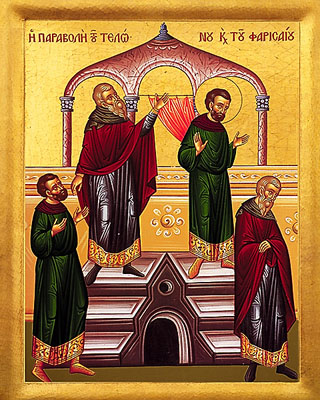
From Saint Luke 18, the Holy Gospel for Trinity XI...The parable of the Pharisee and the Publican is Our Lord's personal way of demonstrating to us how it is that we must come to God - in living colour, it highlights how the Christian, redeemed in Christ, purchased by His Sacrifice, and incorporated into His Body by Baptism, is to accept the free gift of communion and life with God in Jesus Christ. How are we justified? How does God condescend to make us holy and righteous before Him? Does God really care about us, so much as to make us His own children? The Cross and Empty Tomb give a resounding ‘yes’ to these questions, the most important ever asked.
The Pharisee: An observer of the Old Testament Law, he is truly righteous, holy, seemingly living-up to God’s revealed standard in the Mosaic Covenant. He is not a bad person, but really quite good, at least according to the expectation of the rules of Israel. Yet he remains unjustified, because he cannot be justified by following external rules and the rites and ceremonies of the Old Covenant. He tries to work His way into heaven, to merit his eternal life by his outward observance of rules and regulations. He tries to come near to God by perfectly following the Old Law. This isn’t enough. There is only pride and self-exaltation in his heart. He exalts himself above the publican next to him, and is not justified is his own conceit.
The Publican: He recognises his inability to prove himself worthy before God. He humbles himself in repentance and faith; he acknowledges his unworthiness and sin. He is radically, totally dependent upon God and God alone for forgiveness. In his humility, he sees himself as God sees him, and turns to God in love and with the desire for forgiveness.
‘The one went away justified, the other did not.’
Our Lord's teaching lays the foundation for the famous instruction of St Paul in the New Testament regarding how we come to be united to God, how we become members of God’s divine Family the Church, and are made members of Christ and His Body:
Justification is being ‘made right’ before God: God saves and redeems us by His grace, by the grace of God alone as His divine initiative, apart from our own observation of ceremonial law or our own personal merit: St Paul says we are ‘justified by Faith apart from the works of the Law’,’ (Romans 3.28) that is, apart from the Old Testament ceremonial system. God's grace infused into us as a free act of God towards us makes us righteous.
Now the instrumental and initial means of our justification, our union with Christ, is Baptism, the sign that accomplishes what it mystically symbolises: Romans 6.3f,
Faith: Faith is God’s divinely-given Gift placed into our hearts by the Holy Ghost. We are justified by the theological virtue of Faith, the Holy Ghost within us, not by the Old Testament Law. And Faith is the fruit of the Holy Ghost, an infused and supernatural virtue, transmitted to us by God’s own working in His own Act - Baptism. Hence, we are justified by Faith because we are justified by grace. Faith itself is God’s personal gift to us, given to us apart from our own act of the will, our mental assent, or our own deserving! But the everlasting gift of faith is not alone; it must work with Hope and Love in order to produce salvation in us. The three theological virtues cannot be isolated from one another. We must co-operate with God's grace to enable His gifts to work in us toward that for which these are given: ‘These three abide, faith, hope and love, and the greatest of these is love’ (1 Corinthians 13).
‘Faith working by love’ (Galatians 5.6)
‘If I have faith enough to move mountains, but have not charity, I am nothing’ (1 Corinthians 13)
‘We are not justified by Faith alone’ (St James 2.23)
Justification: We are infused with the very Life of the Blessed Trinity and made by supernatural grace, by the power of the Holy Ghost, the children of God, adopted sons and daughters of God; we are made partakers of God’s own nature - transformed and transfigured into the Likeness of Christ (II St Peter 1.4). By His own free act of grace, Jesus Christ vindicates us, sets us free, and give us a new existence of love and life. Jesus does what he declares. He declares us justified - and makes us justified by His grace. Justification is both imputed and infused, imputed and imparted.
Christ in His free and unmerited love forgives us, heals us, restores our nature - and not only this, but Jesus Christ reproduces His life in us. We become one in Christ, one with Christ, ‘little Christs’ to borrow Saint Cyril of Jerusalem’s favourite description of our status.
Justification is absolutely not only a legal, forensic, extrinsic declaration that God has simply forgiven us, not having really changed us from the inside out. When Christ justifies us by His divine grace, the Gift of the Life of God Himself, in Holy Baptism and in the sacramental life, He makes us righteous, He changes our nature, He regenerates and renews us in Himself to be sharers in the New Creation of the New Man, the New Life of Christ. We become partakers of the New Creation as members of the New Humanity, the redeemed humanity of the Church, whose Head is the Second Adam, the Lord from Heaven. Justification is ontological, sacramental, incarnational.
We are insistently not ‘dung hills covered in snow’ as Dr Luther charged. God does not ignore our sinful condition and with a legal fiction merely declare us to be righteous. He makes us godlike by His own grace: we become by grace what God is by nature, what the Church calls theosis. We are men and women re-created by sovereign grace into the Icons of Christ! ‘Behold, if any be in Christ, he is a new creature. The old has passed away, behold all things are made new...’
Justified by God’s supernaturally-infused Life, the grace of the Holy Spirit, His own ineffable Gift, man can be intrinsically, internally, really, essentially made new. The Christian is re-created and made into the Image of Jesus; we come to shed our old nature and put on the human nature of the Incarnate Word in the mysteries of the sacramental life. Jesus Christ is the Great Sacrament, who gives us Himself in His appointed sacramental manner. God assumed our human nature to raise it up and to make it new, to glorify it and bring it Life, God’s life.
We are summoned by God to be His children, adopted by His grace and filled with His Spirit; we are not called God’s slaves, God’s minions, God’s subservient serfs. We are named His children, His sons and daughters, Heirs of God and Co-Heirs of Christ in His Kingdom. We do not earn a wage or salary - we are freely given an inheritance with the Saints in light.
Saint Augustine of Hippo describes our justification in Christ as God’s ‘most excellent work of love and His greatest miracle.’ As he writes: ‘the justification of the wicked is a greater work than the creation of heaven and earth because heaven and earth will pass away but the justification and salvation of God’s people will never pass away....’
Christ has humbled Himself, even unto the death of the Cross, so that we, who were not worthy to be called God’s slaves, should be made His sons and His heirs in His own eternal Family bond, the communion of the Holy Trinity. If we humble ourselves, and receive God’s amazing gift of grace, the Christ-life reproduced in our lives, we shall indeed be exalted to heaven - to be with Christ, to reign with Him, and to extol His wondrous glory forever.
The Blood of Christ: Notes for Reflection
For us all, as we approach Holy Cross Day on 14th September...The Blood of Christ
Why the Blood of Jesus Christ? Why does the Church have devotion to the Most Precious Blood of Our Lord? This practice disturbs some 'modern' persons, why? What is the seeming preoccupation of orthodox Christianity with 'the Blood'? What does Blood represent, and why is it so important in reference to Our Lord Jesus Christ?
The Blood of Christ refers to Atonement = ‘At-one-ment’ with God, reconciliation, re-communion, re-membering, re-union, restoration to God.
The Blood of Christ in the Old Testament (typology)
Genesis 9.4, Exodus 24.6-8, Leviticus 17.11, 16.14-19
The Levitical sacrifice and priesthood arose after the fall of Israel in worshipping the golden calf -- the use of the blood of a victim, animal sacrifice, signified that the offerer must be himself be consecrated and sacrificed with the oblation of the thing sacrificed. The sacrifice of one’s own life is symbolised by the blood. The sinner’s guilt was transferred to an animal, the ‘scapegoat.’ Blood is offered to God because it is atonement, propitiation for sin, as the blood contains the ‘soul’ or ‘life.’ Leviticus 17.11, 6.30, 8.15, 16.27
Atonement is the function of blood -- it belongs to the sin-offering, sacrifice for the forgiveness of sins. Rabbinical teaching is that of Hebrews 9.22 -- ‘there is no atonement, no forgiveness, without the shedding of blood.’ The purification of the altar, temple, vessels and people was achieved through the application of blood, hence, communication is re-established between God and His people. Blood is a medium of life, refreshing sanctity, expelling impurity, restoring communion and relationship between God and Israel. Blood was atoning, for it was the vehicle of life. The profane use of blood was strictly forbidden, as it was used only for sacrifice: all blood must be removed from flesh before eating it. The sole purpose of blood was its offering for establishing communion with God. ‘The life of the flesh is in the blood.’ Animal blood is symbolic of man’s own life-blood, which could not be shed. Blood was a type, an image, a symbol of a communion to be regained, given again, by God.
The Blood of Christ in the New Testament (fulfilment)
Hebrews 9.6-28, Romans 3.24-25, Romans 5.9, Ephesians 1.7
Ephesians 2.13,16, Colossians 1.14,20, Hebrews 9.12-14,
Hebrews 10.19-20, 12.24, 1 John 1.7, 5.6-8, Revelation 1.5-6, 5.9, 7.14, 12.11
‘The New Testament in my Blood’ - Our Lord refers to Exodus 24.3-8, the Mosaic Covenant sealed by blood. Our Lord’s death inaugurates a new covenant relationship between God and His people, by expiation and remission of sins. Our Lord bases His teaching on Jeremiah 31. The institution of the Eucharist is the basis of His Redemptive Work. The Eucharist interprets His Death. Communion is established, relayed, by the Blood of the Messiah. ‘In’ His Blood the Covenant is made. Isaiah 53, self-sacrifice, self-offering, self-donation, perfect complete Self-Oblation, an all-sufficient action, an Offering of the perfect LIFE to God, symbolised by Our Lord’s Blood. The Blood of Christ is the Sacrifice of a perfect filial life, of total consecration, obedience, service. Communion with the One Perfect Life of Sacrifice, Jesus Christ Himself, is God’s means of communion with Him; God’s design and plan, is accomplished through the pouring out of Christ’s Blood, which is divine Life. Jesus Christ is the principle of divine life for the believer - ‘one must eat my flesh and drink my blood’ (Saint John 6). Atonement comes by the perfect atoning work of Christ conveyed to man by virtue of the Eucharistic Chalice.
Christ’s Blood is the ransom for man, the ransom-price that purchases mankind for God -- it consecrates saints, martyrs and priests: Christ’s Blood is adored as the cost of His sacrifice, the sign of his love, the effect of his power. The Blood of Christ manifests His eternal Priesthood, His unique mediatorship, advocacy, intercession, pleading, the presenting of His self-offering. Christ’s Blood is the medium and key, the link and culminating point of Atonement of God. The Blood pleads perfect forgiveness. The Blood represents the High Priest, the perfect Life, the God-Man, the only satisfaction for sin, Jesus Christ.
The Blood of Christ in the Book of Common Prayer:
Te Deum: ‘We therefore pray thee, help thy servants, whom thou hast redeemed with thy precious blood...’ (10)
‘Almighty God...who hast purchased to thyself an universal Church by the precious blood of thy dear Son...’ (38)
‘O Almighty God, look mercifully upon the world which thou hast redeemed by the blood of thy dear Son...’ (39)
‘Spare us, good Lord, spare thy people, whom thou hast redeemed with thy most precious Blood...’ (54)
The Holy Eucharist:
St Matthew 26.28, St Mark 14.24, St Luke 22.20, St John 6.53-56,
St John 19.34, I Corinthians 10.16, 11.25
We receive the Blood of Christ in the Blessed Sacrament of Christ’s Body and Blood. The same Blood shed on the Cross is given to us under the form and species of wine. The Real Presence of His Blood, and making-present of His Sacrifice, is the Atonement pleaded upon the Altar, in the anamnesis of Christ’s Oblation. Atonement and Eucharist are one, the same reality, one is heavenly, the other sacramental. The doctrine of the Prayer Book is ‘Blood-shedding doctrine.’ The Atonement is accomplished by the Blood and Death of Christ, mystically presented before the Father in the Eucharistic Sacrifice. Christ’s Blood is our spiritual nourishment in the Holy Mysteries. The Blood of Christ is uniquely applied to us in the Eucharist, as taught in the Prayer Book: 'grant that through faith in his Blood we may obtain remission of our sins, and all other benefits of His passion.'
The ecclesiology of the Prayer Book teaches that the Holy Catholic Church is a ‘Blood-bought Church,’ a Church purchased by the Sacrifice of Christ, the shedding of His Blood: Acts 20.28
‘This is my Blood of the New Testament’ (Canon, 80)
‘may be partakers of his most blessed Body and Blood' (Canon, 80)
‘and through faith in his Blood’ (Canon, 80)
‘may worthily receive the most precious Body and Blood' (Canon, 80)
‘grant us...to drink his Blood’ (Humble Access, 82)
‘our souls washed through his most precious Blood’ (Humble Access, 82)
‘The Blood of our Lord Jesus Christ, which was shed for thee,’ (Communion, 83)
‘spiritual food of the most precious Body and Blood’ (Thanksgiving 83)
‘Holy Communion of the Body and Blood’ (Exhortation, 85)
‘the innumerable benefits which by his blood-shedding... (Exhortation, 85)
‘Almighty Father, whose dear Son...did institute the Sacrament of His Body and Blood...’ (Maundy Thursday, 152)
Holy Baptism:
Jesus Christ...did shed out of his most precious side both water and Blood...’ (Blessing of the Water, 279 -- St John Chrysostom's teaching on the two Dominical Sacraments, Baptism and Eucharist, St John 19.34)
The Catechism:
Q & A: ‘The inward part is the Body and Blood of Christ’ (293)
Q & A: ‘refreshing of our souls by the Body and Blood of Christ’ (293)
‘Grant O Father, that when we receive... the Blood of Christ’ (294)
The Visitation of the Sick:
‘O Saviour of the world, who by thy Cross and precious Blood, hast redeemed us; Save us, and help us, we humbly beseech thee, O Lord.’ (313)
For the dying:
‘Wash it [the soul], we pray thee, in the Blood of that immaculate Lamb that was slain to take away the sins of the world.’ (317)
Ordering of Priests:
‘For they are the sheep of Christ...for which he shed his blood’ (540)
Consecration of Bishops:
‘The Church of Christ which he hath purchased with no less price than the effusion of his own blood’ (554)
Consecration of a Church:
‘Grant O Lord that whosoever shall receive in this place the blessed Sacrament of the Body and Blood of Christ’ (565)
In the 1940 Hymnal:
Hymnal 190 - ‘Let thy Blood in mercy poured.’
Let thy Blood in mercy poured, Let thy gracious Body broken,
Be to me, O gracious Lord, of thy boundless love the token.
Thou didst give thyself for me, Now I give myself to thee.
Almighty and everlasting God who didst ordain that thine only begotten Son should be the Redeemer of the world and hast vouchsafed to accept his Blood as the propitiation for our sins: mercifully grant that we who here rejoice to honour that Blood, the price of our salvation; may be defended by its power in this present world, and rejoice in the everlasting fruits thereof in the world to come. Through the same Jesus Christ our Lord.
Monday, September 06, 2010
Continuing Church Quotes
Classical Anglicanism has long been called the 'via media' (middle way); unfortunately it is easier to follow an extremist view than it is to hold the middle. Extremists are shot at from one direction, while those in the middle are shot at from all sides. Thus, Roman Catholics have traditionally accused the Anglican Communion of being Calvinistic, Protestant and heretical, while Calvinists and other Protestants have traditionally accused Anglicans of being Papists and medieval. We, of course, know that we are none of these things; but, because we are in the middle, those on the extremes always see us against the back drop of their opposites.
The Congress of Saint Louis promised the emergence of an Anglican Church that would be true to the Holy Scriptures, the seven ecumenical Councils and the ancient Fathers of the Church: Ours is the ancient faith of the undivided Church. Classical Anglicanism has long been called the 'via media', and that is the most difficult position of all to maintain. It has been my observation that the parishes that are growing are warm and welcoming Christian families, committed to the Gospel of Jesus Christ... The way to bring the Affirmation of Saint Louis to fruition is through unity and cooperative work for the Kingdom of Heaven.
Concentrate on being Christians and your Anglicanism will follow naturally, because we are Anglicans. We are all sorts of Anglicans, but let us be Christians first. Christians live together in unity, not uniformity. Concentrate on being Christians - that, I still insist, is what Anglicanism is all about. True Anglicanism is just plain Christianity in its fullness.
Saturday, August 28, 2010
ACNA and Illicit Orders
A new controversy has arisen in the Anglican Church in North America concerning the Episcopate and the recognition of Holy Orders usually classified as deriving from episcopi vagantes, or 'wandering bishops.' Recently, the ACNA received into its House of Bishops without the benefit of consecration sub conditione a bishop originally ordained in the 'Communion of Evangelical Episcopal Churches,' affectionately known in some circles as the CEEEEEC...The problem lies in the fact that, historically, the Anglican Communion has simply refused to recognise Holy Orders conferred by those persons or entities which trace their origin to the various wandering bishops of the twentieth century, without issuing a final judgement as to the sacramental validity of the orders in question: this cautious and prudent disciplinary position was established by the Lambeth Conferences of 1920 and 1958.
By receiving a bishop whose orders originate from episcopi vagantes without conditional consecration, the ACNA has broken from the long-standing discipline of the Anglican Communion in this matter. Anglicanism from the days of her orthodoxy has been very clear on this subject.
The Church Catholic has always taken the safest course as to the validity of Holy Orders, since the validity of orders is necessary for the validity of the Holy Eucharist and other sacraments, and has, whenever there has been a question or doubt about a particular ordination, supplied what might be lacking with conditional ordination - the reiteration of orders under condition does not deny the possible validity of the orders concerned, but only seeks to remedy any defect present and to ensure that the ordination is beyond doubt - 'ecclesia supplet' - the Church supplies what is otherwise lacking in such an ordination by conditional administration of the same.
The Church has a most solemn moral and theological responsibility to make certain, as far as is possible, that the sacramental integrity of her life is preserved and transmitted unimpaired for sake of the salvation of souls. The valid continuation of the Sacraments of the Holy Eucharist, Penance, Unction of the Sick and Ordination itself depends on an unbroken and sacramentally assured conferral of a valid priesthood. Hence the Church has always followed the rule, 'better safe than uncertain,'in the administration of the sacraments.
The irony of this particular situation is that orders conferred by episcopi vagantes are generally recognised by Roman Catholic canon law as 'valid but illicit,' possessive of the power of Order but conveyed in a canonically illegal manner. Anglican Orders, on the other hand, are dubbed null and void by the Roman Church, per Apostolicae Curae (1896). Therefore, the historic Anglican position has, in such cases, been stricter in application than that of the Roman Communion. The Anglican Communion, again, has not asserted that vagans orders are invalid, only that they are not to be recognised or permitted within her own ecclesial life. Oddly enough, with an ironic twist of providence, the APA and some other Continuing Churches possess Old Catholic orders from irregular sources, orders which should be recognised by the Roman See, whereas the Anglican succession is declared invalid at Rome. But for Anglicans, it is preeminently the regular, canonical and orderly administration of Holy Orders through and within duly-constituted catholic jurisdiction - Apostolic Succession of Order united to Apostolic Succession of Creed, Faith, Teaching and Government - which is rightly determined most important. Tactile succession can never be divorced from catholic orthodoxy and authentic ecclesiastical structure. And such canonical transmission and orderliness is mostly absent in the vagantes phenomenon.
The orders of the Anglican Province of America were originally obtained from these same controversial sources: Bishop AH Mathew, Bishop CH Carfora, and Bishop FL Pyman of the English Old Catholic succession; Bishop HG de Willmott Newman and Bishop KC Pillai of the English Old Catholic succession; and Bishop C Duarte-Costa and Bishop EM Corradi-Scarella of the Brazilian Catholic Apostolic Church - orders theoretically recognised by Rome but not recognised by the Anglican Communion, orders which, when held up to every standard of Augustinian Western Catholic theology, are to be regarded as sacramentally valid, but uncanonical. In order to remove all scruple and doubt from the Anglican perspective, our hierarchy received conditional diaconal and priestly ordination, and consecration to the Episcopate, in October 1991 by three orthodox bishops of the Anglican Communion at the Deerfield Beach Unity Conference. This action did not deny the validity of the previous ordinations, but only sought to supply what was necessary according to Anglican theological and canonical precedent.
From an Anglican viewpoint, the ACNA should indeed be willing to do the same for its own clergy and people, in accordance with the perennial Anglican disciplinary approach and for the certitude of the sacramental life.
To read about this controversy, please go here, here and here.
Friday, August 27, 2010
Closer to Home... TEC Diocese of Georgia Excommunicates Continuing Church

It would seem that the Continuing Church is a very real and present threat to the Episcopal Bishop of Georgia...
From the August 2010 TEC Diocese of Georgia Clergy Handbook:
"Anglican" or "Continuing" Splinter Groups not part of TEC
These groups undermine the geographical authority of the bishop as defined in the Constitution and Canons of The Episcopal Church and observed in historical Anglican practice. Therefore, no clergyperson [sic] from these groups may participate in any service of worship, and no joint services may be held with any congregation of the Episcopal Diocese of Georgia. Episcopal clergy of the Diocese of Georgia may not participate in any service held in or by these congregations except with written permission from the Bishop.
Though you may choose to notify the Bishop, attendance at a wedding or funeral held in such congregation, for reasons of previous pastoral or personal relationship, is an exception to this more general statement and requires no such permission.
It would appear we are making progress if this is the reaction! It should be noted that the Continuing Church holds that the See of Georgia has been canonically vacated and replaced by the orthodox continuing Anglican Episcopate, since heresy was introduced into the Episcopal Church in 1976 thus rendering any claim to canonical episcopal government in that Diocese void. Additionally, since the current Bishop of Georgia was purportedly consecrated by a bishopess, his episcopal consecration is to be considered sacramentally invalid.
Episcopalians of Georgia, please come home to the Continuing Church!
Comprovincial Newsletter for November 2026
The Comprovincial Newsletter of the Anglican Province of America for November 2026...
-
Pope Leo IX, Last of the Bishops of Rome in communion with the rest of Christendom. The Bishop of Rome is historically the first Bi...
-
Following on the intriguing discussion at The Continuum , below is the carefully-researched essay by Father John Jay Hughes found in his 197...
-
Being a Tractarian, ressourcement, patristically-minded, first millennial, conciliarist, philorthodox kind of Anglo-Catholic, I have always ...