
Saturday, September 24, 2011


ACA and APA Communion

The Anglican Church in America (ACA), meeting in its Eighth General Synod at the Shrine of Our Lady of the Snows, unanimously endorsed a resolution for inter-communion agreement with the Anglican Province of America (APA). The APA also unanimously endorsed this agreement at its Provincial Synod on July 15, 2011.
Bishop Walter Grundorf, Presiding Bishop of the APA, stated, "This is a result of the recognition that both churches have so much in common theologically and historically and was fueled by the friendships developed by the bishops of both churches. The intent of bringing both churches together in this way is to eventually knit back together that which had been divided." The Presiding Bishop of the ACA, the Rt. Rev. Brian Marsh, said, "We are absolutely delighted to be in communion with our brothers and sisters of the Anglican Province of America. It is God's will that this has been done." Both bishops indicated that work will commence to move forward the hoped for union of the two churches.
The key points of the agreement are:
1. Each jurisdiction recognizes the catholicity and independence of the other;
2. Each jurisdiction agrees to welcome members of the other jurisdiction to participate in the Sacraments, recognizing as well the validity and interchangeability of each others' Holy Orders;
3. Each jurisdiction recognizes that the other holds all essentials of the Christian Faith and seeks to teach and proclaim the same;
4. We commit ourselves to work toward an ever closer bond between our two churches, seeking always to discern God's will for us and for those we serve.
Bishop Walter Grundorf, Presiding Bishop of the APA, stated, "This is a result of the recognition that both churches have so much in common theologically and historically and was fueled by the friendships developed by the bishops of both churches. The intent of bringing both churches together in this way is to eventually knit back together that which had been divided." The Presiding Bishop of the ACA, the Rt. Rev. Brian Marsh, said, "We are absolutely delighted to be in communion with our brothers and sisters of the Anglican Province of America. It is God's will that this has been done." Both bishops indicated that work will commence to move forward the hoped for union of the two churches.
The key points of the agreement are:
1. Each jurisdiction recognizes the catholicity and independence of the other;
2. Each jurisdiction agrees to welcome members of the other jurisdiction to participate in the Sacraments, recognizing as well the validity and interchangeability of each others' Holy Orders;
3. Each jurisdiction recognizes that the other holds all essentials of the Christian Faith and seeks to teach and proclaim the same;
4. We commit ourselves to work toward an ever closer bond between our two churches, seeking always to discern God's will for us and for those we serve.
Friday, September 16, 2011
Holy Land Pilgrimage 2012
Please join us as we make pilgrimage to the Holy Land next year: our 2010 experience was truly life-transforming, and our next in 2012 will be even more profound! A Traditional Anglican pilgrimage to Israel and Palestine is the trip of a lifetime...
You may register on this website.
October 11-20, 2012
Following the Faith
with Bishop Chandler Jones
October 11-20, 2012
SPECIAL TEACHING MOMENTS

- MOUNT OF BEATITUDES.
- MT. CARMEL, the 'Place of Sacrifice' where Elijah had an encounter with the Priests of Baal (1 Kings 1:17-40)
- Celebrate Mass at the CHURCH OF THE HOLY SEPULCHRE in Jerusalem, BASILICA OF THE ANNUNCIATION in Nazareth and the CHURCH OF THE NATIVITY in Bethlehem.
- See and touch the WESTERN (WAILING) WALL.
- Walk the steps of JESUS through the streets of the Old City of Jerusalem along the VIA DOLOROSA.
- Visit St. George's Cathedral, established in 1899, it is the seat of the Bishop of Jerusalem of the Episcopal Church in Jerusalem and the Middle East.
- Ride a boat across the SEA OF GALILEE and visit the ruins of CAPERNAUM, known as Jesus's 'own city' because of the frequency that He visited and the mighty work He did there.
- Experience a historic drive to BETHLEHEM, the royal city of David, to kneel at the traditional place of the birth of Christ at the GROTTO OF THE NATIVITY.
Tuesday, September 06, 2011
'Consubstantial'
Courtesy once again of my brother, Father Brandon Jones, comes this fifth video on the new English translation of the Novus Ordo Missae, in which the traditional Anglican translation of the Nicene-Constantinopolitan Creed is restored, replete with the theological term used in reference to Our Lord Jesus Christ, 'substance,' for the Greek word homoousion - for Our Divine Lord is 'consubstantial' or 'of one substance' with the Father. Another splendid Anglicisation!
Saturday, August 20, 2011


Ordination of the Reverend Doctor Richard Hitchcock


Today, 20th August 2011, was the Ordination Day of the Reverend Doctor Richard Benner Hitchcock, Ed.D. to the Sacred Order of Deacons. Doctor Hitchcock will serve as Deacon of Saint Barnabas Anglican Church in Dunwoody, Georgia. It was a particular honour and delight to ordain Dick, as he shall serve our parish, and the occasion was my first Ordination as a Bishop. In the group photographs, from left to right are: the Reverend Canon William R. Weston, our previous Rector, the Reverend Father Paul A. Rivard, our Curate, the ordaining Bishop, the Ordinand, and the Very Reverend Doctor Charles 'Gene' Mallard, Rector of Saint Thomas the Apostle Church, Alto, Georgia. Congratulations and God bless you, Doctor Hitchcock, on this glorious day!
Friday, August 19, 2011
Thoughts on Article of Religion XXV

...The so-called 'corrupt following of the Apostles' refers to the abuse of the minor or lesser five sacraments in the medieval Western Church: these sacraments were elevated and sacralised by Our Lord and the Apostles to be specific means of grace, but the Church in the West in later ages altered their original use and administration.
For example, the Sacrament of the Unction of the Sick is clearly intended by Our Lord and the New Testament authors to be administered to anyone who is ill and in need of spiritual and physical healing. But the Church of the later Middle Ages restricted Unction of the Sick to the dying alone, in extremis, so that it was transmogrified into 'Extreme Unction,' or a sacrament available only to those at the point of death, contrary to the biblical and patristic tradition.
The Sacrament of Penance was originally given to be a healing balm and a remedy for sin, the 'second plank after shipwreck,' a restoration to baptismal grace and a therapeutic cure and healing ministry of Absolution offered to those suffering from the consequences of grievous sin. But the medieval Church changed Penance into a series of actions performed according to Church law in a legalistic and penal sense, based on a code of justice, judgement and penalty, satisfactions for sins. The performance of penitential actions gradually obscured the heart of the sacrament: the grace of forgiveness and reconciliation with God and the Church. What was originally sacramental, ministerial and pastoral became juridical, judicial, legal.
Another example is the Sacrament of Holy Orders, which from the time of the Scriptures and the Primitive Church has been open to married men and in which state men also could marry after ordination, but which was later restricted to celibate men only in the Western Church.
Again, Confirmation had all but disappeared in several countries and regions within the ambit of the Western Church and had certainly fallen into desuetude in many Dioceses. Often, it was administered only rarely and sporadically, and without due preparation or catechesis.
The point of Article XXV is that the renewed catholic Church of England recovered the biblical, ancient, orthodox and patristic use of these sacraments in their proper place according to the mind of the Lord Jesus Christ and the Apostolic Tradition. The practice and usage of these sacraments demanded reformation and restoration to their original ministrations, and so they received such due treatment when the Church of England was herself reformed. Once again, the Anglican Church historically claims no faith, doctrine or order of her own, only those of the Primitive and Undivided Catholic Church of the first ages. In Anglicanism, the ecclesiastical sacraments were reinstated, refurbished and revitalised according to the practice of the Church in the first millennium.
The phrase 'states of life' refers to those sacraments which are ordained by God for a particular vocation in the Christian journey, Holy Orders or Matrimony, or both, or for particular needs at specific stages of Christian formation and growth, such as Confirmation or Penance. The minor sacraments are means of grace, but again, are not necessary for the salvation for all or for everyone universally. Baptism and Eucharist are necessary for the salvation of all men where they may be had: Holy Orders or Unction of the Sick, for instance, are not. Some sacraments are only necessary for those especially called to them. God calls men and women to particular states of life and provides sacramental grace to equip and empower those called to a particular vocation...
Thursday, August 18, 2011
The Holy Angels

Every September, the Church jubilantly celebrates the Feast of Saint Michael and All Angels. 29th September directs us to the truth that we are not alone in the universe, and we do not exist in a solitary fashion in God’s created order; rather, we are members of a great divine family created by God Himself, in which we share eternal life with brethren spirits, who, like ourselves, have free-will, intelligence, reason, and mind, but are bodiless - the Holy Angels.
The Creed proclaims God the Father as the ‘maker of all things visible and invisible.’ Our heavenly Father, in His wisdom and goodness, has created the world of the supernatural, not now accessible to men with their human eyes, and yet nevertheless just as real, more real, than the physical, tangible world which we now inhabit.
Angels, with men, were created by God to love and serve Him in a wonderfully beautiful and ever-mysterious order not fully comprehendible to the speculation of men’s minds. Together, men and angels comprise God’s created family, His Church, the mystical Body of Jesus Christ. Angels and men belong to One Family in Heaven and Earth (Ephesians 3.15)
Angels absolutely exist, and we should not question that they exist for one second: God has revealed to us that they exist, and not only exist, but love God and mankind. We know Angels exist and love us because we experience the truth of it in our lives. God has made it so.
Before proceeding to attempt an explanation of exactly who the Angels are, let us state for posterity what they are not!
Angels are neither anthropomorphised beings subject to whims of feeling, such as depicted in popular media, nor are they the cute, fat, irresistibly-squeezable babies portrayed in baroque art. Angels are probably not a little amused by man’s efforts to develop such simplistic representations of their glorious nature. If Angels were to appear before us right now, they would strike terror into our hearts by their overwhelming glory and power. Man cannot easily bear their lustre.
Angels are not divine beings deriving their existence from themselves. They are not to be worshipped; they are not half-god, half-mortal mediators that link us to God. They do not mediate in the sense that somehow they must by necessity connect the human race to God because of the infinite separation between Creator and creature. Such doctrine was invented by gnosticism, a pseudo-Christian heresy found in the early centuries of the Church, which deified angels and made them the object of worship. Gnosticism, meaning ‘secret knowledge,’ purports to give men a secret way of being saved, reserved to the initiate, in which angels serve as demi-gods leading man to union with God.
If one were tempted to worship angels as divine, the stern reminder of the Angel who addresses Saint John the beloved disciple in the Book of Revelation would surely apply: ‘See thou do it not: for I am thy fellowservant, and of thy brethren the prophets, and of them which keep the sayings of this book: worship God’ (22.9) Angels are undoubtedly offended when men contort their true purpose and make them an object of divine worship. The Holy Angels will have none of that.
Modern American culture seems to increase its angel-mania with every passing year, with a proliferation of ‘angel stuff’ sold in stores and pandered on television: some contemporary people, starving for an encounter with the supernatural and seeking to fulfil man’s innate need for an experience of the divine, embrace angel-worship and substitute it for a true intimacy with the Eternal. However, they are worshipping the creature, not the Creator, whose glory is radiated from the faces of Angels He has so lovingly made. Everything from angel pins and books to the adoration of angelic spirit guides is now in vogue. Much of this angel religion, devoid of the living and true God, is an explicit return to paganism and polytheism. ‘Let no man beguile you of your reward in a voluntary humility and worshipping of angels, intruding into those things which he hath not seen…’ (Colossians 2.18).
Incorporeal powers, the Angels are created beings, pure, holy, good spirits created to adore the living God and to radiate His divine glory, love and power. Angels are bodiless and not composed of matter - they are total mind, pure spirit, utter will. The Angels are the servants of God. They resemble their Maker in their power, genius and perfection, but they are created beings, called in the Old Testament Scriptures the ‘sons of God.’ The Holy Angels, beings of great grace, beauty, intelligence, fiery brilliance reflecting the glory of God, were made by God the crown jewel of His heavenly court, the joy of that realm we call Heaven.
The Angels of God have a twofold vocation for which they were created:
1. The worship of God. For all eternity, the Angels lead the heavenly liturgy of worship and praise of God the Blessed Trinity, Father, Son and Holy Ghost, singing the Thrice-Holy Hymn, ‘Holy, Holy, Holy’ (Isaiah 6.3 and Revelation 4.8). As servants of God, created to rejoice in His inexhaustible Presence, the Angels adore, serve and glorify the Most High God, their Master. Angels exist primarily to magnify their God and ours, the Lord of Hosts, the Lord of all. ‘And let all the Angels of God worship Him’ (Hebrews 1.6).
2. Service to men as intercessors, protectors and messengers of God’s will. The word Angel, anngelos in Greek, comes from the same word that forms ‘Gospel’ (or Good News), and means ‘messenger.’ Angels were created to serve mankind as messengers of God’s Gospel, His Good News of salvation. ‘Are they not all ministering spirits, sent forth to minister for them who shall be heirs of salvation?’ (Hebrews 1.14). Angels have been appointed by God to be the guardians of our souls, the ministers of our bodies, and our sponsors and supporters from above. As ministers of God, and fellow-servants with men, Angels form with us an inseparable bond comprising what we call in the Creed the Communion of Saints.
According to Apostolic Tradition, there are nine choirs or grouping of Angels in a divinely-created hierarchy: ‘seraphs, cherubim, thrones, dominions, princedoms, powers, virtues, archangels, angels’ choirs’ (Hymnal 1940, Hymn 599). The leader of their heavenly band is Saint Michael, whose name means, ‘Who is like God?,’ the chief and captain of the heavenly army of hosts, the great Prince of the Angels who mightily defends and protects us. Holy Michael is unveiled first in the Old Testament, in the Book of the prophet Daniel. There we see him, the great lord and prince, God’s appointed guardian of His chosen race. ‘And at that time shall Michael stand up, the great prince which standeth for the children of thy people’ (Daniel 12.1). In the New Testament, Saint Michael, our heavenly champion, vanquishes the power of Satan: ‘And there was war in heaven: Michael and his angels fought against the dragon’ (Revelation 12.7). He is the special protector and defender of Christians, the holy standard-bearer who leads souls to love and serve God. Saint Michael battles for us against the world, the flesh and the devil; he is the personification of the mystery of the angelic world.
We rejoice in the communion and fellowship of the Holy Angels, who, with eyes that look upon God face to face, who always behold their Father in heaven, also behold us on earth. With the same eyes of mind and will that behold the Holy Trinity forever in His Beatific Vision, the Angels behold us, and love us intensely with an all-consuming, perfect love, a love not tainted with sin. How wonderful it is to know that we possess such heavenly friends, such dear ones who look upon us in love as they look upon God in love.
The Holy Angels of God love us, protect us, watch over us, guide us, and pray for us. We should honour them, invoke their presence, aid and defence, and ask for the effect of their prayers, knowing that their love for men surpasses imagination.
Saturday, July 16, 2011


Friday, July 15, 2011
APA Approves ACA Intercommunion Offer

The Provincial Synod of the Anglican Province of America (APA) has unanimously passed a resolution embracing an inter-communion agreement with the Anglican Church in America (ACA). The General Synod of the Anglican Church in America will vote on this resolution at its meeting in September. The agreement has already been approved by each of the four domestic ACA dioceses.
In part, the resolution stated “That this preliminary document will serve as a catalyst for the eventual reconciliation of our two jurisdictions, that it will encourage other continuing jurisdictions to seek greater unity and that it will bring to fruition the unity of purpose that God clearly intends for his people.” Each church body will recognize the catholicity and independence of each other, will welcome members of each other’s bodies to receive the Sacraments, and will recognize the validity of each others’ holy orders. The resolution also states that both church bodies will work toward a closer bond between the two jurisdictions. The resolution clearly stated that “possessing a common heritage and in recognition of our spiritual kinship, we acknowledge that we are members of the One Holy Catholic and Apostolic Church.”
The Anglican Church in America along with the Anglican Province of America are two of the largest traditional Anglican Church bodies in the United States. Both seek to uphold the Catholic Faith, Apostolic Order, Orthodox Worship and Evangelical Witness of the Anglican tradition within the One, Holy, Catholic and Apostolic Church of Jesus Christ. The Communion holds Holy Scripture and the ancient Creeds of the Undivided Church as authentic and authoritative, and worships according to the traditional formularies of the Church. The Eastern and Western Churches split in 1054 and the Anglican Church, which existed in the British Isles since the first century, joined with Rome in 664 and later separated from the Roman Catholic Church in the 16th Century.
In a statement issued by the President of the House of Bishops, the Rt. Rev. Brian Marsh said "The APA action reaffirmed what we have known in both bodies for a number of years, that in Christ and in each other, we are one Church, one body. I applaud Bishop Grundorf and the Synod of the APA for their actions to to which I am sure we will respond in kind in September."
Anglican Province of America Synod 2011
 Today, 15th July 2011, witnessed the conclusion of the Seventh Provincial Synod of the Anglican Province of America, held in Dunwoody, Georgia and sponsored by Saint Barnabas Church. A magnificent affair, the Synod welcomed what may be a record number of delegates, observers and friends from throughout the United States and across the globe. We were particularly honoured to welcome the three Diocesan Bishops of the Anglican Church in America (ACA), the Right Reverends Brian Marsh, Stephen Strawn and Daren Williams, the Vicar General of the ACA Eastern Diocese, Father John Vaughan, and the Archbishop of the Anglican Church in the Philippines, the Most Reverend Frederick Belmonte.
 At this morning's session, the Province endorsed a formal intercommunion agreement with the Anglican Church in America, which agreement will be considered for final approval by the General Synod of the ACA in September 2011. Previously, all three Dioceses of the Anglican Province of America, the Diocese of the Eastern United States, the Diocese of Mid-America and the Diocese of the West each endorsed the same intercommunion agreement separately. The four ACA Dioceses have also already individually endorsed the agreement. From this humble beginning, this first crucial step, this gesture of charity and reconciliation, we pray that the reunion of the entire Continuing Church will begin in earnest.
The APA again made history today by presenting a cheque in the amount of $100,000 to Operation Mobilisation for the building of a Dalit educational centre in India, a vital Christian English-language school that will have the potential socially, intellectually and spiritually to liberate hundreds if not thousands of children who otherwise would possess no hope or opportunity for the future. Through intense commitment and sacrifice, our parishes and missions raised the money for the school. Our global outreach and missions have entered a new and exciting phase. Over $5,000 was raised for the Philippine Church's theological training centre at the Synod.
Many fantastic volunteers, over fifty-five in number, made the glorious occasion of Synod possible: our heartfelt thanks go to all those who so graciously and selflessly served to make this year's Provincial Synod a truly wonderful and momentous event.
Let us continue to pray for the unity of the Anglican expression of the Holy Catholic Church of Christ and for the advancement of the Gospel of Our Blessed Lord!
Thursday, July 07, 2011
Conrad Lewis Kimbrough, Priest - RIP
 The Reverend Father Conrad Lewis Kimbrough was born 10th May 1924 and entered eternal life on Tuesday 5th July 2011.
A dearly beloved friend, priest, pastor, mentor and embodiment of all that is good, gracious, beautiful and true in orthodox Anglicanism, a son of Nashotah House and a faithful servant of the Lord in the Anglican Communion for thirty-two years.
Rest eternal, grant unto him, O Lord, and let light perpetual shine upon him: may his priestly soul, and the souls of all the faithful departed, through the mercy of God, rest in peace. Amen.
Friday, July 01, 2011
Credo
Courtesy once again of my brother, Father Brandon Jones, comes this fourth video on the new English translation of the Novus Ordo Missae. The notable re-Anglicisation of the Nicene-Constantinopolitan Creed to the liturgical first-person singular form, 'I believe,' marks yet another area in which the new translation conforms to the age-old Anglican Rite.
Sunday, June 26, 2011
Address of Bishop Marsh to Continuing Anglicans
 The Right Reverend Brian Marsh, Presiding Bishop of the Anglican Church in America and Ordinary of the Diocese of the Northeast, made an address at the Congress of Continuing Anglicans in Victoria, British Columbia, Canada, 1st June. The text of this address is available at this link.
Sunday, June 19, 2011
Super Synod - from the Dunwoody Reporter
Anglican church leaders to gather in Dunwoody in July
Anglican clergy and leaders from across the country are scheduled gather in Dunwoody in July.About 150 delegates will take part in the gathering, called a synod, scheduled for July 11 through 15, said Bishop Chandler Jones of St. Barnabas Anglican Church in Dunwoody. During the synod, clergy and church leaders conduct church business.
“A synod is basically the ecclesiastical legislative body of the church,” Jones said, “but it’s also a family reunion. This is really an opportunity for people to come together.”
Most of those attending will come from the eastern United States. But Anglican clergy and lay delegates from as far as Arizona and California are expected to take part because the gathering will include representatives from the Diocese of the Eastern United States, the Diocese of Mid-America and the Diocese of the West, the three dioceses that cover the U.S., Jones said. A delegation from the Philippines also may attend, he said.
“Our meetings are really devoid of any controversy,” the bishop said. “We’re looking at strengthening our ties with Anglicans worldwide.”
The group will meet at the Holiday Inn, Perimeter and at St. Barnabas, Jones said.
The meeting will be held in Dunwoody, Jones said, because St. Barnabas is one of the larger Anglican congregations in the country. Also, Jones was installed as a bishop, the Anglican church’s youngest, last year.
St. Barnabas hosted a similar synod in 2001. One reason for the return this summer, Jones said, is that the church sanctuary and nave have been renovated since that 2001 meeting.
The Dunwoody congregation, founded in 1979, calls itself “a traditional Anglican Church” that bases its services on the1928 Book of Common Prayer. Anglicans split from the larger Episcopal Church in the 1970s because they believed the American version of the denomination had become too liberal and strayed too far from its original teachings, members say.
Friday, June 17, 2011
Consecration of the new Bishops of Richborough and Ebbsfleet
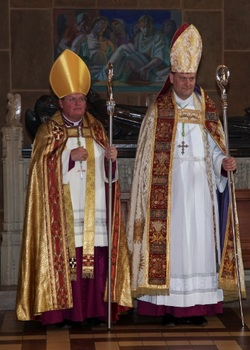 The Catholic Tradition of the Church of England lives on...
Congratulations and blessings to Bishop Norman Banks (left) and Bishop Jonathan Baker (right).
The Rt Revd Jonathan Baker and The Rt Revd Norman Banks were Ordained and Consecrated Bishop of Ebbsfleet and Bishop of Richborough respectively
by The Most Revd Rowan Williams, Archbishop of Canterbury and other Bishops
at Southwark Cathedral on 16th June 2011
by The Most Revd Rowan Williams, Archbishop of Canterbury and other Bishops
at Southwark Cathedral on 16th June 2011
Friday, June 10, 2011
Synod 2011

ALMIGHTY and everlasting God, who by thy Holy Spirit didst preside in the Council of the blessed Apostles, and hast promised, through thy Son Jesus Christ, to be with thy Church to the end of the world; We beseech thee to be with the Council of thy Church here assembled in thy Name and Presence. Save us from all error, ignorance, pride, and prejudice; and of thy great mercy vouchsafe, we beseech thee, so to direct, sanctify, and govern us in our work, by the mighty power of the Holy Ghost, that the comfortable Gospel of Christ may be truly preached, truly received, and truly followed, in all places, to the breaking down the kingdom of sin, Satan, and death; till at length the whole of thy dispersed sheep, being gathered into one fold, shall become partakers of everlasting life; through the merits and death of Jesus Christ our Saviour. Amen.
Saint Barnabas Church is wonderfully privileged and blessed to welcome the triennial Provincial Synod of the Anglican Province of America from Monday 11th July until Friday 15th July 2011. Additionally, the Diocesan Synods of the Eastern United States and Mid-America will also gather here concurrently in Dunwoody for their annual deliberations. It has been almost exactly ten years ago since Saint Barnabas last hosted our Diocesan Synod, and we are certainly honoured to be able to welcome the wider Church back to our parish and the metropolitan Atlanta area. Of your Christian charity, please pray earnestly for the impending Synods and for their ministry and work, as they seek to conduct the administrative business of the Church according to the mind of Christ and His Gospel and to advance the mission, governing, formation, preaching, teaching and evangelistic outreach of our unique branch of Christ’s Holy Catholic Church. We especially wish to thank our many volunteers who have made our sponsorship of the Synods possible; in particular, we thank the members of the Synod Planning Team: Rette Ledbetter, Al Duncan, Lynn Ledbetter, Barbara Shoaf, Elizabeth Raffa, Gordon Bigg, Cathey Eves, Oz Baptist, Ben Badejo, Bill Storey, DJ Fulton, Jack Wilson, Angie Patterson and Father Paul Rivard.
The word Synod, which term may be new or unfamiliar to many, is taken from the Greek word σύνοδος (sunodos) meaning ‘assembly’ or ‘meeting,’ and it is synonymous with the Latin word concilium, meaning ‘council.’ Synod literally means ‘to journey with’ or ‘the way together.’ No better description of the annual meeting of the Church’s authorised representatives, lay and clergy, could possibly be offered! Synod is not merely a business meeting, an ecclesiastical legislative body or a social event, although it is all of these things; it is the Church herself gathered, the Church at worship, in communion, in service and ministry, the Church in movement together. Synod powerfully and tangibly demonstrates the unity of the Body of Christ, the catholicity and universality of the Church, what is called in the Russian language sobornost, from the root word meaning ‘to gather,’ wholeness and inner completeness, wherein the many are brought together into free and organic unity by the power of love, a perceptible manifestation of the Holy and Undivided Trinity in Whom there is both unity and diversity in communion of love.
In short, Synod is the Church, one in heart, mind, and soul, on pilgrimage.
All of the Christian life is described in Apostolic Tradition as being a pilgrimage: we are on a pilgrimage through this mortal world to our true heavenly homeland. We are the Pilgrim People of God, the Church, making our way as God’s ecclesia, His ‘called-out ones’, through this world to the next. Everything we do, pray, say and think as Christians should orientate us towards the ultimate, final goal, the final reward and promise, which is eternal life in Our Lord Jesus Christ, in the heavenly Jerusalem.
If the vocation of the Christian in this life is pilgrimage, the wayfaring journey through this vale of tears to heaven, then the gathering of the Church in Synod, journeying together, should be seen as a microcosm of what the whole of the Christian life genuinely entails.
Pilgrimage is an essential part of life and living. Christians, filtering their existence through the data of the Holy Scriptures, see life itself in terms of a journey, coming from God and returning to God. In her earthly state, the Church needs places where her sacred society can gather together. Our visible churches, holy places, are images of the holy city, the heavenlyJerusalem, toward which we are making our way on pilgrimage. Ours is a daily pilgrimage in Word and Sacrament in the Church. Holy Mother Church is for us the Sign of the Kingdom and the Sacrament of our pilgrimage to Jesus Christ. He is the Mystery lived out at our Altars, Eucharistically, day by day. Synod is thus an intensification, a focus, of that Sign and Mystery which is Our Blessed Lord in His Church.
We encourage everyone at Saint Barnabas to take a decided interest in the meetings and events of Synod and to volunteer where possible to assist in the organisation of this intensely gratifying and important occasion in the life of our Church. Most critically, we invite everyone to enter into the spirit, significance and purpose of Synod by prayer. Thank you all so very much for your loving support and encouragement during this special time in our corporate life together.
God bless you!
Saturday, June 04, 2011
Twin Brothers and Friars

A very moving story indeed, all the more personal since my brother, a priest of the Roman Rite, and I are identical twins...
From the moment of their birth in Buffalo 92 years ago, twin brothers Julian and Adrian Riester rarely left each other's side.
They played together, went to school together, as young men traveled cross-country together -- and, in their 20s, joined the Franciscan order together.
And on Wednesday, after 65 years as identical twins wearing the identical brown robes of the Franciscans -- mostly at St. Bonaventure University -- Brother Julian Riester and Brother Adrian Riester died together at St. Anthony Hospital in St. Petersburg, Fla. Julian died Wednesday morning, followed by Adrian in the evening.
Those who knew the Riesters best say they are not surprised at all.
"If ever there is a confirmation that God favored them, this is it," said their cousin and close friend Michael Riester of Buffalo. "They weren't even separated for 12 hours."
The biological brothers were also religious brothers, committed to the monastic life of Franciscan friars, not as priests but in roles as physical laborers.
During two stints at St. Bonaventure, from 1951 to 1956 and from 1973 to 2009, "the twins" were a common sight strolling in lockstep across campus -- or, in later years after a few "incidents" resulted in loss of their driver's licenses, on identical bicycles wearing identical helmets.
They became known as accomplished artisans who expressed their talents as gardeners and woodworkers, turning out tables and cabinets from their workshop in the garage of St. Bonaventure's Franciscan Friary.
Yvonne Peace, former secretary to the university's Franciscan community, remembers them as handymen and "fixers" who repaired all sorts of items brought to them by many on campus.
"They were always busy," she said.
Brother Julian, whose given name was Jerome, and Brother Adrian, whose given name was Irving, were part of a family of seven children born to Dr. Julian Riester and his wife, Clara. Their father was a prominent obstetrician who as a medical student observed surgery on President William McKinley after he was fatally shot in Buffalo in 1901, according to Michael Riester, who is the historian of St. Louis Catholic Church.
The attended St. Joseph's Collegiate Institute in Buffalo (where they had a reputation for fooling teachers by their identical looks) and then a radio technology school in Los Angeles before applying to the Franciscans' Holy Name Province.
Toward the end of World War II, after mutually pledging to reply to whichever came first -- an acceptance from the Franciscans or an expected induction notice from the Army -- the morning mail brought an invitation to join the friars, and the afternoon mail "greetings" from the draft board.
God's call, they told interviewers in later years, took priority.
They were separated only twice, once from 1946 to 1951 when Brother Adrian was a sacristan at St. Francis of Assisi Church in Manhattan and Brother Julian was general manager of St. Anthony Shrine in Boston. Later they were not far apart in the 1950s when Brother Julian was assigned to St. Patrick's Parish in Buffalo and Brother Adrian to Bishop Timon High School in South Buffalo. But from 1956 on, the Riester brothers were together.
Michael Riester remembers them as family men who used the money given them by friends to travel to Buffalo on their day off to take their mother -- who lived to 103 -- to dinner at fine restaurants such as Salvatore's Italian Gardens or Romanello's. "They liked a good time," he said.
Indeed, in 2003 Brother Julian told the Bona Venture, the university's student newspaper, that they confounded the friars' seniority system by often claiming they "walked in the door together" and by never divulging which twin was born first.
"We don't tell," Brother Adrian told the newspaper. "We like to keep them guessing."
Michael Riester said his cousins will be remembered as "exemplary men and holy men," who lived their lives in a truly Franciscan spirit. When word came earlier this week that both were seriously ill in the Franciscans' retirement home in St. Petersburg, where they had lived for the last two years, Michael Riester and many in the St. Bonaventure community said they almost expected that the pair would leave together.
Now they will be buried together Monday in Olean.
"They had this intimate bond, in which neither was selfish at all," Michael Riester said. "And because they were so in tune to God and to each other, it's not surprising at all."
Subscribe to:
Posts (Atom)

-
 Following on the intriguing discussion at The Continuum , below is the carefully-researched essay by Father John Jay Hughes found in his 197...
 -
 Being a Tractarian, ressourcement, patristically-minded, first millennial, conciliarist, philorthodox kind of Anglo-Catholic, I have always ...
 -
Another liturgical tradition from the Orthodox Church for one's contemplation, a section of THE OFFICE FOR THE RECEPTION OF CONVERTS: Wh...